A Deep Dive into Pope Leo’s Magnifica Humanitas
By Sean Ogay (12C) and Shaun Cua (12A)
|7 min read
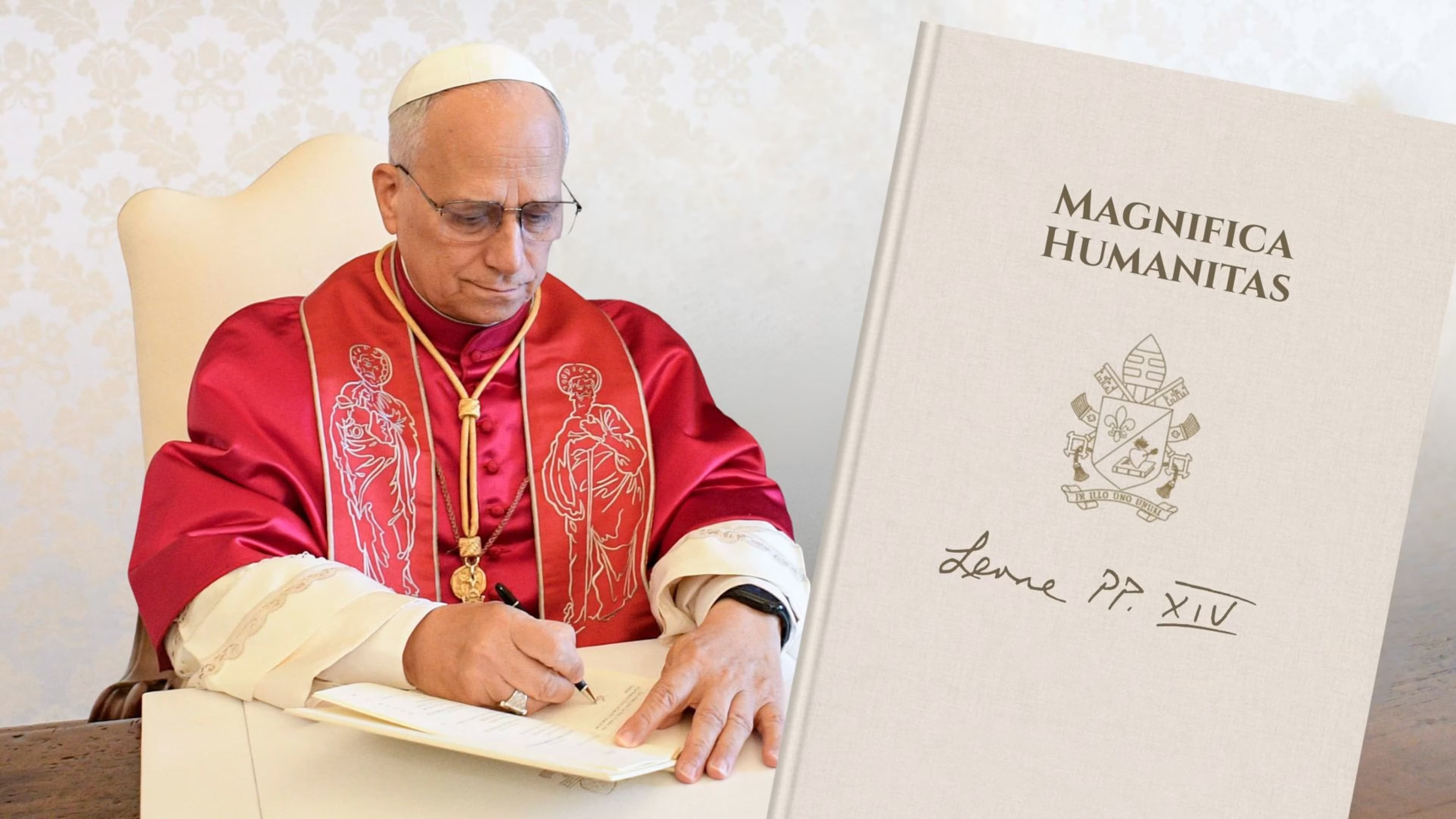
Photo credits: EWTN News
By: Sean Ogay (12C) and Shaun Cua (12A)
Xavier School’s 70th Anniversary Red Mass wasn’t just about the start of another school year. With students, teachers, alumni, and parents gathering to celebrate seven decades of Jesuit education, one unlikely figure took center stage for a moment of reflection: Pope Leo XIV. But during his homily, Manila Archbishop Jose F. Cardinal Advincula, Jr. didn’t draw attention to the Pope’s power or achievements; instead, he pointed to what he called “his magnifica humanitas,” the magnificence of his humanity.
It has become a phrase to define Pope Leo XIV’s early papacy.
Pope Leo XIV, earlier last year, was elected and was very quickly dubbed a “Pope of the encounter”. His early ministry has been mostly known, not by sweeping reform, but by simple and deeply human gestures: seeing children, praying with refugees, listening to the young, comforting those impacted by war. These encounters are part of a vision that has been a trademark of his ministry, Magnifica Humanitas, which translates to Latin as “the greatness of humanity.” It is more than a slogan; it is a call for us Christians to live, in which it encompasses that every person’s dignity is central, in which God calls us to meet others with compassion, humility, and authenticity.
In these simple, but powerful moments, Pope Leo XIV has consistently embodied this vision. He does not talk from afar from a podium or stage, but stops to listen to the stories of individuals after Papal audiences, and gets to know communities of suffering and reminds the faithful that leadership starts with accompaniment, not authority. The Church’s mission is expressed not just in words, but in relationships that recognize the value of every human person, as his witness shows us. His witness echoes the invitation to “listen, accompany, and serve”, and the Church’s mission is realized in both words and relationships.
This is a human touch from an organization that is plagued with problems in reaching the younger generation in many institutions. The Pope has been preaching the same message repeatedly in our time of fast-changing technology, growing polarization and confused times: all people are deserving of dignity in their regard, their hearing and their treatment. He doesn’t present “humanity” in some abstract form, he shows humanity in his personal encounters, which connect with humanity across cultures and generations.
The theme resonated especially during Xavier School’s Red Mass. In his reflection on 70 years of Xavier education, Cardinal Advincula made Pope Leo XIV’s role as a witness of compassion and genuine humanity, as a model of leadership in this regard. His Homily reflected on the three main values of wonder, truth, and dignity.
It is not ironic then that Pope Leo XIV’s magnifica humanitas and Xavier School’s anniversary converge. Both point to what kind of leader has to lead with more than his achievement, but his relationships with others. Xavier represents an image of leadership today because it is based on love for the other, humility, and total concern for the human person.
The image of magnifica humanitas is not just a theme for classrooms, homilies, and discussions over the course of the school year but is already part of the pope’s daily witness. As a whole, his papacy is a reminder that for all the world we live in where we’re surrounded by influence and success, humankind itself is one of the greatest expressions of leadership.
If so, then the most urgent question of our moment is what threatens this humanity. For Pope Leo XIV, that’s technology such as artificial intelligence and its risks to us as humans. The encyclical focuses on AI, but it’s really about “safeguarding the human person”, much like Pope Leo XIII’s Rerum novarum on the Industrial Revolution. To make sense of this, the Pope reaches back to two Biblical stories.
What Magnifica Humanitas means for you
Pope Leo XIV makes it clear that he is not trying to answer the question of whether we should use technology or not, and instead challenges us: are we building the Tower of Babel, or rebuilding the walls of Jerusalem?
The first image, from Genesis 11, represents pride, faithlessness, dehumanization and the betrayal of human dignity for efficiency’s sake: “the idolatry of profit that sacrifices the weak”, and “building a future that excludes God.” People were building the Tower of Babel without reference to God, aiming to concentrate power amongst themselves.
Instead, he wants humanity to “rebuild the walls of Jerusalem”, which was done as a collective effort from every family, through shared responsibility and “recognizing that their strength comes from the Lord.” In this case, what matters is what we do or “build” with these technologies, and that decision does not just rest on companies, but on us too. “The construction of Babel or the rebuilding of Jerusalem,” the Pope writes, “begins within each one of us”; “we all have our own areas for action.”
So, what can you actually do?
Love the truth
“Prefer what is right despite the most appealing content and pursue wisdom rather than immediate results”
At its core, Magnifica Humanitas is an encyclical about the human person. Thus, he tells us to maintain our values, like loving the truth: this means verifying, cross checking, and not treating digital tools’ output (which often mixes “facts with opinions”) as truth. It takes effort and time to do this, but doing so preserves our desire to be curious and ask questions, and helps us grow.
“For an algorithm, an error is a flaw to be corrected; for a person, however, an error can be a catalyst for profound change.”
The slow process of learning and the mistakes we make are not “inefficient” things to optimize, but are what make us uniquely human and help us grow. So, don’t outsource your thinking to AI. The goal of an essay, Performance Task, PBL Project, or IA, for example, is to give you the chance to develop your skills, apply your knowledge and reach mastery of the subject, which you couldn’t achieve through lectures alone. Making AI create the output for you defeats the entire purpose; not only does it limit your mastery of a topic, it also destroys wonder and outsources critical thinking, researching, writing, etc.
Over time, you’ll lose these skills, which are so important later on in life. So don’t be afraid to fail, or take on the slow process of learning.
Protect your attention and spend time with others
While I love scrolling Instagram Reels as much as the average Xaverian, I know that it’s not good for me, and that it fries my attention span. Pope Leo XIV seems to agree, as he calls for “rhythms that incorporate silence, in-depth study, reading and judicious analysis, for without these elements inner freedom may be compromised.” What does he mean by this?
Practically, we should use technology more meaningfully and prefer real presence. So, avoid impulsively using your phone. What I did, for instance, was to shut off Instagram Reels and suggested content through app-modifying tools. But perhaps more effectively, I try to keep my phone in another room when I’m studying, sleeping, or having meals. This also keeps me in the real world, which helps build relationships. The Pope stresses the importance of this by saying: “Let us cultivate relationships!” So eat dinner with your family (without your phone), and connect with people offline. Also, try to reach out to those in your life who you don’t get to see often, or are isolated; perhaps your grandparents, or a batchmate. It sounds cliche and small, but it seriously has an impact; Pope Leo XIV lauds those who do so as “martyrs of everyday life.”
Disarm your words
“Let us disarm words and we will help to disarm the world.”
The focus in Magnifica Humanitas is often on powerful people, and so it may be tempting to dismiss this quote as dedicated to them. But, he also says that “Peace begins with each one of us: in the way we look at others, listen to others and speak about others”. Pope Leo XIV also invites us to “examine our conscience regarding the words we use, the prejudices we have and the explicit or implicit aggression that lies within them”.
This includes our activity online, a space which is already super toxic and polarized. In private GC’s or public posts, disarming your words will not just make you polite, but also prevent conflicts. Importantly though, this does not mean being silent or staying out of it; we should have the courage to disagree when we know the truth is not being upheld.
Again, none of us are tech CEOs or politicians, and so it’s tempting to just ignore Magnifica Humanitas, an encyclical that talks about AI and power, as written for another target audience. But we get to decide how technology is used in our lives, inside and outside school; online and offline. Quoted by the Pope in the encyclical, Gandalf (from J.R.R. Tolkien’s The Lord of the Rings) says that “It is not our part to master all the tides of the world, but to do what is in us…uprooting the evil in the fields that we know”. As Xaverians, we have the obligation to make sure it gets used to uphold truth and dignity, and without disrupting our sense of wonder and growth as a person. We are the ones who build Babel or Jerusalem, and, once again, that choice begins within each one of us.
Sources
Pope Leo XIV. (2026). Magnifica humanitas: On safeguarding the human person in the time of artificial intelligence. Vatican. https://www.vatican.va/content/leo-xiv/en/encyclicals/documents/20260515-magnifica-humanitas.html