Coronavirus Philippines’ Very Decent Attempt
By Amery Atinon (G11)
|5 min read
Article by: Amery Atinon (G11)
When I think of crisis management, I definitely do not think of the Philippine Government. If anything, how they normally function is a clue to the fact that they are the complete opposite of anything positive. A good number of people probably think that if aliens were to arrive, with their laser guns and vaporizing beams on a random morning, we are, tactfully, screwed.
I never thought, however, to change this opinion on a whim. At the time of writing, the King United States of America has more than a million cases of COVID-19. The Queen People’s Republic of China, on the other hand, reports a lot less cases, but those numbers are almost certainly fudged. It is impossible to make a good judgment on Earth’s most populous country because of their secrecy. The rich and politically influential European Union has suffered much from the pandemic as well.
While researching the numbers of COVID-19, I noticed that a lot of less impacted countries are in Asia. Of course, this is not applicable to every Asian nation, but there are several that come to mind.
South Korea had a major outbreak of COVID-19 in the earlier months of its spread, but their daily increase has nearly halted. Taiwan, the country suspiciously neglected by the World Health Organization, still has less than five hundred cases; impressive, considering their densely packed population. Vietnam, which is comparable to the Philippines as a fellow Southeast Asian country, only has a quarter of a thousand reported cases and has no fatalities. These three countries have no major accusations of cover-ups nor do they lack the capacity for testing.
There are several more examples of proper dealings with the current pandemic such as New Zealand, Hong Kong, and Macau, but I believe a case can be made for the Philippines to be entered into the list.
The standards set for the Philippines compared to wealthy nations are too high for a “third world country.” Corruption is rampant. Poverty is widespread. Education, and many other needs, remain unprovided. Each problem has affected the nation’s efforts, manifesting in several controversies, but the honest work of good apples shows a very decent attempt at crisis management.
Government Response
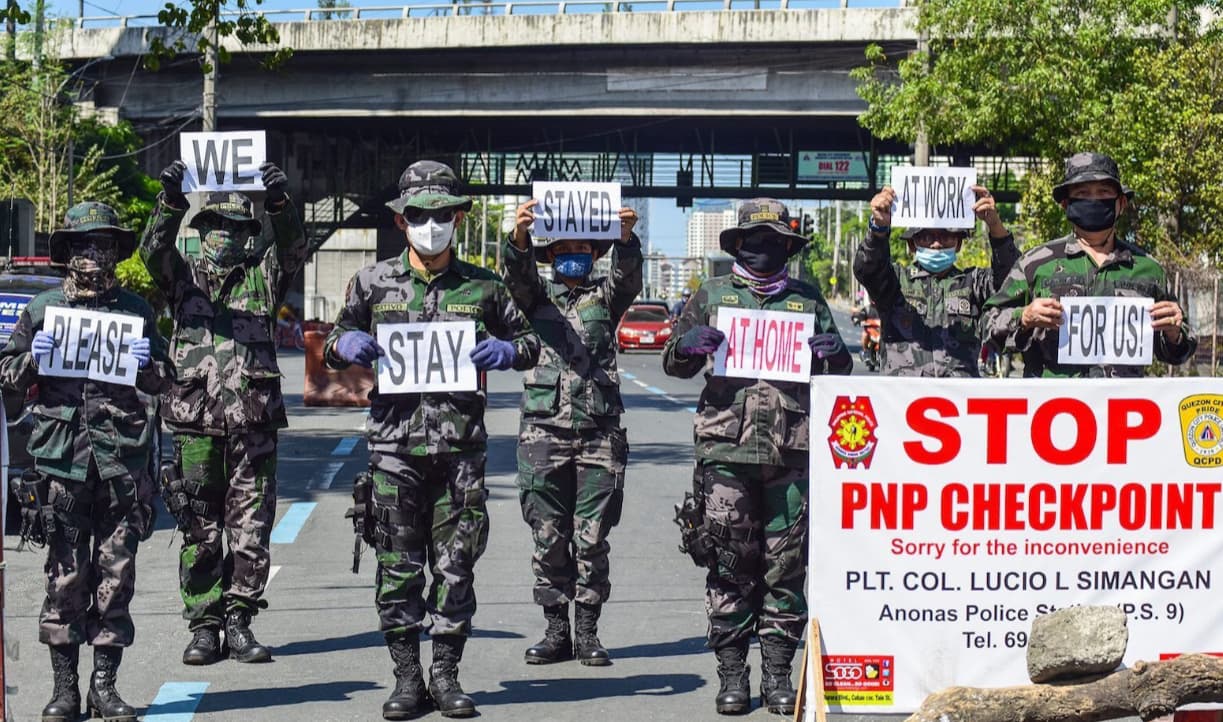
Discussing politicians or the administration responsible is not as pertinent as effects. The lockdown has stalled the Philippine economy as millions of laborers reliant on their employers have sacrificed much for their families. Once a noisy and bustling city, Metro Manila has become silent. At the same time, this has prevented the massive spread of COVID-19 among people who might not even be able to afford the necessary treatment. As of the time of writing, mass testing results have not yet been released, but the Philippines is relatively low in cases per million people.
In judging a nation’s efforts to contain the virus, looking at unnecessary losses is important. If proper measures were not taken to lock the country down, we might meet a fate worse than Sweden, whose failure to implement proper containment measures has led the Nordic country to an extremely high mortality rate.
The government’s relatively swift and decisive action are seen in an early lockdown and allocation of funds. One of the reasons for the American outbreak is the slow reaction of several states, many of whom took weeks after the first case to impose any sort of quarantine. The Philippine reaction was far from immediate; life as normal continued for a few days while cases started to pile, but within around a week of the lockdown, important measures and an Interagency Task Force (IATF) were mobilized.
“But, the economy!”
An argument is to be made for an economic collapse. The stock market has been suffering from closed businesses. Economic activity is at nil. If the furloughed find no jobs, their families will suffer from starvation. At the same time, opening the lockdown is going to expose the virus to the entire population of the Philippines, with the most vulnerable areas being in dense cities.
Survivors suffer a lot from COVID-19’s symptoms. This is more than just the flu. Pneumonic symptoms are hard enough for people with milder symptoms, but many tell of a ventilator “nightmare.” One survivor from Rhode Island, US says that despite being a healthy male, he could not help but think of “the next hour.” Ghastly hazmat suits would enter his room of asphyxiation to drain his lungs of liquid.
Reports of doctors being forced to choose who to let live are harrowing. Forcing these men and women to value their beloved patients’ lives over the other would be traumatising for anyone. If cases were to explode, these unnecessarily cruel dilemmas would become more and more commonplace. The economy is important, but if upholding it means sacrificing the health of the population, then I believe New York Governor Andrew Cuomo put it well: “If it’s public health versus the economy, the only choice is public health. You cannot put a value on human life.”
With the consistent increase of COVID-19 cases in the Philippines, along with the number of recoveries surpassing fatalities, there is reason to hope that the same problems will not manifest.
A Very Decent Attempt
There seems to be an endless number of looming disasters threatening the stability of the country we hold dear, from an inability to control the virus’ spread, to the awful trauma and collapse of the healthcare system. We can only prevent the worst-case scenarios through smart and decisive action. The Philippines has undertaken several initiatives which, while imperfect, are assertive enough to prevent an extreme outbreak like that of many others. All these actions are not even to mention social amelioration programs or the communal concept of “Bayanihan.”
I believe the government has done what it could, given its resources, to combat this global pandemic. Amidst controversies and unreliable information, anecdotes of efforts from the many heroes trying to fight the spread of COVID-19 revitalize the nation in precarious times. One could only hope that this level of competence lives long after these tough times and would only grow better.