COVER STORY — Culture Shock
By Enrico Perez
|6 min read
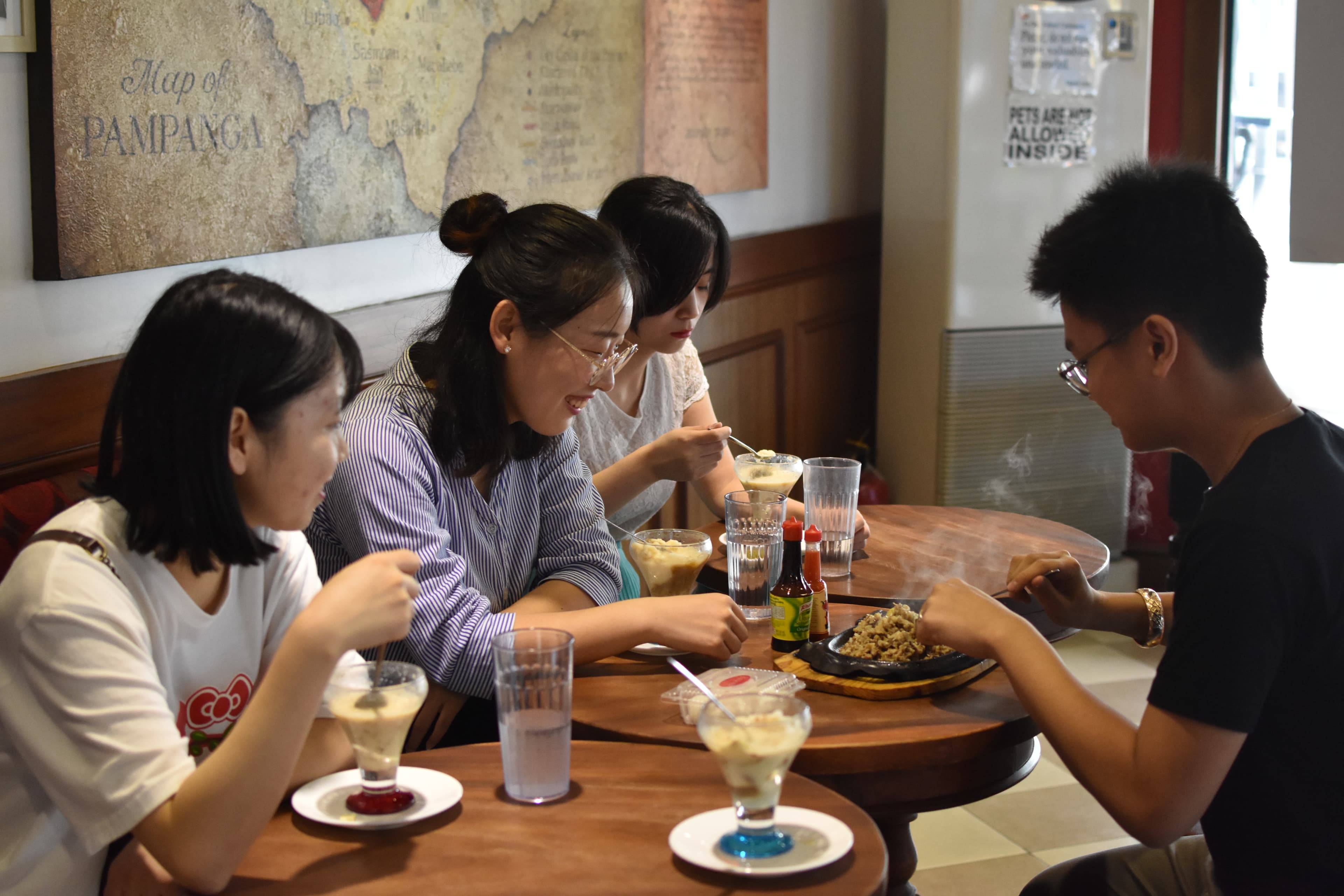

Ada Wang, Lumia Lu, and Yelena Yang enjoy their very first cups of halo-halo.

The laoshis sample dinuguan, a Filipino delicacy. Ms. Lu likes the puto, not the bloody broth.

Ms. Lu and the laoshis frequent Unimart for groceries.

As I sat on a couch in a questionable shade of beige interviewing three Chinese nationals known to us as laoshis in a fluency not even my modular teachers can be proud of, I scolded myself in embarrassment and said, “I should’ve paid more attention in Chinese class.”
Life in the Philippines
At around 4 o’clock on an uncharacteristically bleak Tuesday, I, along with my translator and photographer, called for Ada Wang, Lumia Lu and Yelena Yang for an interview about how they ended up teaching in the Philippines. All 39 of them arrived here last May 15, 2017. ‘Them’ refers to the Chinese teachers who took a government test to come to the Philippines and teach in Xavier San Juan and Nuvali. All of them are staying in the Philippines for ten months either as part of their requirements for secondary education or for more work experience.
After work they head to Gold’s Gym in Gate 4 to exercise and go home at around six o’clock five days a week. They usually cook for themselves, predictably chinese food, and on weekends they venture out into Manila’s crowded streets filled with busy people. I asked them if they’ve been to a wet market already and they told me they had. “We aren’t going back there, though,” all three of them quickly agreed. Perhaps there are still some things about Philippine culture they aren’t ready for.
“Everything is more colorful,” said Ms. Wang when asked about what she likes about the Philippines. Though unspoken, I’m convinced she was talking about the loud and boisterous people as much as the jeepneys and cars that paint the streets at rush hour. She tells us of how different our orange sunsets are to the typically grey skies back home.
Ms. Yang tells us that when she was still in China, she loved to eat anything that tasted sweet. When she set foot in the Philippines, she told me something about never realizing food could’ve been even sweeter. She was also pleasantly surprised when she found out even our spaghetti tasted sweet and was endorsed by a cute (their words, not mine) anthropomorphic bug. It was in that moment I realized they’ve discovered Jollibee.
Classroom Management
“How are your classes?” I asked them. They responded, perhaps telepathically, through their knowing laughter. They know that we know.
In China, Ms. Yang tells us, they are taught how to teach but when they got here, they soon found out the difference between teaching and managing a class. They all agree that Xaverians come off as too loud—the large class sizes don’t help either. “Greenslips don’t do their jobs; they’re a reminder of what they did but it doesn’t stick,” one of them pointed out as we find out that only one of them has ever issued one. The general consensus was that although Xaverians are polite enough to apologize for being noisy, it doesn’t take long before they start making noise again.
They are aware that Xaverians don’t take Chinese seriously because they know it isn’t essential to survival. But Chinese teachers need to be able to understand English given that it’s an international language—which is why they’re compelled to learn it.
Changing the subject, I asked them if they’ve tried ‘real’ Filipino food yet.
“We haven’t, actually,” said Ms. Wang.
Filipino Food Gone Wrong
The following Saturday finds us at the Razon’s on Club Filipino Drive as their foreign taste buds grapple our local cuisine.
“Is this a usual thing Filipinos do?” they ask as Mrs. Africa, Johann and I realize we’re all eating dessert before the main course. No, we tell them, all of us now laughing as they try to look as candid as they can while their pictures are being taken.
As they ate their halo-halo they asked us if Ninoy Aquino was our national hero—predictably because that day was a national holiday named after him. “No,” we said. Then we told them we have a holiday for him because he, like many other individuals of his time, fought against the Marcos dictatorship of the 1980s. As I tried to find the word for ‘dictator’ in Chinese, I looked at Johann and asked “can I compare him to Mao Zedong?” I didn’t need to as they overheard and affirmed my connection.
When it was time they tried the sisig and dinuguan we could sense an aura of strong hesitation. Whether they tried it because they were compelled to or not, is something we’ll never know. But what we do know however is that they don’t like it. “We should’ve ordered rice to go with that” Johann tells me in a hushed voice. If we would have redone this whole introduce-me-to-Filipino-food thing we would, but here we are eating dessert before the main course and eating the main course without rice.
“I need to ask you guys something,” Ms. Lu tells us with an oddly cautious tone. “Go ahead,” I tell her. She then asks us why our culture is so open to homosexuality and feminine culture. Mrs. Africa then tells them that before the Spanish conquests and Western influences the Philippines existed as a matriarchal society. During that time many tribes, such as the Babaylan, championed equal opportunities of all the members of the society including transvestites and, by today’s standards, understandings of the ‘third sex’ beyond their time. Ingrained deep within the recesses of our culture and individuality are notions of gender equity.
Groceries in Uni-Mart and Waiting
As we went to nearby Uni-Mart to take more photos, I couldn’t help notice the produce that they were buying. The usual vegetables and canned goods reminded me of that one time all of the Chinese teachers decided to go to a wet market for cheaper prices. As they told their intent on never returning to one ever again, I realized there’s only so much local culture a foreigner can handle at a time.
“You might want to write about their groceries,” Johann told me while he was taking pictures of them holding mangoes in the fruit section. As I peered over at the cartons of cowhead milk and vegetables wrapped in a plastic bag I thought to myself “why would anyone want to read about how three chinese teachers buy vegetables and a stunning lack of junk food?”
When our translator-turned-photographer Johann, accompanied by Mrs. Africa, also a photographer, went onto the street to take the cover photo they told me to stay inside and guard their stuff. As I looked at my notes I realize how these three women communicate with a sense of camaraderie only individuals who are undergoing the same situation can achieve.
The Good, The Bad, The Poignant
As I waited for what seemed like an hour, which was actually just half of one, I realized that like the rest of our teachers, these ones have lives and personalities. Most of them will leave in a year, we’ll be taught by their replacements and we’ll all forget that they existed—that’s just how it works.


