D-Day: How a Massive Allied Landing Turned the Tide of one of the Biggest Wars
By Tyler Lim (G7)
|4 min read
By: Tyler Lim (G7)
June 6, 1944. To you, this date may seem insignificant, but to many others, this was a significant turning point in the Second World War. This day was when, under the cover of darkness, a massive Allied force landed on the French coast, in the Normandy region. 1944 completely changed the tide of the war. Italy surrendered to the Allies after the landings on Sicily and Anzio. On the Eastern Front, the Red Army drove the Wehrmacht closer and closer into Berlin. However, the Italian front had made no progress due to the determined Nazi force guarding Rome. Therefore, an amphibious landing was considered on the coast of France. The landings occurred in Normandy, which is the farthest point from England, rather than Calais, which is only a couple of miles from the English Coast. This may have seemed unconventional, but this made sense due to the Germans expecting the landings to happen at Calais, catching them completely off-guard when the Normandy landings took place.
Prelude
Although the Normandy landings ultimately proved significant to the Nazis’ demise, there were many events that led up to WW2 which eventually led up to D-Day. To put it simply, the countries that would come to form the Axis Powers, namely Germany and Italy, were in a dismal state following WW1. Therefore, a new movement, known as Fascism,quickly grew in these two powers, now with a desire for revenge against the League of Nations (The Predecessor to the United Nations), who they thought was responsible for ruining their respective countries. This started with the so-called Phony War, in which the Allies remained relatively hopeful that another war would not break out while the Nazis teamed up with the USSR to annex Poland, Czechoslovakia, Austria, and many more.
The Trouble Starts
After the Phony War, the Axis Powers now started to instill worry among the Allies. However, the Allies could not stop the Axis from invading France, bombing London and wreaking havoc in Europe. Hitler’s blitzkrieg strategy, which involved speedily pushing through his enemies at lightning speed, resulted in the Fall of France and the invasion of the USSR, as well as the constant fighting between the British and Italians in North Africa. That said, there was one superpower notably absent from the early years of WW2: the United States of America.
America Missing
Despite the looming threat of the Germans, America, who still believed in following President Roosevelt’s foreign policies, did not intervene in the first few years of the war. They remained neutral until they placed an oil embargo on Japan for its recent activities in the Pacific, eventually resulting in the Japanese launching a sneak attack on the American base in Pearl Harbor, Hawaii. This prompted American President Franklin Delano Roosevelt to declare war on Japan and Germany.
America Enters the War
This new addition barely affected the course of the war in its formative stages (1941-43), but soon enough, the Americans joining the war would prove to be a catastrophe for the Axis Powers. First, the Allies pushed the Axis Powers from North Africa, which led to the Allies landing on Sicily and Anzio on the Italian coast, resulting in Italy’s surrender. The Allies considered opening up a new front to put pressure on the already weakened German war machine. They decided on the coasts of France, specifically on Normandy, which the Germans did not expect due to it being the farthest point from the British coast. After a few deceptive tactics including dummy armies placed on Calais, the nearest point to Britain, to fool the Germans, the plan was finally ready. On the eve of June 5, thousands of Allied soldiers, ships, and tanks made their way into Normandy.
Operation Overlord
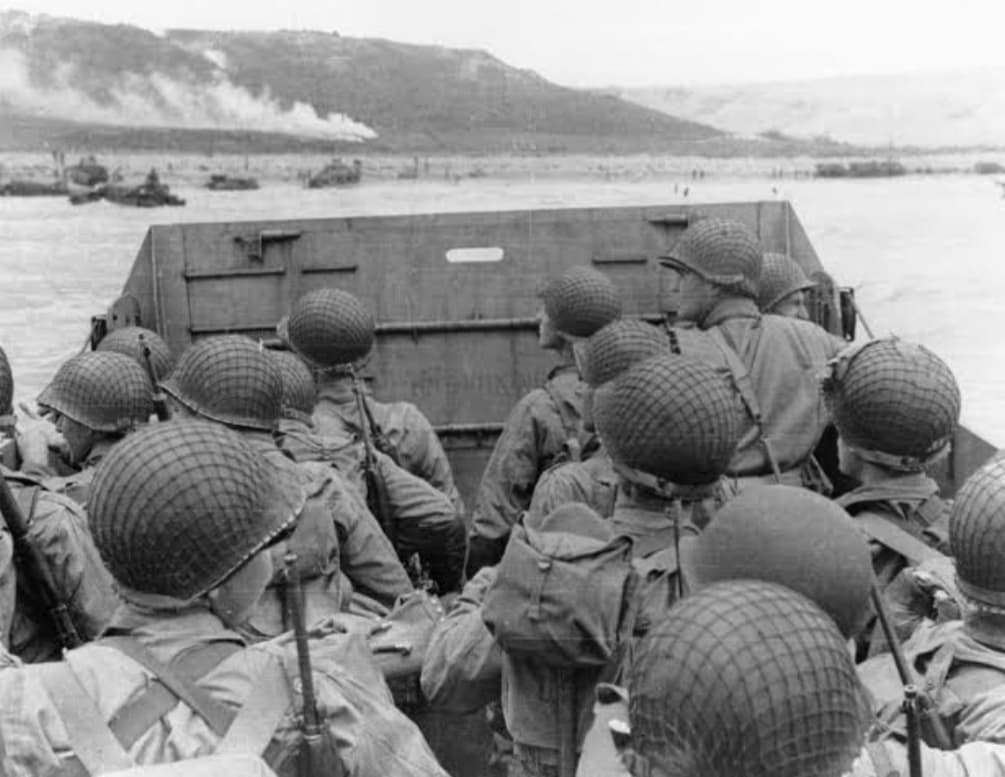
In the early hours of June 6, the Allied forces, composed of British, Canadian, and American troops, were assigned to land at 5 designated beaches: Utah and Omaha for the Americans, Gold and Sword for the British, and Juno for the Canadians. Omaha beach especially saw fierce combat, as hundreds of landing crafts composing the first wave landed. The sound of waves suddenly turned into machine gun fire. The men, only with a few tanks and light weapons supporting them, slowly swam and crawled towards the shore, having to duck under the German mortar and flying bullets. Those who did not get ripped to shreds by the machine guns either sank with their heavy gear, or were stuck behind the anti-tank barriers. The fighting remained at a stalemate, as the Allies were unable to break through the beach until some brave men breached the barbed wire, not taking into consideration their safety, which led into the Allies charging and capturing the beach. This major breakthrough led to the Liberation of France, which paved the way to the Fall of Berlin.
Conclusion
Looking back, this battle was not just significant in the sense that it led to the collapse of the Nazis, but it was also important in showing how sacrifices are necessary to accomplish a goal. In this case, a few soldiers sacrificed everything to push up against the barbed wire guarding the defensive line and breach it, leading to the long-term victory of the Allies. This can also be applied in life: one has to make short-term sacrifices in order to achieve long-term success. As the saying goes, “if you want to make an omelette, you’ve got to break a few eggs.”
Ultimately, the D-Day Landings not only made a historical mark — it is an inspiration, a calling, if you will, for contemplation on one’s own goals, and the steps and risks involved in achieving them.


