Fr. Desautels, S.J., Xavier’s Founding Father
By Gabriel Camiña (12B)
|8 min read
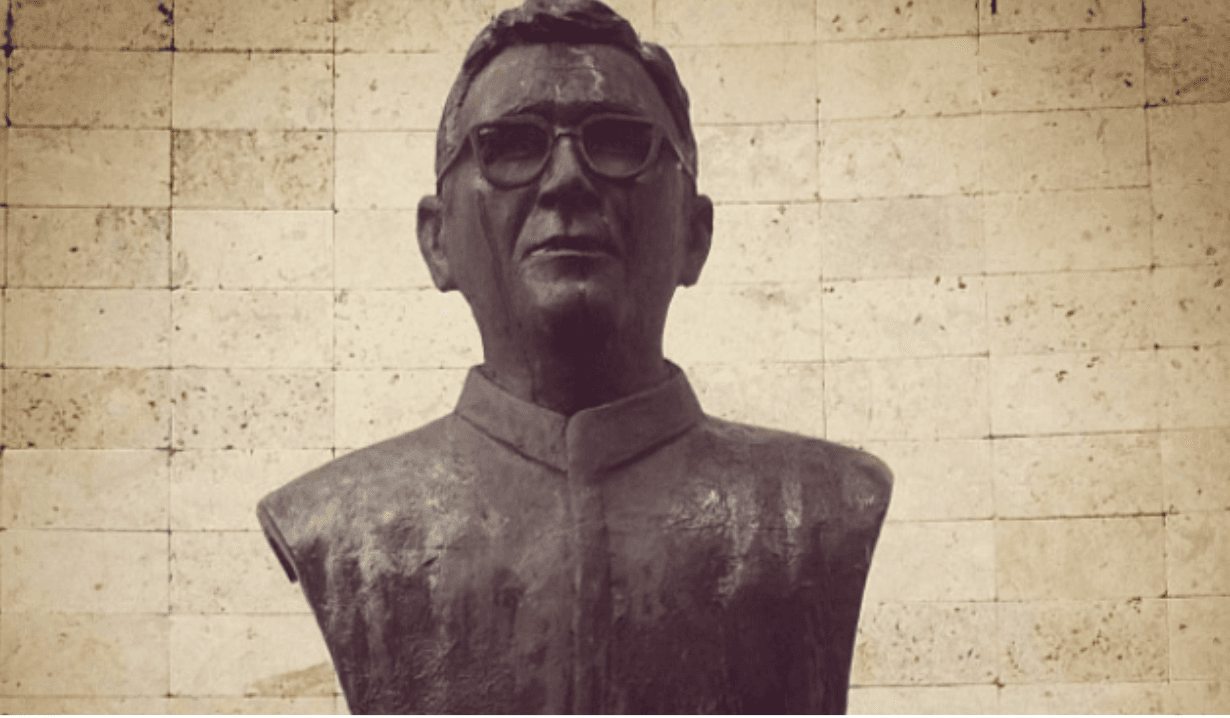
Written by: Gabriel Camiña (12B)
No institution can function without its leader. The one individual willing to represent every choice that the group makes, and the one entrusted with spearheading the organization when it goes through difficulties – and of this, Xavier School is no exception.
Our school presidents, or directors as they were called in previous years, have been tasked with the thankless job of managing every single aspect of Xavier School, all to achieve strides in both education and the school’s mission and vision.
Throughout our 68-year history, we have had 7 school presidents, with our new president, Fr. Joseph Haw, very recently taking over the helm. As Xavier School enters this new era, let us take a look back to the very beginning, to see what being a Xavier leader truly entails. Of course, this means knowing the story of our very first president, Fr. Jean Desautels, S.J., who served as our leader from 1956-1966, and his constant pursuit of being both an educator and a Jesuit.
Locked out of China
Every story starts somewhere. Xavier’s starts in China, specifically in the Chinese Civil War.
Tensions between the Republic of China and the Chinese Communist Party (CCP) persisted from 1927-1949. This concluded with the CCP gaining total control of the nation, and with this new leadership came their hatred of religion, deeming it “superstition” or “foreign culture imperialism.” Thus, many Jesuit missionaries were deported and found their home in the Chinese communities of the Philippines, many of which went on to form Xavier School.
Fr. Jean Desautels, S.J. was one of those affected, as he became barred from reentering China. Born on March 2, 1914 in Montreal, Canada, he eventually became enamored with China, as his education after leaving Canada brought him to many places throughout the Chinese nation, even if he himself wasn’t Chinese. He spent his time in Beijing familiarizing himself with the language and was appointed Assistant Principal, Prefect, and English Teacher in a Chinese school by 1939. He later took his theological studies at the Jesuit International Theologate in Shanghai and was ordained there in 1945. After becoming a priest, he returned to Canada for some time and was eventually assigned to head the Jesuit Language School in China, only for the school to sadly close down due to the CCP on the day of his departure from Canada.
Not letting this get in the way of his mission, he bided his time studying at Harvard for advanced Chinese studies, demonstrating his true commitment to both education and Chinese culture. One Jesuit school that closed down in China was the Chabanel Hall, and he was assigned to reopen the school anywhere in Asia. This commission is what ultimately brought him to the Philippines, as he reopened the school in 1949 after buying a few quonset huts from a former field hospital, as well as reopening a seminary for Chinese secular priests.
In a Radyo Katipunan interview, he stated he never thought staying in the Philippines would be his calling, thinking of it as just a temporary mission until his next task. Little did he know, his pursuit of education in the nation had only just begun.
The Deal to Build Xavier
After serving as rector of Chabanel Hall for 6 years, we are brought to the year 1955, the year right before Xavier’s formal founding. By this point, he had amassed connections with many different Jesuits, both Chinese and Filipino, and had the task of building a Chinese school in Manila. He had assigned Fr. Pineau, S.J. to create the curriculum, while he looked into finding a property.
In his pursuit, however, he faced a massive issue: money. He was able to secure about 20,000 pesos early on, but his deal with Atty. Ayala involved a payment of 20,000 pesos for the construction and another an initial payment of 100,000 pesos by December 15th, which is equivalent to 14 million pesos in today’s currency. This would then be accompanied by another 33,000 pesos every 3 months. Otherwise, the deal would be entirely off, and the constructors would focus on Cebu, with no refund of the initial 20,000 pesos.
Even after constant begging throughout Chinatown and desperately trying to find loans, by the dawn of the 15th, they still only had about 41,000 pesos. None of the pledges the priests made were able to pay early enough to hit the deadline. Desautels’ psyche took a heavy toll, with his notes stating: “We were quite discouraged, and never in my life have I prayed so intensely for light and wisdom in the face of a momentous decision.” He even had thoughts of abandoning the project as a whole, as he begged for St. Joseph’s assistance in this time of distress. Nevertheless, he remained resolute, even refusing an offer of over 100,000 pesos to leave the property alone.
The day of the deadline arrives, and at about 10:30 am, he receives a call for an advance of about 20,000 pesos. Generous, yet they remain 31,000 pesos short. By 1:30 pm, he and his companions Ambrose Chiu and Basilio King eat a cheap lugaw lunch to maintain as much of the payment as possible. Desautels and Chiu constantly question the possibility of this purchase, whether they should give up or keep searching for every tiny possibility, whereas King remained persistent in reminding his compatriots that it is possible.
With only 3 hours left on the clock, the attorney calls, asking if the deal is pushing through, and Desautels resolutely responds with “Most certainly” – either as a bluff or a demonstration of his complete trust in God. Regardless of his thought process, Desautels rescheduled the meeting to 4:30 pm, half an hour earlier than the original time. This only serves to signify his faith in a miracle, even when they’re almost one-third short of the cost. He placed the entire fate of the school into God’s hands and stayed determined to find the thousands they lacked.
Of course, the deal pushed through. The priests scrounged up every connection they had, 30,000 pesos from Father Willmann and another 9,000 pesos from the Parish Priest of Mary the Queen Fr. Beauregard, finally making just enough to secure the deal. Funnily enough, they were able to push the deal back even earlier to 3:30 pm, making it seem ironic that they believed they couldn’t afford it just a few moments prior.
The priests led by Desautels were able to set up Kuang Chi School, named after a 16th-century Chinese evangelist, on Echague Street in Quiapo, on June 16th, 1956. This new site was hardly extravagant, being one and a half hectares and merely a converted saw mill, yet it was easily enough for the humble goals of spreading Jesuit values and teaching Chinese languages and culture in the Philippines. Notably, they had the primary goal of integration of cultures, not wanting to only be a Chinese school, but a Filipino school teaching Chinese, thus allowing for both Filipinos and Chinese to interact within the environment. It had a two-story building that was transformed into the Jesuits’ residence, a sawmill that could be converted into a basketball court, and a large bodega to be the classrooms.
Fr. Desautels, S.J., became our first-ever director, with co-founder Fr. Pineau, S.J. as our first-ever principal. They received assistance from many different Jesuits in the area, such as Fr. Papilla, Bro. Louis Tremblay, and Fr. Clifford. The first year only saw a mere 174 students, with only 2 students in high school. As small as it is, however, it became incredibly important as one of the first Jesuit schools for Chinese established in the Philippines. This school was eventually renamed in honor of Jesuit founder St. Francis Xavier, a name it has kept until now.
By 1960, we were finally brought closer to the school we know and love, as Xavier moved to a far larger campus in Greenhills, San Juan – the place it has maintained ever since. With the expansion came even more Jesuits joining the staff, as Fr. Barbero, Fr. Cortina, Fr. Chi, and many others chose to help the school prosper. The student population also considerably increased, with over 1,000 students able to enjoy a sprawling 7-hectare campus with numerous basketball courts, football fields, gymnasiums, pools, and so much more. A big improvement from barely being able to afford a property just one-fourth its size!
Passing the Torch
By 1965, after a decade of cultivating the growth of this fledgling school, Fr. Desautels passed on the position of School Director to Fr. Ismael Zuloaga, S.J., and with that, he also formally left Xavier School to this new administration. He traveled to many ends of the Earth, yet always kept the pursuit of being God’s servant in both evangelization and education. He left for Vietnam, founding the Alexander de Rhodes Educational TV and AV Center. His work for the Jesuits brought him to Brussels as the Secretary-General of UNDA/World, as well as to London as director of the Jesuit Center for the Study of Communications and Culture. For about 14 years from 1981 to 1995, he became Executive Secretary of the Federation of Asian Bishops’ Conferences and Consultant for Radio Veritas Asia Overseas Program.
No matter how far he traveled, Xavier never truly left his heart. After 30 years, he finally returned to the Philippines to serve in both Mary the Queen Parish and the school he founded all those years ago. No matter how much Xavier has changed since he left, already having its fourth president, he could still always call it his home. He remained as Father Confessor and Spiritual Director in Xavier, until his unfortunate passing on August 1, 2002, the day after the Feast of St. Ignatius of Loyola. In the days before his death, he could be seen still ever grateful, telling people nearby “Thank you for your love.” His funeral mass was presided by our second president, Fr. Zuloaga, S.J., and his body rests at the Sacred Heart Novitiate in Novaliches.
True Leadership
Our first president’s campaign for our school is a testament to what a leader really is. He encountered an obstacle at every turn, from being barred from his first-ever mission in China to barely affording his dream of creating Xavier School, yet he never allowed it to break him. He is a manifestation of a leader’s grit, as a leader must be willing to undertake the necessary hardships just to accomplish whatever mission he has for the group. Without his perseverance, Xavier School as we know it today would cease to exist. Without his faith in God’s plan, he would have never been able to spread both Jesuit and Chinese education in the Philippines. Thus, the message he imparts on all of us, be it any Xaverian or future leaders, is that failure isn’t the result of hardship, but of surrender.
For all he has done to create the Xavier School we now call home, there is only one thing we can say – thank you for your love, Fr. Desautels.


