Humanity’s Future on Mars: An Overview
By Skyeler Kho
|8 min read
Article by: Skyeler Kho
Mars has captured humanity’s imagination. Different countries’ space programs have sent scientific equipment like probes and rovers to the planet, all with the hope of learning more about the planet and the history of the solar system. With the recent string of Mars missions successfully reaching the red planet, it is time to take a look at the current and future plans of just a few space agencies: the US’ National Aeronautics and Space Administration (NASA), the European Space Agency (ESA), the United Arab Emirates (UAE) Space Agency, and the China National Space Administration.
Not just NASA
Most of the recent hype surrounding Mars focuses on NASA as their Perseverance rover and Ingenuity helicopter successfully touched down on the red planet last February 18. Despite this, NASA is not the only one to have launched a Mars mission last year. During the Mars launch window in 2020, three missions were launched by separate space agencies. The first mission was the UAE’s “Hope” probe, which launched atop a Mitsubishi H-IIA 202 rocket last July 19. This is the UAE’s first Mars probe, and it was sent to survey the Martian atmosphere.
To achieve its goals, the Hope probe has three main instruments: a multiband imager, an infrared spectrometer, and an ultraviolet spectrometer. The Emirates exploration imager (EXI) is meant to take photos of the surface, allowing scientists to study Mars’ climate systems. The Emirates Mars Infrared Spectrometer (EMIRS) was placed in order to examine temperature patterns in the Martian atmosphere, as well as to measure the dust, ice, and water vapour levels in the lower atmosphere. The Emirates Mars Ultraviolet Spectrometer (EMUS) will study Mars’ upper atmosphere, measuring relative changes and determining the abundance of carbon monoxide and oxygen.
A multi-part mission
Following the UAE Space Agency, the China National Space Administration launched their “Tianwen 1” mission. Launched on July 23 atop a Long March 5 rocket, the Tianwen 1 mission consists of an orbiter, a lander, and a rover.
Initially, China intended on using the orbiter to study the surface of Mars for around two to three months. Afterwards, the orbiter will detach from the lander stage, which will land on Mars’ surface. The rover is mounted onto the lander, and it will simply drive off once the lander touches down.
The orbiter stage is going to study the magnetic field of Mars, as well as investigate the various particles present in the vicinity of the red planet.
The Tianwen 1 rover stage is meant to study the magnetic fields on the Martian surface. Aside from this, it has a Ground Penetrating Radar (GPR), which can measure up to 330 feet beneath the surface.
Looking for a sign
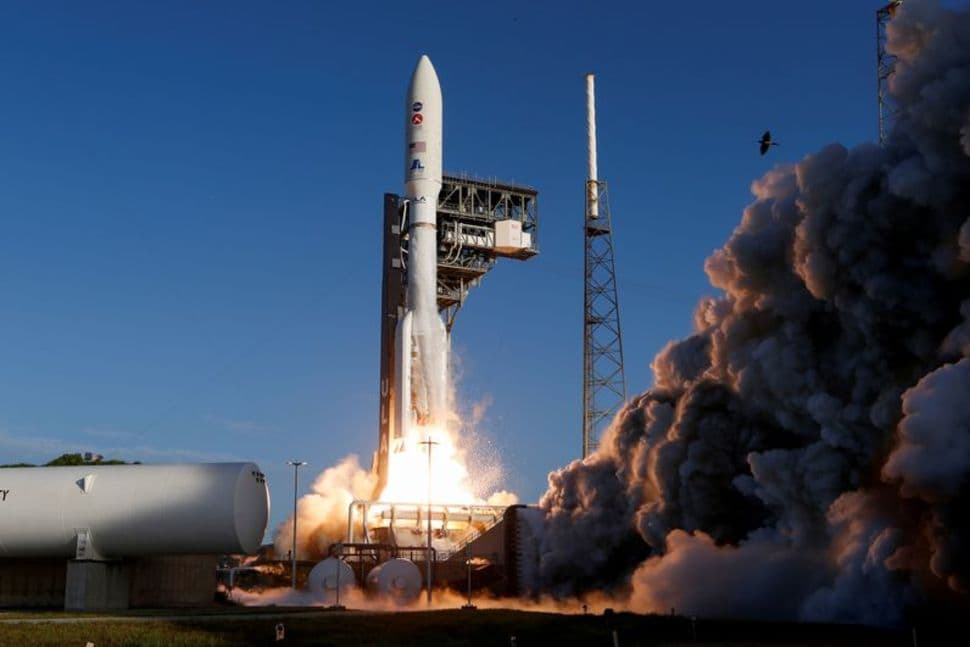
The last of the three to launch was the Mars 2020 mission, headed by NASA. Launched on July 30 atop an Atlas V 541, the Perseverance rover and Ingenuity helicopter are meant to study different aspects of Martian surface conditions.
As one of the first missions dedicated to searching for life on Mars, the Perseverance rover makes use of several instruments:
- Mastcam Z is mostly intended to take high-definition photos of the surface and is capable of stitching several photos into panoramic images.
- The Planetary Instrument for X-ray Lithochemistry (PIXL) will be used to determine the composition of the Martian surface.
- The Mars Environmental Dynamics Analyzer(MEDA) will measure the Martian weather. These measurements include temperature, wind conditions, pressure, relative humidity, and dust size and shape.
- The Mars Oxygen In-Situ Resource Utilization (ISRU) Experiment, or MOXIE, is an experiment that will attempt to produce oxygen from the martian atmosphere.
- The Radar Imager for Mars’ Subsurface Experiment, or RIMFAX, is a ground-penetrating radar. This instrument will provide scientists with data regarding the geologic structure of Mars’ subsurface.
- The Scanning Habitable Environments with Raman & Luminescence for Organics and Chemicals, or SHERLOC, is a spectrometer. Its purpose is to detect organic compounds within the Martian soil.
- SuperCam is made up of a camera, a laser, and spectrometers. It will be used to study the composition of surface material and will actively search for organic compounds within these materials.
Aside from these, Perseverance also has a drill attached to its arm. The purpose of this drill is to collect samples, which will be sent to Earth.
The Ingenuity Helicopter, which was mounted beneath the rover during its descent, is a tech demo for NASA. If successful, it will be the first human-made object to achieve powered flight on Mars, setting the stage for future missions. Aside from the technology demonstration, Ingenuity will also be used to take surface images in great detail.
Humanity’s future on Mars
With the Emirati and Chinese missions achieving successful orbital insertion and the NASA mission achieving a successful landing on Martian soil, all of the launches last year have reached the vicinity of Mars. The question now turns to the future missions that have been planned.
Topping the list of future missions is the ExoMars 2022 mission helmed by the European Space Agency (ESA), which is planned to launch along with the three other missions. Due to delays caused by the COVID-19 pandemic, the ExoMars launch has been pushed back to the next Mars transfer window, which is in 2022. This mission will arrive in a similar fashion to the Tianwen 1 rover, with a rover mounted onto a landing platform. ExoMars 2022 will collect samples from a depth of up to two meters below the surface, and it will analyze the samples on an onboard laboratory. The ExoMars 2022 mission is also meant to look for organic material within the surface.
Looking further into the future, NASA and the ESA have proposed a sample return mission, which will be done in three parts. The first phase of the mission uses the Perseverance rover to collect samples from the surface. Perseverance will then drop these samples back onto the surface in small canisters.
A future ESA mission will launch a “Sample Fetch Rover,” as well as the Mars Ascent Vehicle (MAV). This mission is meant to collect the sample canisters left by Perseverance, as well as bring the samples to Mars orbit.
A final mission, also launched by ESA, will be an Earth Return Orbiter. This orbiter will rendezvous with the samples in orbit, and it will bring the samples to Earth.
A wild Musk appears
Of course, it wouldn’t be possible to analyze future Mars missions without mentioning SpaceX. The company, founded by Elon Musk, is currently testing its “Starship” prototype in Earth’s atmosphere. After these tests, it is proposed that Starship will serve as a human transport system for Mars exploration. SpaceX has already launched two Starships, SN8 and SN9, with both completing most of the flight.
SN10 has just performed the first successful landing of a “completed” Starship, although it did experience a Rapid Unplanned Disassembly (RUD) afterwards.
Aside from these, SpaceX is currently constructing several more prototypes for its Starship, as well as the first prototype of its “Super Heavy” booster. The Super Heavy will be responsible for taking Starship from Earth’s surface to orbit, as well as launching the tanker stage that will refuel Starship in orbit.
The importance of exploration
When scrolling through articles and reactions, it doesn’t take long to find some opinions that question all of the progress made in space exploration. These views range from placing more importance on Earthly issues to flat-out conspiracy theories stating that space exploration isn’t possible. After all, there are a lot of issues currently facing humanity, such as poverty and healthcare. However, it is important to recognize the importance of space programs and their contribution to humanity as a whole.
First off, progress in space exploration drives innovation on Earth. Many of the technologies and materials that are in widespread use first came from space programs. For example, most of the current phone cameras have a high resolution because of space programs. This was a result of the need to fit a small camera on a spacecraft while still getting useful data out of it. Aside from this, those who wear glasses may have come across scratch-resistant lenses, which also came from space programs. Scratch-resistant lenses were created in order to develop astronaut helmets. Space programs have helped pave the way for technologies that are in widespread use on Earth.
Second, space programs launch spacecraft to help monitor Earth. While most of the fanfare may go to these interplanetary missions, around half of governmental space missions are actually sent to orbit around Earth. Take NASA’s Soil Moisture Active Passive (SMAP) spacecraft, for example. SMAP was launched in order to study many conditions on Earth, including weather, droughts, water cycles, and soil moisture. Spacecraft like SMAP make it possible to predict weather conditions, as well as help farmers predict their crop yields. Note that these missions don’t even include commercial spacecraft, such as those which provide GPS, radio, and internet. While commercial satellites aren’t funded by government space agencies, the launches of these space agencies make the launch cost substantially cheaper for commercial missions.
Aside from these, it is also important to recognize the economical impact of space exploration. Not only are jobs created to build the spacecraft themselves, but jobs are also created to build the infrastructure required to communicate and monitor spacecraft. More people are employed to monitor the data that come from spacecraft, and even more get jobs to build the launch vehicles for these spacecraft. The funding of space programs contributes to thousands of jobs which fuel economies.
One final reason for space exploration is the survival of humans. There are many threats to humans that, while unlikely, can still wipe out the vast majority. The most dramatic of these threats is a possible asteroid collision with Earth, and space agencies aren’t ignoring that possibility. Some countries have built an asteroid detection system, and NASA is going even further with their Double Asteroid Redirection Test (DART) mission. DART is a spacecraft that is meant to fly into an asteroid, causing a slight course correction that will stay clear of Earth.
Going back to Mars, the Perseverance rover was specifically designed to search for signs that Mars could sustain human life. Not only does the rover have tools to search for water underneath the surface, but MOXIE (stated above) is meant to study whether oxygen could be produced from Mars’ atmosphere. These two conditions are imperative to sustaining long-term human life on Mars, and they may very well lead to human colonies on the red planet.
It’s an exciting time for space exploration. Three missions have successfully reached the red planet, a possible sample return is in the works, and we get to see Elon Musk’s Starships belly flop! If there’s any time to get excited about Mars, it’s now!
The reference list for this article can be found here: https://tinyurl.com/StallionMars


