Manipulation in Today’s World: The Orwellian Portrayal of Language and Power in 1984 and Animal Farm
By kylechuaunsu
|5 min read
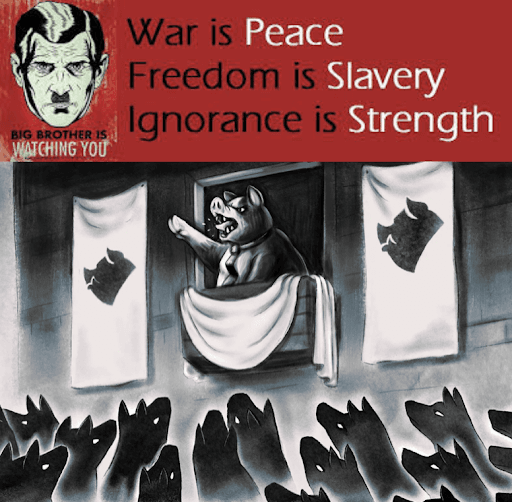
Language is the main medium humans use to convey thoughts, emotions, and information with one another. Because of its inherent power, language can be used for both good and evil purposes; it can be either used to address complex personal and communal concerns or distorted to deceive others of a certain truth. Throughout history, language has served as a tool for colonizers and totalitarian regimes to strengthen their iron grip. Even today, authorities take advantage of phrasing to boost certain agendas and campaigns and shape public opinion into a favorable mold. Well-acclaimed English author George Orwell offers readers an overt demonstration of how language can give power in two of his best works: 1984 and Animal Farm.
Contradiction Within the Mind
Among the many ways one can achieve power over someone, being able to influence their thoughts is certainly one of the most effective. The government in 1984,known as the Party, broadcasts their messages on telescreens to cause “doublethink,” the state where someone simultaneously believes in two contradictory ideas, especially due to indoctrination. For instance, the Party enforces three crucial ideas onto the people through their slogan: “War is peace; Freedom is slavery; Ignorance is strength.” Although this, like their other messages, is factually incorrect and absurd, it is absorbed and wholeheartedly believed by most people because they simply consider their leaders to be infallible. This psychological trick can easily compel people, especially the less shrewd, to embrace “facts” out of blind obedience.
Exploitation of the Uneducated
In Animal Farm, the animals hoped to create a free and equal place, but under the corrupt pigs’ rule, it became just as bad as before when they were under an abusive farm owner. Squealer, the ruling pigs’ spokesperson in the novel, utilizes another means to get a message across: jargon. When the common animals point out the pigs’ indulgence in alcohol, which was strictly banned by the pigs themselves, Squealer rambles on how small amounts have always been allowed and that they misremembered the commandments. The others, who are much less educated than the pigs, do not genuinely comprehend his explanation, but it is this resulting confusion that Squealer exploits to let them take his words as fact.
Those educated in the field of law fear that the proposed Anti-Terrorism Act of 2020 may be abused in a similar manner (Venzon, 2020). Because of the act’s vague definition of the grounds upon which someone could be charged with terrorism, the bill could consider something as minor as a bar fight as such. Though those with expertise know what injustices may come about, many without such a background can be easily convinced that arrests made are for the greater good.
Silencing the People’s Voice
Aside from inculcating the population with misinformation, the Party attempts to reduce their vocabulary by modifying English into “Newspeak.” Words like “freedom,” “equality,” and “justice” are emptied of their original definitions to ensure that no one becomes inspired by these ideals. This is an example of censorship, which is used to suppress influences that are deemed objectionable and stopped from reaching an audience.
Censorship can be beneficial on social media sites to combat fake news, such as when Former U.S. president Donald Trump’s Twitter account was banned for spreading misleading information on the 2020 US election results. On the other hand, the Chinese government set up the “Great Firewall” to block foreign sites from Chinese citizens out of fear that they will be unable to control the information being absorbed: spiritual movements, the condemnation of the lack of free speech in China, and mentions of the 1989 Tiananmen Square Massacre, among others. This not only limits the citizens’ understanding of the world around them, but also their freedom of thought and speech.
The Decaying in Power and Greed
Another common theme in both novels is corruption — the possibility of harnessing power with greed and selfishness. In Animal Farm, though the pigs initially joined the other animals in striving for equality, they started seeking criminalized luxuries because their position enabled them to clean their traces. At the end of the novel, the pigs eventually replaced the rules the animals created together after overthrowing the farm owner– the Seven Commandments– with one absolute: “All animals are equal but some animals are more equal than others.” With this, the pigs lived like kings, while the rest were subjected to long, brutal physical labor and starvation.
Similar to the pigs, the Party, initially led by Big Brother and Goldstein, was a government established after a revolution. It was not a ruthless totalitarian government at first, but it became one after Goldstein was ousted and branded as a traitor due to a conflict with Big Brother. Big Brother then became the sole figurehead of the Party’s leadership. From then on, as O’Brien (a Party member) says in the novel, everything the Party does is for the good of itself and not for the greater good of its citizens. This shows how when one sees power with greed, absolute power corrupts absolutely.
Language, a Double-Edged Sword
Like all things that come with great power, the ability to use language to communicate with others is a double-edged sword. Just like power, language must not be abused but instead constantly reflected upon, whether its usage fulfills its purpose for the greater good or not. Through his works, Orwell calls his readers to spot the ways in which formidable individuals could misuse the power and influence they possess. Therefore, it is our duty to elect competent and reliable leaders, whom we can trust to hold such great power. At the end of the day, power and language pose a challenge to one’s moral compass — a compass in which one must choose whether to point oneself in the right direction, or not.
References:
Venzon, C. (2020, June 10). Nikkei Asia. The Philippines’ Anti-Terrorism Bill: Five things to know. Retrieved from: https://asia.nikkei.com/Politics/The-Philippines-Anti-Terrorism-Act-of-2020-Five-things-to-know
Images from: https://www.wired.com/story/orwells-animal-farm-review/ and https://discover.hubpages.com/literature/Big-Brother-Social-Classes-and-George-Orwells-1984


