SONA 2024 Highlights: POGO Ban, WPS Rights, Standing Ovations, and Everything In Between
By Lorenzo Vito Miguel (12A)
|12 min read
By: Lorenzo Vito Miguel (12A)
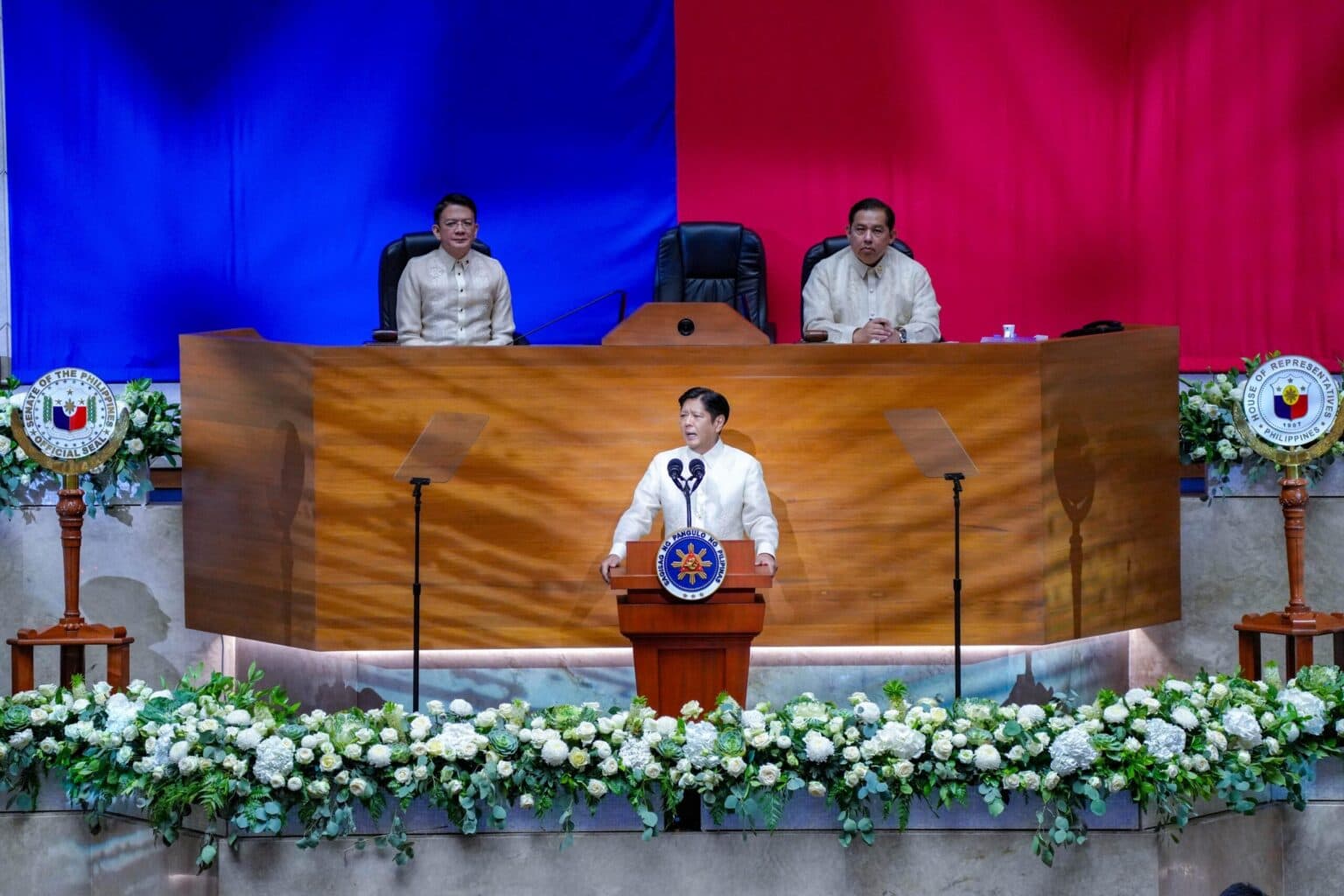
MANILA, Philippines — President Ferdinand Romualdez Marcos, Jr. formally gave his third State of the Nation Address, during which he tackled various issues and matters of interest to the nation at present, most notably staking the Philippines claim to the West Philippine Sea and banning POGOs or Philippine Offshore Gaming Operations, July 22.
At exactly 3:58 in the afternoon, in the audience of all members of Congress, military officers, and other high-profile government officials, House Speaker Martin Romualdez officially entered the 19th Congress into session. The session opened with the singing of the Philippine National Anthem by WCOPA champion Blessie Mae Alipopo Abagat and the praying of the Nation’s Prayer by select representatives of various religions.
President Marcos took his place atop the podium immediately after, and, at 4:04 p.m., began his 1 hour and 23 minute-long address, where he laid bare the current state of the nation, the progress of all the government’s projects and initiatives present, and the President’s envisaged future for the nation.
Agriculture
The president opened his address on the topic of agriculture, initially bringing focus to the topic of rice and the current state of farmers. Marcos outlined the many improvements and advancements made in this regard, with nearly 20 million tons of grain and 13 million tons of rice harvested in the past year. However, he also outlined the need for reform with regards to the current rate of farmgate prices, which serves to be a major obstacle in the government’s goal of attaining low market prices. This is in spite of the implementation of various policies and legislation in response to this, such as price ceilings on rice and extended reduction on tariff rates.
Marcos also focused on the significance of providing support to local agriculture workers, outlining the 100 billion pesos worth of feed given to farmworkers and the 500 million fingerlings and 3,000 boats given to fishermen in the past year, along with various technical and capital forms of assistance.
The presence of Kadiwa Centers will also be expanded throughout the country and will be made more frequently available to the public.
Irrigation has also been made more accessible throughout the nation, with over 45,000 hectares of land being targeted to be given irrigation access, along with the implementation of Malitubog-Maridagao Irrigation Project and the use of solar power pump irrigation systems in Isabela.
As a result of El Niño, the government has provided Crop Insurance to farmers, along with a transition to modern methods of farming to ensure a stable water supply.
Climate Change
Marcos also gave focus to the issues associated with climate change, highlighting our vulnerability to its repercussions given our geographical location and archipelagic landmass structure, and the resulting need for proactive measures.
In line with this, Marcos announced that the Philippines was given a seat on the Board of the Loss and Damage Fund, having been selected as a host nation for the fund, which will allow the nation to access the needed funds for climate initiatives and mitigation measures.
Besides this, the government has also started to build infrastructure to ensure safety during calamities, having built 100 evacuation centers, officially conducting operations of Disaster Response Centers, and the completion of nearly 5,500 flood control projects. The Kalinisan sa Bagong Pilipinas project was also started, where volunteers from each barangay were tasked to collect trash from flood-torn areas, resulting in nearly 50,000 tons of trash being collected as of January 2024.
Infrastructure and Research and Development
The significance of infrastructure was also given precedence, outlining its nature as the backbone of the various economic sectors of the nation and its role in helping the Philippines attain its goal of becoming an upper middle income economic target.
Power and Internet infrastructure were greatly enhanced and developed throughout the past years, with nearly 10 million unique user devices making use of the free internet services provided by the government. Phase 1 of the National Fiber Backbone project has been completed, with Phase 2 and Phase 3 being projected to be completed by 2026. Along with this, Common Towers will be used to provide full internet connectivity throughout the nation.
A National Cybersecurity Plan was also implemented as a part of the government’s initiative to improve upon its Information Technology sector.
Bringing light to the persisting issue of power outages and blackouts in the nation, Marcos discussed the various initiatives of the government aimed towards expanding access to electricity. These included the implementation of the Mariveles-Hermosa-San Jose Transmission Line in Luzon, Cebu-Negros-Panay Backbone Project in Central and Western Visayas, and Mindanao-Visayas Interconnection, which aim to ensure a steady supply of electricity throughout the nation and decrease the overall amount of cases of power outages.
Marcos also expressed the importance of providing fair electricity prices, with the implementation of an improved Lifeline Rate for all qualifying citizens, suspension of Fit All Tariffs, the Anti-Bill Shock Programs, and the proper allocation of refunds and removal of unnecessary fees.
Various roads and bridges across the nation have been upgraded and installed. Nearly 12,000 kilometers of roads and 1,200 bridges have been built, with 1,600 kilometers of roads and 367 bridges still to be constructed, which include the Plaridel Bypass, CALAX, and Panguil Bay Bridge, the longest spanning bridge in Mindanao.
In his speech, Marcos also discussed a “railway renaissance”, pointing towards the many developments and advancements made with regards to the nation’s railway infrastructure. A significant amount of progress has been evident for the Metro Manila Subway, MRT 7, and North-South Commuter Railway. The LRT 1 Line has also been extended to reach Bacoor and the PNR Bicol Line has been opened to service passengers from Naga to Legazpi.
The Manila Airport will be constructed to service 48 flight services per hour and accommodate over 62 million passengers per year. Other airports, such as the General Santos Airport and Bicol Airport, have also vastly expanded their passenger service capacities by 300% and 500% respectively.
Marcos also outlined the role of investments, both foreign and domestic, in providing funding and support for these projects, with Public-Private Partnerships serving as one of the primary sources of funding for the NAIA renovation project and the construction of the UP PGH Cancer Center.
Health
The president also provided insight as to the various measures taken upon by the administration in pursuit of furthering the healthcare system in the nation.
At the present, the government has already implemented over 20 Urgent Care and Ambulatory Service or UCAS Centers throughout the nation with the hopes of providing open access to immediate medical care. All provinces are also intended to be given Mobile Clinics to provide access to various medical services, such as Laboratory Exams.
Philhealth, the government-owned corporation aimed at providing universal healthcare benefits and services to Filipinos, has also vastly increased its benefits and coverage in response to the increasing cost of medical services and medications. This includes increasing the coverage of medicines for outpatient cases, from 21 to 53 medicines and doubling the benefits for those with critical illnesses, such as Stroke and Breast Cancer.
The significance of providing proper nutrition and protection from illness was also highlighted by Marcos, announcing the continuation of vaccination programs for infants, and the expansion of the Philippine Plan of Action for Nutrition and Walang Gutom 2027 programs, with the hopes of feeding over 1 million malnourished families.
Education
With studies revealing that half of Grade 6, Grade 10, and Grade 12 students failing to achieve proper proficiency in various fields of education, Marcos underscored the need for development with regards to the education sector.
Students and classrooms will be provided with proper digital devices, televisions, Internet, and Electricity with the hopes of bridging the digital gap. Textbooks will also be produced and published in a more swift manner, shortening the production time from 3 years to 1 year.
The significance of providing teachers with the proper compensation and treatment was also highlighted, with the provision of various benefits such as a Teaching Allowance, Personal Accident Assistance from GSIS, and a Special Hardship Allowance. A Career Progression System will also be put into place for teachers to pursue various career paths in education.
TVETs or Technical and Vocational Education Training will also be developed further to further boost employability, which will be through collaborations between DepED, CHED, DOLE, and TESDA.
Innovation, knowledge sharing, and research and development will also be given further precedence, through the Filipinnovation and Malikhain Pinoy programs, along with developments in the fields of I.T. and Artificial Intelligence. Scholarships and financial aid will also be made accessible to foster start-ups and further research and development.
Employment and Economic Status
Marcos also underlined the progress of the administration with regards to boosting employment rates and improving the labor force within the nation, along with the current state of the economy in various fields.
At the moment, the Philippines currently has a 95.9% employment rate, with a significant increase in middle-skilled employment and full time jobs. The economy has also reached its lowest underemployment rate since 2005, currently having only 9.9% of the population underemployed.
Many of the initiatives and policies recently implemented by the government have generated a vast amount of job opportunities and stimulated economic growth within the Philippines. Investment pledges will open opportunities for nearly 222,000 quality jobs, along with this, the CREATE Act has garnered nearly 1 trillion pesos worth of investment, which will be used to create nearly 100,000 jobs. Publicment Employment Service Offices or PESOs were seen to have a job placement success rate reaching nearly 98%. Reforms in capital markets and the implementation of green lanes are sought to bring in nearly 3 trillion pesos worth of investments.
Members of the 4Ps or Pantawid Pamilyang Pilipino Program have also consistently achieved its various targets and goals, with nearly 420,000 families graduating the program and several members attaining high marks on licensure examinations.
Along with this, the digitalization of government services was seen to have produced a “multiplier effect”, increasing revenues and making transactions more efficient.
Poverty rates were announced to have reached its lowest levels since 2018, currently standing at 15.5%.
GOCC or Government-Owned or Controlled Corporations have also generated dividends that have exceeded their past contributions in 2022.
Tourism and OFWs
In his address, Marcos delineated the significance of reviving the tourism industry. With a great number of Filipinos depending on this sector for income, the government has implemented numerous measures in order to attain this goal, in spite of the issues currently faced by the nation.
The administration seeks to implement a “multi-faceted strategy”, giving focus to “experiential tourism”. It aims to capitalize upon the One Town, One Product concept in boosting tourism and enhancing the overall experience of tourists.
Following this, the topic of Overseas Filipino Workers or OFWs was brought to light, more specifically with regards to the numerous contributions they have made, which have significantly contributed to the nation’s economy.
Marcos stated that OFWs have brought in nearly 37 billion Dollars worth of money into the nation, giving high praise and thanks to them for their service, stating “Hindi lamang pasasalamat, kundi parangal ang ating ipinapaabot sa lahat ng ating OFW”. (We wish to offer not only our thanks, but also our commendation to all our OFWs).
In line with this, the government has provided multiple benefits and services to OFWs, such as the OFW Lounge in the NAIA Airport, repatriation of nationals from Israel, Sudan, and Lebanon, and the provision of aid to Filipinos who have experienced calamities in their respective resident nations.
Crime Rates and Guerilla Fronts
“Peace and order is an essential ingredient of genuine prosperity and social development”, stated Marcos as he brought forth the significance of mitigating crime and providing security for all Filipinos.
With this, the president discussed the provision of capacity building training and asset upgrading for the military, police and navy. Along with this, this Republic Act 12009 ensurs modern and innovative government procurement of goods.
In line with this, guerilla fronts were reported to have been “severely weakened”, with only seven remaining groups that are yet to be tackled. Peace agreements and amnesty proclamations have also ensured that past combatants live peaceful lives, with some being integrated into the AFP and PNP.
Marcos garnered high praise for his crackdown on dangerous drugs, stating “Our bloodless war on dangerous drugs adheres and will continue to adhere to the established 8Es of an effective anti-illegal drug strategy. Extermination was never one of them”. With more than 71,500 operations, over 44 billion pesos worth of illegal substances and over 97,000 personalities arrested and a drug conviction rate of 79%. Along with this, “dirty money and assets” worth more than 500 million pesos have been frozen.
International Relationships and West Philippine Sea
Marcos gained his first of three standing ovations with his stern statement on the Philippines’ claim to the West Philippine Sea, saying “Ang West Philippine Sea ay hindi kathang-isip lamang, ito ay atin.” (The West Philippine Sea is not merely a figment of our imagination, it is ours.
With the recent escalation of tension on various military fronts such as the Ayungin Shoal, asserting the territorial rights of the Philippines through the same “fair and pacific way” was given extreme precedence, with the President explaining that diplomatic channels remain the only acceptable means of handling disputes. Besides this, the Philippines has continued to strengthen its defenses and its maritime and domain awareness through the fortification of its capabilities as a nation and its partnerships with other nations.
Garnering his second standing ovation was the President’s proclamation of gratitude for all the military personnel and fishermen who have remained steadfast in the face of the relentless attacks made by the Chinese in the West Philippine Sea.
The Ban on POGOs
With the recent controversies surrounding Philippine Offshore Gaming Operations or POGOs, most especially with the recent hearing of former Mayor Alice Leal Guo, Marcos brought to light the topic of POGOs, stating that their operations have begun to venture into “illicit areas”, which must be shut down immediately.
“Effective today, all POGOs are banned”, this announcement, arguably the most controversial and notable statement of the President’s address, was met with high praise from the entire Session Hall, with all members of Congress unanimously chanting the President’s initials of “BBM”. This proclamation formally set the stage for the crackdown of the PAGCOR on all POGOs across the country, with the administration targeting the eradication of all operations by the end of the year.
His Closing Statement
After nearly one and a half hours of discussion on topics ranging from the supply of rice to the ultimate shutdown of all POGOs across the nation, Marcos admitted that although these solutions aim to rectify many of the issues faced by the country at present, it will not be able to solve all of it.
To cap his address off, the President made a heartfelt appeal to all Filipinos, stating “Lagi po nating ipaglaban ang tama at ang mabuti. Lagi po nating mahalin ang Pilipinas. Lagi po nating mahalin ang Pilipino.” (Let us always fight for what is just and good. Let us always love the Philippines. Let us always love the Filipino).