Stranded No More: Choosing between IB vs Academic Tracks
By Riley Ti (10B)
|7 min read
Illustrated by: Jet Ng (10B)
Written By: Riley Ti (10B)
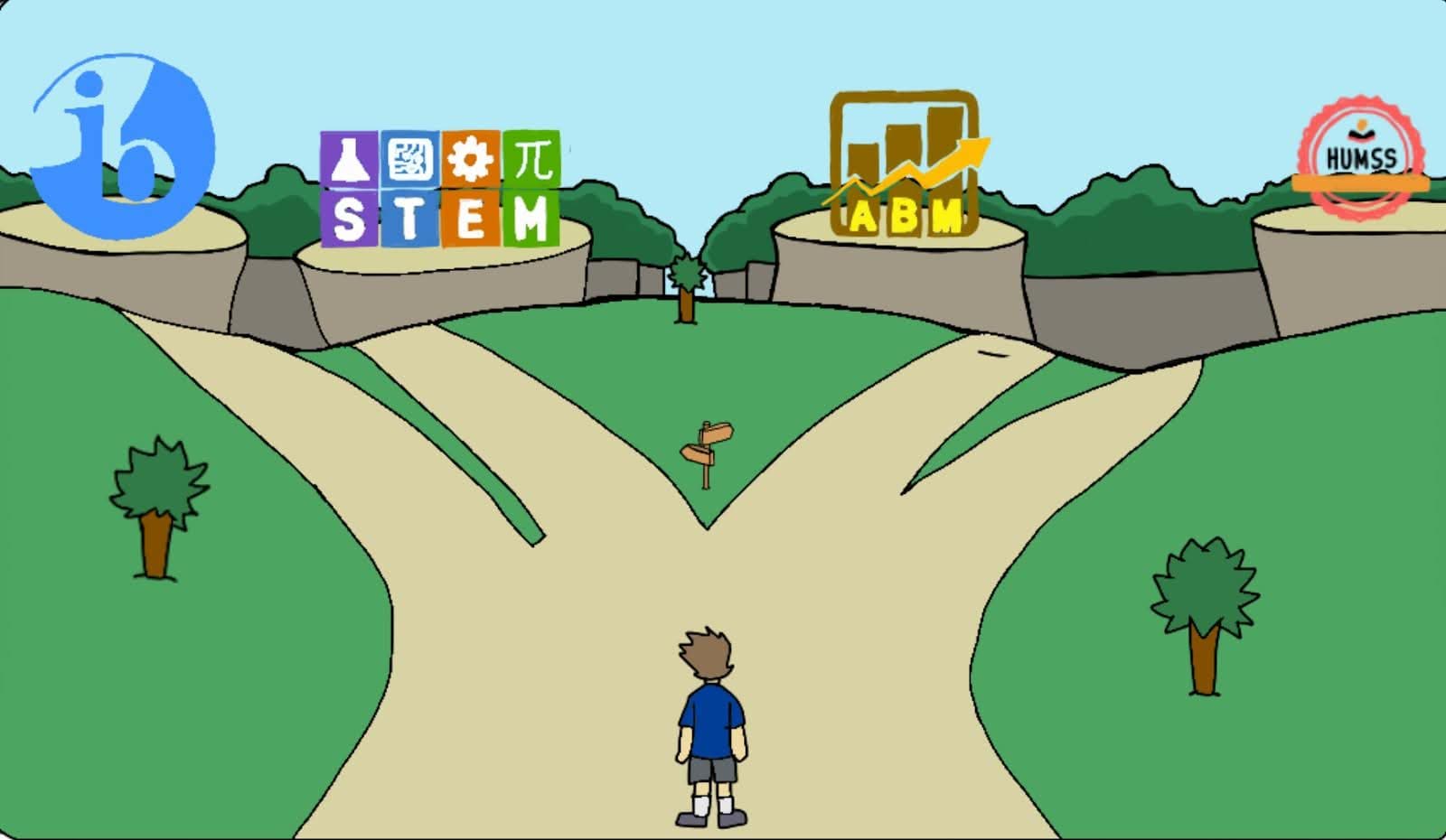
When entering senior high school, every Xaverian faces ‘The Choice’. For some, it’s a no-brainer. Those eyeing universities abroad often turn to the International Baccalaureate Baccalaureate Diploma Programme (IBDP) or simply the IB. Students with dreams of becoming engineers or doctors go for Science, Technology, Engineering, and Mathematics (STEM). The business-minded lean toward Accountancy and Business Management (ABM), while those drawn to people, culture, and social change find their place in Humanities and Social Sciences (HUMSS). But for many others, the choice isn’t as clear-cut. A large portion of the junior high population remains unsure of what they want to pursue and uncertain about the right path forward. We often hear debates about which strand is harder, more impressive, or more worthwhile. But is there really a ‘best’ option? In this article, we interviewed students from both the IB and academic tracks to understand the motivations behind their decisions. Their answers reveal that choosing a strand is more than just about academics, it’s also about personal goals, priorities, pressures, and practicality.
A Global Mindset: Why Some Students Choose IB
For some students, the IB program represents more than just academic rigor – it’s a gateway to global opportunities. A common thread among those who chose IB is the desire to study abroad and prepare for universities with international standards. “I chose the IB program because it gave me more flexibility and a wider set of opportunities to study abroad,” shared Kyle Chua-Unsu (XS ‘25), who is headed to the University of Pennsylvania (UPenn). “I was able to pick subjects that I was interested in and study them in depth over two years, such as Economics and Psychology.” He also reflected, “It is the people I journeyed alongside – my cohort mates and teachers – who made my experience very fulfilling and one that I certainly do not regret.”
Others echoed this global sentiment, emphasizing how IB’s structure helps develop a skill set that goes beyond memorization. Jayce Wong (G12) explained, “IB provides an easier path to studying abroad. It also prepares me better for college by developing necessary skills in research, time management, and critical thinking.” Gabriel Castañeda (G11) added, “I chose IB because I plan to study in Australia. I believe it will allow me to better prepare myself for the future, as many universities also recognize the program.”
The desire for academic challenge and personal growth also shaped many students’ choices. “I still felt undecided about what I wanted to pursue in the future… [but] by pushing myself towards my limits, I could grow personally and academically,” said Benedict Ng (XS ‘25), who will be attending Ateneo de Manila University. Marcus Castro (XS ‘25) shared, “The freedom of subject choice and academic rigor allowed me to develop my work ethic and be more flexible with college applications.” Still, not every student viewed rigor as the main appeal, as Alfonso Lee (G12) candidly remarked, “People say they choose IB for the ‘rigor,’ but that’s all a lie. We all just want to go abroad with higher chances to be accepted.”
For others, the decision was influenced by siblings. Another incoming Ateneo student Franco Vibar (XS ‘25) said, “I knew it would allow me to be more prepared for colleges with its rigorous nature… provide more opportunities when applying. Also, my sister was IB.” Ethan David Ang (G12) echoed this: “I wanted to study abroad like my brother who really inspired me to work hard and aim high.”
Despite its demanding workload, those who chose IB did so knowing it would stretch their limits and open doors. As Ethan further reflected, “Even if it may be time consuming, this program really trains you… pushing me to work hard and truly dedicate myself to studying.” Indeed, his older brother, Adrian Ang (XS ‘24), now an incoming sophomore at the University of California – Los Angeles (UCLA), attests to this, saying, “The IB prepared me… by developing a strong and consistent work ethic. Juggling internal assessments, the Extended Essay, Theory of Knowledge, and external exams all at once forced me to learn time management on a different level… IB taught me how to work under pressure while still producing quality output.”
These students show that IB is more than just an academic program, it’s a mindset. It represents ambition, resilience, and a readiness to go beyond the familiar in pursuit of growth.
Staying Grounded: Why Others Chose the Academic Track
While the IB program appeals to those seeking global flexibility, many students choose to stay within the academic tracks – STEM, ABM, HUMSS, or GAS (General Academic Strand) – not out of limitation but alignment. For them, the choice is less about prestige and more about career focus, personal balance and practicality.
Sean Chen (G12) chose STEM because it aligned directly with his long-term goal of becoming a doctor. “The reason is simple – STEM focuses on science, tech, and math, while IB is more broad and international. I chose STEM because it focuses more on the things I need to learn to become a doctor.” Joaquin Parreño (G12) shares the same sentiment, “I chose ABM because I plan to explore my capabilities in terms of business and economics. I don’t intend to apply for universities abroad, hence, I don’t see the need to enter IB.”
Others were driven by the need for balance and manageability. Madison Chua (XS\ ‘25) said, “I chose the standard track because I felt like I could more easily balance my school, extra-curricular activities (ECA), and personal lives. I specifically chose STEM because I believed it could help with engineering courses in college.” Matthew Ong (G12) agreed: “Although IB has its advantages, I felt that the rigor and difficulty of the program would be too much. STEM allowed me to not only focus on what I liked to learn but also to take part in ECAs.”
For students not planning to study abroad, IB’s workload was seen as excessive. Owen Ang (G12) shared, “I don’t have any plans on studying abroad, and so choosing STEM gave me the flexibility of an academically focused strand, allowing me to balance my ECAs and personal life – something I knew would be harder to manage with IB’s heavier workload.” John Jeremy Tan (G12) added, “My brother advised me that if you aren’t going to study abroad, IB is drastically more workload for not much additional benefit. I chose HUMSS because of my interest in History.” Ethan Bradley Ang (G12) has this to say: “We have a family business here and I want to help in it, so it would be better to stay. Plus, there have been students in non-IB strands who went abroad as well.”
A few students initially considered IB, only to realize it wasn’t the right fit. Bryner Liao (XS ‘25) said, “In Grade 10, I initially chose IB but switched to ABM. It wasn’t necessarily about difficulty – it just aligned better with my strengths, especially in leadership and student clubs.” Emilio Bernardino (G11) shared a similar journey: “I was looking forward to IB and even got accepted. But after consulting with both my parents and teachers, I dropped out and joined the ABM strand instead. My parents would like me to study here for my bachelor’s degree first.”
Even so, some students found ways to benefit from the IB curriculum without taking on the full diploma. By enrolling in IB Certificate subjects, they were able to challenge themselves in selected areas while avoiding the cost and pressure of the complete IB program. “IB is expensive… I’m just doing IB Certificate for History,” Sean added, showing how students can customize their learning based on future goals. Meanwhile, John Jeremy is taking the IB Certificate for Global Politics.
For these students, choosing an academic track was not a fallback – it was a deliberate choice rooted in practicality, priorities, and a clear sense of purpose. And for some, certificates offer the best of both worlds.
Your Strand, Your Journey
After hearing from students across both strands, one thing is clear: there’s no one-size fits-all choice. Whether it’s the globally focused IB program or the more targeted academic tracks, each path offers its own strengths and challenges. What matters most is choosing the option that aligns with your interests, goals, and the kind of high school experience you want to have. In the end, the best strand isn’t the most difficult or most popular, it’s the one that feels right for you. Don’t follow someone else’s path. Choose the one that makes sense for you.