<strong>Russia-Ukraine War Continues</strong>
By Karl Chua (12A)
|3 min read
By Karl Chua (12A)
How it All Began
Russian President Vladmir Putin announced in a televised address that Russia would be conducting a “special military operation” on Ukraine. Russian forces invaded the borders of Eastern Ukraine shortly after this announcement, signifying the official start of the Russo-Ukrainian war, Feb. 24.
The war can be traced to a series of events, i.e., the first significant move transpiring in February and March 2014. Russian forces invaded the Crimean Peninsula and seized its control in over a month’s time. Pro-Russian and anti-government seperatist groups arose concurrently within the region of Donbas, starting the War in Donbas, stirring unrest and armed conflicts within the region.
Following this was a buildup of the Russian military starting March 2021 in both the Russo-Ukrainian border and Belarus. Russia justified this was in line with their revised national security strategy that mentions its potential use of “forceful methods to unfriendly actions by foreign countries.”
Around February 17 to 21, 2022, small clashes between Russia and Ukraine took place, heightening tensions between the two nations. Such was exacerbated when the Russian government recognized the independence of Donetsk and Luhansk people’s republics in Donbas from February 21 to 23, and mobilized Russian troops within Donbas as a “peacekeeping mission.”
Status Quo
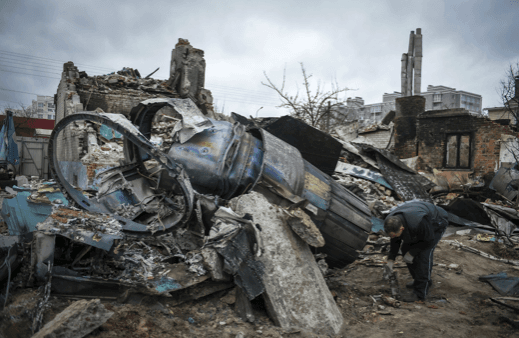
Ukrainian and Russian forces have been fighting ceaselessly with one another since the war’s commencement. Russia’s superior military strength resulted in the country acquiring approximately 20% of Ukraine’s territory.
The war has also led to one of the largest unanticipated refugee crises within Europe in decades, displacing over 13 million citizens and causing the migration of around 6.7 million to other countries.
Apart from this, both Ukraine and Russia have sustained thousands of casualties in military personnel and civilians.
Dozens of countries have also supported Ukraine in its endeavor to fight against Russia, contributing billions of dollars in terms of monetary assistance, military equipment and training, and humanitarian aid.
In the United Nations Security Council, Russian ambassadors continue to veto any draft resolutions that may support Ukraine in this war and have inhibited potential support from reaching the nation.
Implications
The conditions of the people of Ukraine worsen as the war rages on; living standards have plummeted, supplies have dwindled, and the people have continued to suffer.
The World Bank predicts that the Ukrainian economy could shrink by 45% this year as a result of the war. Immense funds are needed to keep Ukraine afloat in this fight, and much more are needed to reconstruct the nation and assist its people.
The war has also adversely affected the trade of crucial products. Oil prices worldwide also continue to spike following the imposition of oil embargos by the European Union on Russia — the formerly second largest exporter of oil. A global food shortage is also taking place as Russia is blocking Ukrainian sea ports, given Ukraine’s position as a large exporter of agricultural commodities prior to the war.
Sources:
Rappler. (n.d.). Live updates: Russia-Ukraine crisis. Rappler. https://www.rappler.com/world/europe/updates-russia-ukraine-crisis/
Al Jazeera. (n.d.). Russia-Ukraine War. Al Jazeera. https://www.aljazeera.com/tag/ukraine-russia-crisis/
Al Jazeera. (2022, August 24). Russia-Ukraine war: list of key events, day 182. Al Jazeera. https://www.aljazeera.com/news/2022/8/24/russia-ukraine-war-list-of-key-events-day-182
The New York Times. (n.d.). Russia-Ukraine war. The New York Times. https://www.nytimes.com/news-event/ukraine-russia
The Associated Press. (2021, June 1). Russia’s security strategy envisages ‘forceful methods’. ABC News. https://abcnews.go.com/International/wireStory/russias-security-strategy-envisages-forceful-methods-78002786
The Visual Journalism Team. (2022, August 24). Ukraine war in maps: tracking the Russian invasion after six months. BBC News. https://www.bbc.com/news/world-europe-60506682
Hayda, et al. (2022, August 24). 6 key numbers that reveal the staggering impact of Russia’s war in Ukraine. NPR. https://www.npr.org/2022/08/24/1119202240/ukraine-russia-war-by-numbers
Kiel Institute for the World Economy. (n.d.). Ukraine support tracker. Kiel Institute for World Economy. https://www.ifw-kiel.de/topics/war-against-ukraine/ukraine-support-tracker/
Strubenhoff, H. (2022, June 14). The war in Ukraine triggered a global food shortage. Brookings. https://www.brookings.edu/blog/future-development/2022/06/14/the-war-in-ukraine-triggered-a-global-food-shortage/