Tesla, Westinghouse, and Edison: War of the Currents
By Justin Sy
|4 min read
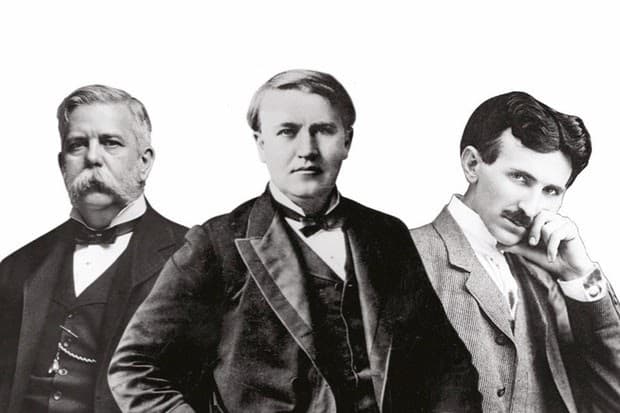
Well-acclaimed inventors, innovators and creative-thinkers are always thought of to be great men who think of the future and perceive a bigger picture for the world and its people. However, on the day of August 6, 1980, the horrid electrocution of a man was what became of a fight between three great men.
One of these men, who is sometimes described as America’s greatest inventor, is the controversial figure Thomas Edison. Known for his invention of the most practical and efficient incandescent light bulb at the time, he also invented the phonograph and the motion picture camera among the 1093 patents held in his name.
His main rivals in this tale were George Westinghouse and Nikola Tesla, two other greats who, combined, had over 500 patents. These two developed and marketed alternating current as the best form of electrical distribution—pitting them directly against Edison’s direct current.
During the period when light bulbs were relatively new, the public and the government officials were not exactly sure on how to operate these strange entities that can be equipped with systems that could power cities. Their decision would prove crucial in the future, with the usage of electricity becoming reliant on these electrical distribution systems. Safety, efficiency, and cost were major factors needing further judgment and research.
Edison’s direct current — current which ran in a single direction — was the standard in the initial years. Its crucial flaw, however, lay in its difficulty alternating between higher and lower voltages. Thus, alternating current was discovered and patented by his rivals. With the help of a transformer, it could easily alternate between different voltages, and was overall more cost-efficient.
It is interesting to note that Tesla already had an existing feud with Edison and shared a tumultuous employee-employer relationship. Prior to this issue, Tesla, a Serbian immigrant, came to work at Edison Machine Works in New York. According to Tesla, Edison once made a bet with him, saying that if he could succeed in improving Edison’s DC generators, he would receive $50,000.
After months of hard work, Tesla succeeded. But Edison refused to pay, saying “Tesla, you don’t understand our American humor.” Shortly after, Tesla left his company. Tesla’s suggestions regarding the use of alternating current were also ignored during his stay.
Westinghouse, who was a relatively private person who didn’t like pictures of him taken, immediately saw the potential in Tesla’s idea, and bought the patents for the alternating current system innovations Tesla made.
This led to what is famously known as the “war of the currents”. The three aggressively clashed, city by city. A lot of things were at stake, after all, including money and the desire to become the “better one”. To gain an advantage, Edison spread disinformation to the masses — specifically about how the alternating current system was a lot more dangerous. To further add to the furor, Topsy the elephant was publicly electrocuted by Edison to discredit both Tesla and Westinghouse. Edison even coined the electrocutions as being “Westinghoused.”
At the pinnacle of this issue the thought of electricity as a way to deliver death penalty was brought to the table, as it was thought to be swift opposed to the drawn-out norm of hanging. Edison ruthlessly took this opportunity to use Tesla and Westinghouse’s alternating current to create an infamous killing device – the electric chair.
Here, Edison’s brilliance shone in a different way, and with all the cogs in place, alternating current was portrayed as dangerous, with the reputations of his rivals all tarnished.
The first victim was William Kemmler, a drunkard who murdered his wife. Seventeen seconds after flipping the switch, physicians declared him dead. They were mistaken, however, revealed with the exclamation of “Great God, he is alive!” It took another four minutes of electrocution until the man died.
In his autopsy, some of his blood vessels were found to be carbonized and his brain hardened. Together with his stretched-out death, the results were grotesque.
“They could have done a better job with an ax,” Westinghouse remarked after the event.
In the end, Westinghouse and Tesla emerged victorious— AC was deemed the “best” in the eyes of the people. All of Edison’s efforts in discrediting the duo were for naught, and quality spoke for itself.
One contract in 1893 decisively and unofficially ended the war. The two victors ended up supplying and displaying the efficiency of alternating current to the world in the 1893 World Fair in Chicago, winning the contract to supply the fair against Edison.
To further cement their victory, the duo also supplied the hydro-electric power plant at Niagara Falls. Eventually, Edison revealed that he viewed alternating current as superior, and even in the present day, it continues to be used in nearly every single home.
However, these series of events do not completely define these three greats. Countless other discoveries and theories were still waiting to be found by the trio.
With all their achievements in mind, the hot-blooded rivalry between three of the greatest minds somewhat comfortingly showed how these greats can also succumb to human traits such as pride, envy, greed, and competitive spirit. Nevertheless, this seemingly petty battle led to a revolution of one of the most essential necessities and deserves much awe.
Image Source: https://www.historyextra.com/period/victorian/edison-westinghouse-tesla-real-history-behind-the-current-war-film/