The Lexus LFR is Here— Can it Live Up to the LFA?
By Alfonso Lee (12A)
|7 min read
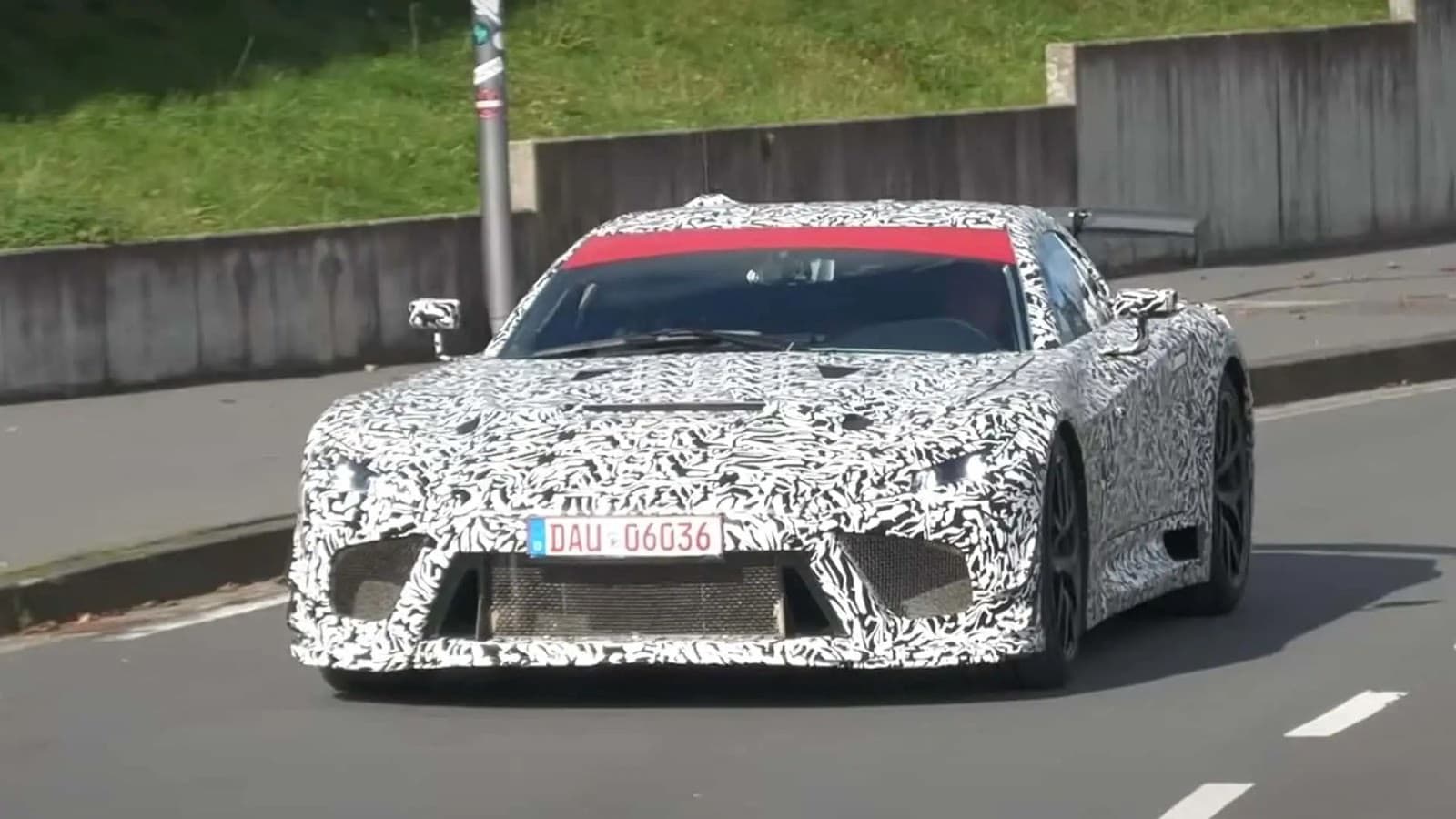
Photo Courtesy: Carspymedia
By: Alfonso Lee (12A)
Japanese automaker Toyota, under the luxury marque Lexus, is preparing to launch their new “halo car,” the Lexus LFR, for the 2027 model year. However, it has large shoes to fill, bridging the almost 15-year gap between its last flagship model, the LFA.
The LFR will replace the naturally aspirated (NA) V-10 of the LFA, instead opting for a Hybrid V-8, which some may call a downgrade.
While we don’t know every detail just yet, building upon the legacy and almost mythological status of the LFA will be a difficult task for Lexus, considering the LFA’s zero-to-hero story in the automotive industry.
Large expectations will be put on the LFR, but why? The LFA wasn’t ground-breaking for its time, even being considered a failure by reviewers at launch. With a steep price tag of $375,000 USD, excluding the Nürburgring Edition which was priced at $445,000 USD, nobody wanted to buy it— “Why buy an LFA when I can buy a Ferrari, a Lamborghini?” many asked.
Now valued at almost $900,000 USD according to Classic.com, the LFA cemented itself in automotive history. Characterized by its screaming naturally aspirated (NA) V-10 and an almost musical exhaust note produced by Yamaha (yes, the ones who make instruments, motorcycles, and Formula 1 engines in the late ‘80s to ‘90s…), the LFA became that car— the car you’d only get to own in video games. But why?
What Made the LFA so Special?
Born from the alcohol-induced conversations and drawings on table napkins in an Izakaya, inspired by Gordon Murray’s legendary McLaren F1, and forged for speed in the lush forests of Germany’s “Green Hell,” the Nürburgring Nordschleife, Toyota President and CEO Akio Toyoda, Chief Engineer Haruhiko Tanahashi, late Chief Test Driver Hiromu Naruse, and their team had one goal in mind: revive the Japanese supercar.
It was difficult to get the idea past the board of directors at Toyota, let alone give them the funding for such an ambitious project with no guarantee of a return on their investment. Everyone was against the idea of the LFA, then codenamed Project P280. It required a huge amount of resources that Toyota simply didn’t want to allocate to such a project. Why dump almost a billion dollars to develop one car when we could make God-knows-how-many Camrys?
However, with Toyoda’s support, the LFA project, a showcase of cutting-edge Japanese engineering rather than a business decision, had virtually an unlimited budget and pushed towards an aluminum-chassis prototype. It was a challenge for Toyota as they created everything in-house with no cost-cutting for the LFA. The engine created for the LFA, the 4.8 liter V-10 named 1LR-GUE, was an engineering masterpiece. Being the size of a V-8 but the weight of a V-6, dry sump lubrication, titanium alloy conrods, lightweight pistons, and incredibly tight tolerances, combining such features with an output of 550 horsepower and a redline of 9,000 RPM, it was one of the most powerful and advanced NA engines ever produced. They also called the help of Yamaha to make the 1LR-GUE sing, breathing a symphonic soul into a savage V-10.
A specially-designed digital dashboard had to be designed for the LFA. The 1LR-GUE revved to the redline in just half a second, so quick for anything at its time that an analog tachometer struggled to keep up.
Its prototype was revealed to the masses in January of 2005 at the Detroit Auto Show, originally called the LF-A, the dash being dropped later in 2009.
However, at the back of Tanahashi’s head, he could not betray the Kaizen spirit, or the philosophy of continuous improvement, and his dream of making a carbon fiber supercar. He only pursued an aluminum chassis out of fear, but he was finally pushed over the edge by Kazuo Okamoto, Toyota’s head of R&D. This delayed the LFA’s production for three years as Toyota’s Motomachi Plant had to create carbon fiber from scratch without any prior experience or knowledge.
Then, under the guidance of Hiromu Naruse, Toyota, under the newly formed “Toyota Gazoo Racing” name, entered fully-complete LFA prototypes into the 24 Hours of Nürburgring, with Akio Toyoda himself being one of the drivers of such prototypes.
The production version of the LFA was finally shown to the world at the Tokyo Motor Show in October of 2009, with Akio Toyoda revealing it himself. However, it had one problem. As beautiful as the LFA may have looked, as much as the spirit of Kaizen developed and perfected the LFA for nine years, two years prior at the 2007 rendition of the Tokyo Motor Show, Nissan revealed its newest iteration of “Godzilla,” the R-35 Nissan GT-R. Launching with 480 horsepower delivered to all four wheels via an all-wheel drive (AWD) system named ATTESA (Advanced Total Traction Engineering System for All-Terrain), and costing less than the LFA by more than $300,000 USD, why would anyone buy the LFA when Nissan had a similarly exciting car for a fifth of the price?
Sure, it didn’t have the bits and bobs, the exclusivity, the craftsmanship, the materials, the certificates, and the background of the LFA, but that didn’t matter to the eyes of the public. All they saw was a near-$400,000 USD Toyota.
As expected, the LFA struggled to sell. Collectors stayed away because of the Lexus badge and money-conscious consumers bought the GT-R. And tragically, on the 23rd of June 2010, Hiromu Naruse died in a head-on collision onto oncoming traffic while testing the LFA Nürburgring Edition. The accident happened in the municipality of Boos, which happened to be near the Nürburgring.
Over a year after the incident, Lexus, whether imbued by the spirit of Naruse or not, officially took on the Green Hell using the very car Naruse had developed into a race-capable machine. The LFA Nürburgring Edition held the fastest lap of any production car in the Nurburgring Nordschleife for its time, clocking in a lap time 7:14.64.
The LFA was only in production for three model years— 2011 to 2013, though it’s worth noting that it was in production from December 2010 to December 2012. And in that two-year production span, only 500 units were allotted to be produced.
But out of nowhere, years after LFA production ended, the value skyrocketed— people wanted the LFA. People realized that it wasn’t necessarily the speed they were buying, rather, it was the experience. Consumers would pay for the engine, the years of craftsmanship, the exclusivity, and the raw emotional experience created by the LFA.
The LFA was competing with heavy-hitters at reveal in 2009, like the Ferrari 458 Italia, the Audi R8, the Mercedes-Benz SLS AMG, the Aston Martin One-77, the McLaren MP4-12C, the Lamborghini Gallardo and Murciélago… all of them were “faster on paper.” But what they didn’t have was the very soul of the LFA’s unique character, a once-in-a-lifetime, meticulously developed NA V10 in collaboration with Yamaha, capable of revving from idle to redline in half-a-second, producing a note many described as closer to an F1 car than a road car.
Beyond the numbers and what executives considered as a financial and business failure of a car at the time, the LFA was hand-built with obsessive Japanese craftsmanship and the spirit of Kaizen, offering a raw, visceral driving experience that critics and enthusiasts called “soulful” in a way its rivals couldn’t replicate.
And the rest is history.
This was the Lexus LFA— How Can the LFR Live Up to it?
Car and Driver estimates the pricing of the LFR to be somewhere in the ballpark of $250,000-550,000 USD, which certainly follows the story of its older brother. But will Lexus follow those same footsteps?
An increase in horsepower is to be expected for the LFR, considering an almost decade-and-a-half of technological improvements in the automotive world, Lexus’ experience in racing series like Super GT, IMSA, and WEC, and the hybrid system.
It’s also fair to say that the LFR will be heavier than the LFA, as it now has a battery pack and electric motor accompanying its internal combustion engine. Retaining the same noise as the NA V-10 will also be a difficult task, especially if Lexus chooses to turbocharge the LFR or use an MGU-H-like system Formula 1 uses, where heat of the exhaust charges the battery, but the latter is unlikely.
From footage on the Nürburgring and the LFR showcase in the Goodwood Festival of Speed (although with a camouflage livery), the LFR will have a race-purpose version, keeping to the LFA’s racing DNA.
So, not only does the LFR carry the tale and heritage of the LFA, but carries an expectation that it will be better, faster, and simply more than what the LFA was.
The story, the people, and the scream behind the LFA will always be remembered. Can the LFR continue its legacy?
Sources:
Clifford, J. (2018, July 19). A closer look inside the Lexus LFA’s V10 – Lexus UK Magazine. Lexus UK Magazine. https://mag.lexus.co.uk/a-closer-look-inside-the-lfas-v10/
Fitzgerald, J. (2025, August 19). 2027 Lexus LFR Is a V-8 Hybrid Sports Car Worth Waiting For. Car And Driver. Retrieved August 21, 2025, from https://www.caranddriver.com/news/a65800793/2027-lexus-lfr-future-cars/
Lexus LFA Market – CLASSIC.COM. (n.d.). https://www.classic.com/m/lexus/lfa/
Padeanu, A. (2024, October 31). The Lexus LFR supercar sounds promising. Motor1.com. https://www.motor1.com/news/739375/lexus-lfr-supercar-spy-video/
THE SQUIDD. (2022, December 22). LFA: How Toyota Made a Supercar Unlike Anything Else [Video]. YouTube. Retrieved August 21, 2025, from https://youtu.be/sdVWKpqZaXg?si=NA0l52Rkx0tK8qvz
Wikipedia contributors. (2025, August 8). Lexus LFA. Wikipedia. https://en.wikipedia.org/wiki/Lexus_LFA#Production


