The Problem With COVID-19 Guidelines
By Joaquin Gabriel Malachi Antonio de Castro
|4 min read
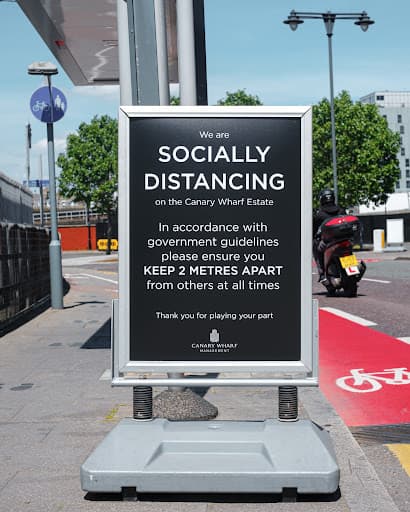
In the chaos and confusion stirred by the COVID-19 pandemic, individuals, institutions, and governments alike have turned to established authorities in public health such as World Health Organization (WHO) and Center for Disease Control and Prevention (CDC). The social distancing guidelines they have laid down have become dogmas that people and establishments follow faithfully. Supermarkets have placed markers on queue lines, and many public places have imposed occupancy restrictions based on these rules. Yet even these two authorities disagree on the minimal distance, with WHO and CDC recommending 1 meter (3.28 feet) and 6 feet (1.83 meters) respectively. Fortunately, studies on the physics and epidemiology of the virus can provide insight into creating better measures to curb its spread.
In an interview on the show ‘Startup to Storefront,’ MIT Professor of Chemical Engineering Martin Bazant said that the repercussions of blindly trusting in COVID-19 guidelines is what pushed him to research the physics behind it. Despite these guidelines being enforced by reputable organizations, he claims there is “limited scientific justification” for them, and that they may even give people a “false sense of security.” While these rules are simple and convenient to follow, the problem at hand is much more nuanced.
1 meter, 6 feet, 15 minutes: none of these magic numbers that we hear all too often are guaranteed to prevent transmission. This is precisely because they only control one variable. Obviously, each situation will differ in occupancy, humidity, and ventilation (among other parameters). Professor Bazant highlights that taking into account how these variables interact physically and mathematically is key to creating a universal guideline against COVID-19.
In his MITx course ‘Physics of COVID-19 Transmission,’ Professor Bazant analyzes these factors and how they contribute to the indoor spreading of disease. While the formula he presents as a safety guideline for COVID-19 can be technical and intimidating, it can be interpreted as a relatively simple graph:
The blue line on the graph represents the maximum occupancy for a given time. This limit clearly decreases as the time spent with other occupants (exposure time) increases. If together only for a very short period of time, large groups of people are less of a concern. But when exposed to each other for a long time, even a small group can be at high risk.
But what is this dynamic between occupancy and time? Bazant’s graph actually puts a bound on the conditional probability of a transmission given one infector in a room. The important part is that it takes into account the cumulative exposure time. This is just the product of the occupancy (minus the one infector) and the time the infector spent in the room. The graph therefore takes into account both variables instead of bounding just one.
Bazant’s graph shows the concern with simple restrictions that bound a single variable. To better illustrate the problem, a green line representing a guideline that only limits occupation is placed:
For short times, the occupancy limit guideline is visibly well within the safe area, and is too conservative. Situations with shorter exposure times can safely accommodate a higher number of people than the occupancy limit suggests. It’s true that more occupants would increase the cumulative exposure time. But in terms of risk, it may be just as safe as having less people but more time exposed.
Conversely, for large exposure times, the guideline is well outside of the blue line. This means that the guideline limiting occupancy would be too risky for large exposure times.
Similar to the first graph, the following would represent limiting time:
This rule would be too conservative for a small number of people, and too risky for large crowds. For smaller groups, the occupants can afford to stay inside the space for longer than the time restriction. On the other hand, large enough groups would be at a higher risk even when following the restriction. Going back to cumulative exposure time, more occupants would mean a higher chance of transmission to any one of them.
It’s easy to understand why risky guidelines are an issue, but what’s wrong with measures that are overly safe? At the level of an individual, nothing should prevent someone from being extremely cautious – it is a pandemic after all. Although, it is also important to consider the operations of many businesses and schools, which have either been stopped or heavily compromised. While more extreme measures are sometimes necessary, applying a more accurate tolerance for cumulative exposure time greatly helps maximize operations and minimize losses.
Occupancy and exposure time aren’t the only factors at play either. As mentioned, ventilation, room area, breathing activity, and others can all play a role. In essence, even recognized regulations such as the six-foot rule are not the most effective in curbing transmission for all spaces, where a lot more than one factor are at play.
The point of all of this is not to create a new universal guideline. Doing so would contradict all that’s been said. Instead, managers of office spaces, schools, nursing homes, and other indoor spaces should take into account the different factors mentioned in order to set proper limits catered to their situation. Thankfully, this doesn’t even require any heavy math. Prof. Bazant and fellow MIT professor John Bush have created a website that automatically calculates the maximum time or occupancy given all these different variables. The website can be found here.
Ultimately, creating effective guidelines to help ease the pandemic, while maximizing operations, requires appreciating, or at least respecting, the epidemiological complexities of disease spreading. As a final note, Professor Bazant reminds us that the message of the MIT study is “not to be less careful but more careful.”


