Track and Field in a Nutshell
By Gavin Chua (8D)
|9 min read
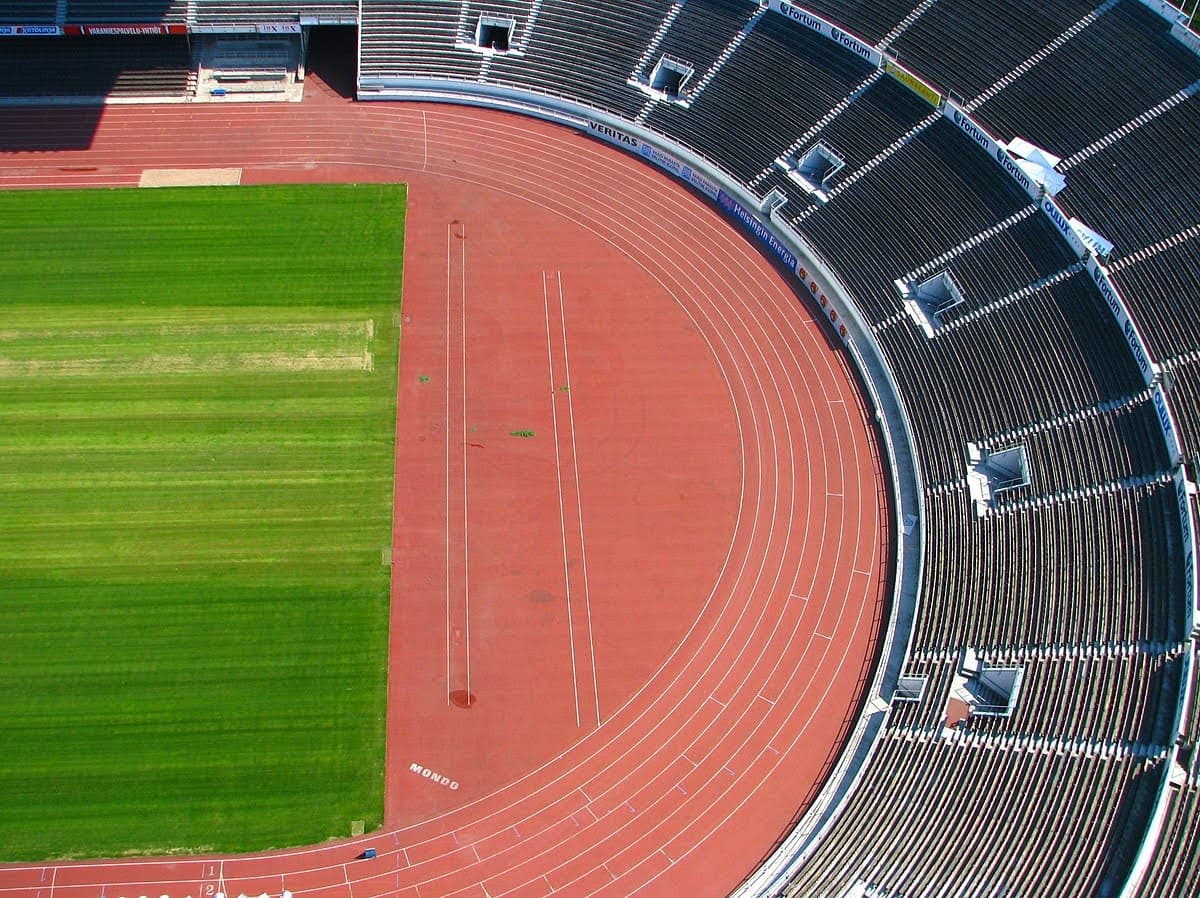
Photo Credits: Eija, https://commons.wikimedia.org/wiki/File:Track_and_field_stadium.jpg
By Gavin Chua (8D)
The world of sports is a dazzling, entertaining, and fun realm. Unfortunately, some sports just shine brighter than others. Track and field is one of these sports that are overshadowed by the popularity of others.
In my opinion, track and field is a very underrated sport. People may know a little bit about it, but not every event. This is a shame as every event is unique in its own way and can appeal to different people. Some might enjoy the fast paced action of the sprinting events or the drawn out races in long distance and many more. Due to this lack of knowledge, I am giving my opinionated overview on every event in Track and Field from my experience as an athlete in that sport.
100m
Probably one of the more iconic track events due to Usain Bolt, but just know that you’ll literally never be like him. Never. The best part of a 100m is that you don’t really get tired at the end, but the worst part is seeing some guy pacing in front of you while you’re already going all out but you can’t seem to catch up to him. Then that random person starts to move slowly away from you but you can’t do anything to catch up.
200m
This event is for people who can’t decide between the sadness of the 100m and the suffering of the 400m. This is because it has a bit of both worlds. People who run this event are not fast enough for the 100m but you don’t have enough stamina to do a good 400m. This event is also the most fun to run in my opinion as it’s more forgiving if you have a slow start.
400m
Imagine walking down the street. Except the street is on fire, you’re on fire, everything is on fire. This is what it feels like to run a 400m. You start off strong and push hard to the first 200m feeling good, you slow down a bit to start pacing at 250m but then a wave of fatigue strikes you. Suddenly you don’t feel like running anymore and you just want to curl up into a ball and die a peaceful death.
Unfortunately, the 400m is unmerciful, and as you and your competitors suffer together you make it to the final 100m. At this point all the people in the bleachers are screaming “YEAH, YEAH, YEAH” but in your mind you’re shouting “AAAAAAAAAAAAAAAAHHH”. You start praying for the literal hand of God to push you to the finish line. So, yeah, 400m is kinda fun I guess.
800m
Not as bad as 400m and in the end it’s pretty chill… if you hate your legs. 800m sucks in a different way from 400m because first of all it’s double the distance but you need to run only slightly slower. This means that you start praying much earlier and you need to suffer for much longer. Fortunately, the amount of suffering is lessened but prolonged. So if the 400m is a shotgun then this is a machine gun in terms of damage to your body.
1500m
One of the more fun events to run because you’re not suffering as much and you’re conscious enough to understand what you are doing and make corrections to your form. This event is the last middle distance event so it tends to have many people running it. Because of the number of people doing this event who are actually good, it is extremely difficult to medal.
3km
The first of the long distance events and in my opinion, probably the best. The suffering induced by this event is comparable to that of the 1500m but a new rule applies to this event. If you are lapped by another runner, you are immediately disqualified.
This makes this event surprisingly entertaining and exciting to watch due to seeing slower runners giving everything they have to stay in the race, while the leading runners slowly but surely catch up to them.
5km
The dear old 5km. Memorable for most runners because it is usually found in fun runs and fun runs are what started me on track and field. Unfortunately, all the fun times with a 5k ends when you make the decision of running it as your event. The same rule that applies to the 3km applies to this one (if you get lapped you are disqualified), but due to the longer distance, much more people get disqualified.
There was this one occasion where a runner during the NCR regional meet that started sprinting when the 5km started. While I was watching I was really confused as he already started to burn out before he could finish his first lap. I watched him intently as he started getting passed by other runners that were pacing, and by the time the race was almost finished, the leading runners were catching up behind him and he was about to be lapped.
I could see him turn and look back as he was lapped. It might seem funny but what can you really do when your opponents are basically machines that have infinite stamina.
Hurdles
This event seems good and pretty cool and it is. But what most people don’t understand is that the hurdles are really high. The first time I did this event I tripped on the first hurdle in front of the bleachers (I still got a silver medal) because I was not used to the height, I heard the people go “ooooooh” when I fell.
There are two hurdles events: the 110m and the 400m. 110m is an odd number to run but the extra ten meters is really needed for momentum to jump over all 10 hurdles in such a short distance. The 400m hurdles is just a worse version of the 400m (which you know how much it sucks to run already) because of the 10 hurdles you need to jump over, but the hurdles in this event are much lower than in 110m hurdles.
This doesn’t stop the 400m hurdles from showing you a glimpse of the afterlife as you barely pass the finish line. This event is so extremely specialized that you need to count how many steps you are doing between hurdles to optimize your speed.
Steeplechase
I have not met one single person who is not on track and knows what this event is. This event is the long distance version of hurdles, where the hurdles are much less in number but much higher in height. The interesting part being that runners can get over the steeplechase in any way.
For example, you can vault over it, jump over it, step on and off it, etc. Due to this, you can clearly see who is an experienced runner (they tend to jump over it) and who just got put in that event because they are bad at everything else (they use their hands to get over).
Racewalking
This is a weird, (so weird that I had to do research about what kind of person would intentionally create an event that goes against the nature of the human body) but very difficult event came from pedestrianism from the 17th and 18th century. It originated from footmen walking beside their master’s coaches.
This event is probably the most technical out of all the track events. Simply trying to do the motion of racewalking is hard enough (I can’t do it past 50m, it’s unnatural in my opinion), but doing it for prolonged periods of time at the speed of a fast jog is incredibly impressive. Judges are also spread out across the track to observe the form of the walkers, you are allowed two form breaks and you are eliminated on the third.
Professional racewalkers can walk faster than some people can sprint. Now envision someone running away from a bear by racewalking.
Discus, Shotput, Hammer and Javelin
Severely underrated and it should be provided more in schools. Unfortunately they’re not popular enough to garner the attention that it needs in order to establish itself as a staple event, but that doesn’t mean that people don’t care about them (I care). This event takes a lot of dedication as competitors must put on a lot of mass to generate centrifugal force to throw the projectile far.
Fun fact: Xavier used to have discus and shotput when the track varsity was first created but they lost it eventually, which is sad because it is a missed opportunity for people who might be good at the event or for people who find it interesting as a sport.
Pole Vault
This event might be on par with racewalking in terms of technicality, but it is way more dangerous. Unlike other events, making a mistake in the pole vault is more likely to result in injury or even death. You could get injured if you clear the bar wrong, the pole hits you on the way down (there are many videos on the internet depicting the bar hitting a male vaulter’s jewels on the way down), you don’t jump properly or if you land in the metal jump box.
I don’t know how to even hurl myself over the bar, the physics just doesn’t click for me. This is also the one event that I will never personally try, it’s way too intimidating so I’ll stick to running the 200m and the 400m. A popular pole vaulter from the Philippines is E.J. Obiena (whom I met in person and whom I high fived).
Jumps
Like the 200m, these events are more fun in my opinion. First of the jumping events there is long jump, this is the simplest and easiest of the three as it simply requires that a competitor must run and jump. Second is high jump, this event is a polar opposite to long jump.
For example, jumping forward versus over a bar, running straight versus running in a curved line. Also, when a high jumper clears the bar they do a maneuver called the fosbury flop, which makes them look like a fish out of water.
Finally there is the triple jump. This event is basically the younger brother of long jump that is doing everything in its power to try to be different. Instead of them jumping, they run, hop, hop then jump. It’s a long jump with extra steps, literally.
Relay
This event consists of four runners that pass a baton to the next runner until all four are finished. Aside from having to be fast, relay teams need to practice the pass to avoid dropping it. Unfortunately, no one is safe from dropping the baton.
During a time trial during a PATAFA (Philippine Athletics Track and Field Association) meet, the national team dropped the baton on the third runner (I saw this with my own eyes).
There are two relay events: 4x100m and 4x400m. 4x100m puts a lot of emphasis on the passing as teams need to minimize the time as much as possible. This is in contrast to 4x400m as by the time the runner is almost done with the 400m, they have already felt horrors beyond your imagination bestowed upon them through the eternal suffering of a 400m, they just hand the baton to the next runner and pass along the suffering.
This event is a fun way to break friendships within your team especially when you start comparing the times of your splits or if someone drops the baton.
In conclusion, track and field is a sport that appeals to every type of audience, except people who don’t like sports. Each event has its own specialty and unique quirks that set them apart from the others. Hopefully, after reading this fully, you might be able to find an event that you personally find interesting and research on it. So, let’s be open minded. The world of sports is a big one but don’t let it distract you from hidden gems like this.
Sources
Race Walk: History, Types, Objective, & Equipment – Sportsmatik. (n.d.). Sportsmatik. https://sportsmatik.com/sports/race-walk/about