Trump Puts Tariffs on Canada Over Wildfire Smoke – Are They Justified? And a Better Path to Take
By Ziv Keh (12F)
|5 min read
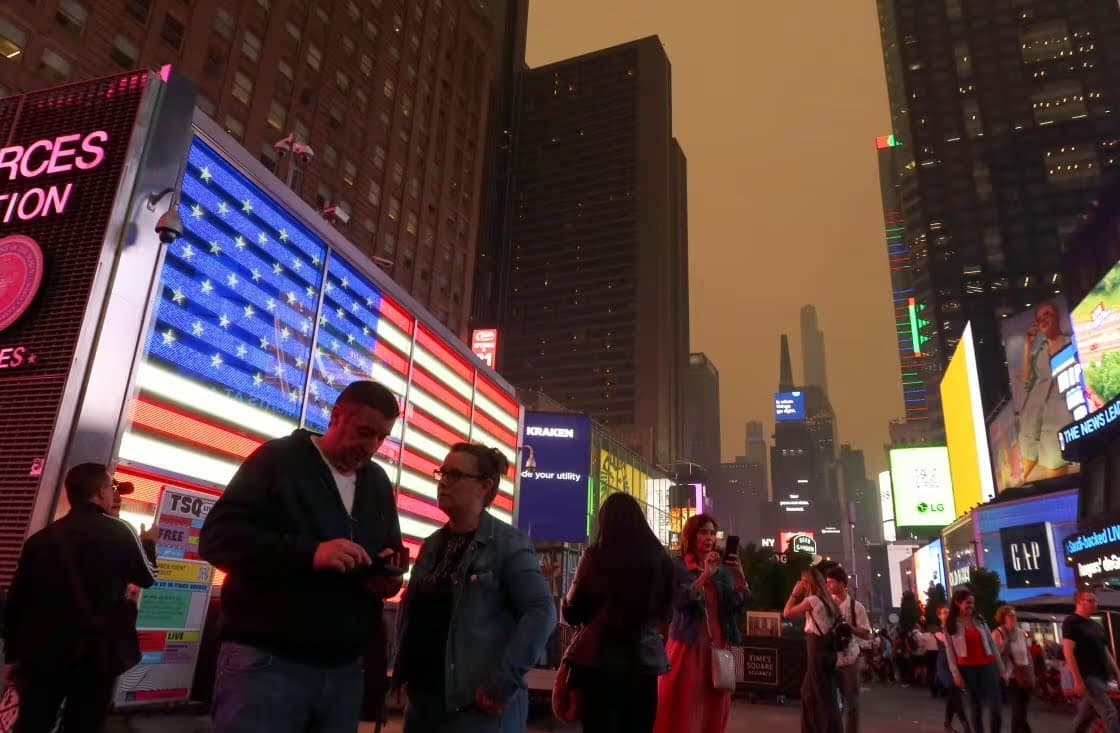
Wildfire haze over New York.
Photo credits: Gary Hershorn / Getty Images
By: Ziv Keh – 12F
WASHINGTON, DC – US President Donald Trump has threatened to place new tariffs on Canada after hundreds of raging wildfires have left much of the northern US covered in smoke, July 19.
What’s the Issue?
As of July 18, 2026, there were about 955 wildfires burning in Canada, with “the majority of said fires burning out of control”, according to the Canadian Wildland Fire Information System. Most of these active wildfires are located in northwestern Ontario and have “triggered air quality warnings for states close to the Great Lakes.”
In a social media post, Trump wrote that the US government was “holding Canada responsible for the fact that they are not properly maintaining their Forests, and Brush,” arguing that the wildfire smoke was “unnecessarily invading” American airspace.
He also continued to call it “willful negligence,” stating that it had “cost the United States billions of dollars,” and said that he intended to call Canadian Prime Minister Mark Carney to discuss the situation, which he described as “totally unacceptable.”
The smoke from the wildfires has blanketed major cities across the northern United States, primarily in the Great Lakes region as well as New England and as far south as Maryland. Air quality has plummeted in 20 US states as a result of the wildfires.

Smoke from Canadian wildfires has covered DC in a blanket of haze. J. Scott Applewhite/AP.
Are the Tariffs Justified?
Experts have stated that the cause of these wildfires is likely due to climate change. An Associated Press article by Seth Borenstein states that a recent study revealed that human-caused climate change made the weather conditions that sparked the fires highly likely. Borenstein noted that the findings reflect “a world where hotter and drier conditions are making fires burn more often and more intensely.”
Journalists and scientists alike have pointed out the irony of Trump’s actions. The study’s authors highlighted the United States’ “huge historical emissions of heat-trapping gases” as a major cause of global warming.
Writing for the Guardian, Oliver Milman also emphasized that elevated temperatures “more than doubled the likelihood of severe fire conditions” when Canada was most recently engulfed by large wildfires back in 2023. Milman has noted that the burning of fossil fuels is only accelerating global warming, which is what is more likely to be the cause of the fires.
Marshall Burke, an environmental policy expert at Stanford University, has stated that the main cause of these fires is “a warming climate that has made large and extreme wildfires more common”, not “mismanagement” like Trump accused Canada of. Burke noted that most Canadian forests are “remote and not managed at all, unlike the US,” therefore making Trump’s claims both false and unjustified.

Aerial firefighting using Super Scoopers like this one is often the only way to combat large wildfires in remote areas. Photo credit: AerialFire
A Better Path to Take?
Looking at the situation, Trump’s actions appear to be completely unfair. Blaming a longtime ally over something that is entirely natural is utterly unjustified, especially when studies show that the United States itself has also in a way contributed to the conditions that sparked the fires in the first place. Treating the smoke as a hostile “invasion” when it is simply natural flow of air simply does not work.
A better solution, and one that has been proposed by many experts, is international cooperation between the two countries. Although many have suggested that they cooperate, few have created a concrete blueprint on how they should do it. As previously mentioned, many Canadian forests are very remote and have no road access. This means the only way to contain these fires is through aerial firefighting. Fortunately, both countries already field large numbers of aerial firefighting equipment, meaning they already possess the resources they need to work together in order to contain the massive fires.
The most actionable way forward, given the existing conditions and resources, is to integrate both countries’ fleets into a unified aerial firefighting force. Many provincial governments maintain their own fleets of Super Scoopers—amphibious aircraft capable of scooping thousands of gallons of water in seconds—which are used to fight these fires. However, these fires cannot be contained using water alone. Wildland firefighters also use chemical fire retardants dropped from larger land-based tanker aircraft to create fire lines and prevent the fire from spreading.

Land-based tanker aircraft like this Boeing 737 are used to drop fire retardant. Photo credit: Coulson Aviation.
Both countries possess large amounts of commercial air tankers owned by companies such as Coulson Aviation and Conair, which specialize in operating these types of aircraft and routinely provide aerial firefighting services to clients across the world. The US Air Force also operates specialized aircraft equipped with a self-contained unit called the Modular Airborne Firefighting System (MAFFS) for this purpose. These tankers can be used for long-term containment while Canadian Super Scoopers provide direct attack on the fires. By pooling together, both nations can more effectively contain the fires and thus solve the pollution problem that has threatened the air quality of major US cities. If we want to protect citizens’ health and clean up the air, we cannot keep on fighting each other—we must work together to fight these fires as one unified front.
Sources
Yousif, N. (2026, July 18). Trump threatens new Canada tariffs over wildfire smoke in US cities. https://www.bbc.com/news/articles/cwyq93j34lgo
Major, D., & Zimonjic, P. (2026, July 18). Trump threatens increased tariffs for wildfire smoke that has ‘unnecessarily invaded’ U.S. CBC. https://www.cbc.ca/news/politics/us-complaints-trump-widlfire-smoke-9.7274466
Betts, A. (2026, July 16). Air quality plummets in 20 US states as smoke from Canadian wildfires spreads. The Guardian. https://www.theguardian.com/us-news/2026/jul/16/smoke-canadian-wildfires-air-quality
Borenstein, S. (2026, August 6). Trump blames Canada for fires but experts point to climate change | AP News. AP News. https://apnews.com/article/canada-wildfires-trump-climate-change-mismanagement-99389ce431e3f4c8821218e2134d6ada
Milman, O. (2026, July 24). Scientists decry Trump’s ‘blame game’ after he claims Canada ‘poisoning’ US air. The Guardian. https://www.theguardian.com/us-news/2026/jul/24/trump-canada-wildfires-smoke-scientists