A Show of Oppressive Power and the Failure of Education: Russia Bans the International Baccalaureate
By Zion Alvior (11G) and Dart Mariquit (11H)
|5 min read
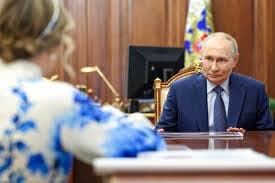
Photo credits: Gavriil Grigorov / POOL / AFP
By: Zion Alvior (11G) and Dart Mariquit (11H)
The Russian Federation has recently banned the International Baccalaureate over its promotion of anti-Russian propaganda, calling it “undesirable”. This article seeks to show the flaws in their argument and possible consequences if this decision is not reversed. This recent news can also draw parallels and attention to what is happening in our country.
What is the IB?
For those unaware, the IB or International Baccalaureate is a Swiss-based international program that focuses on developing well-rounded students and important skills to help them deal with the ever-changing real world. Their main goal is to develop inquiring, knowledgeable and caring people who can help create change in the real world. In addition, it is a highly rigorous educational program also offered here at Xavier for Senior High School students. For Russian students, this is an opportunity for them to be exposed to other cultures and be more open-minded; allowing them to create better decisions and be more prepared on a more global standard.
Why did the Russian Federation ban the IB?
Russia believes that the goal of the IB is to shape the youth in accordance to Western values, breaking their impartiality in teaching and allegedly changing their curriculum to promote an Anti-Russian stance. The Prosecutor General has said that the IB has included its own interpretation of history, changing facts and inciting hate.
Problems with their statement
Since the IB is headquartered in Switzerland, its neutrality and impartiality in foreign affairs are heavily observed. This means that the organization approaches situations objectively without following the viewpoints of any particular country or region. For example, when the IB condemned Russia’s actions in Ukraine, it did so based on its own decision as an organization rather than following the criticisms from countries like the US.
In addition to this, the IB adjusts to the history and culture of the other partner countries, helping the youth understand their culture and allowing them to develop in the context of their country. For example, in Xavier, the IB curriculum offers Filipino and Chinese, the predominant languages in our school, showing its flexibility to different schools, values and curriculums. This means that the IB does not have any malicious intent when it changes their curriculum, regardless of the situation of the country, and simply wants to further student growth. If encouraging students to become critical thinkers is labeled as “Western,” then Russia’s ban clearly reveals an intent to indoctrinate their youth with government propaganda; suppressing independent ideas and replacing them with official narratives.
Why banning the IB is not ideal
Banning the IB prevents the youth from developing their critical thinking skills and preparing them for the future. The growth of the youth will be significantly hindered due to the lack of academic rigor. Education solely controlled by the state can be influenced by extremist ideologies which further prevents open-mindedness and awareness of what is happening globally.
The IB for Russians is one of the only connections to the foreign world, in place of state-controlled media and education. This means that by removing this, Russia will be further isolated from the world and students could become a hivemind from only consuming what their authoritarian government gives them, hindering the development of students and leaving them unprepared for what happens globally. The lack of awareness for these global challenges and the sugarcoating of their own nation could result in very dangerous and hypernationalistic ideals.
How does this affect us?
Even if this does not affect the Philippines, the issues faced by Russia can also be related to the Philippines as our standards of education are severely lacking due to our government. Even if some schools have the IB, our public schools are lacking in funding and a quality education system which results in our youth not developing skills such as creativity and critical thinking. This issue is similar to the situation in Russia because our government fails to implement the proper academic standards and goals in an already difficult academic environment.
This not only wastes students’ time by hindering their productivity, but also adds on to possible issues for the students such as weather conditions, lack of school materials, very long and tiring school hours, underpaid teachers and a lack of schools in remote areas, making the learning experience even more difficult and inefficient. All these issues stem from the mismanagement of our education department and funding due to corruption. The effects of this mismanagement is seen in our PISA scores, where our country placed among the lowest in creativity among other basic subjects such as math and science.
Just to make things clear, the reasons why education is failing in both of these states are very different; with Russia being a direct oppressive action and the Philippines being a lack of action and a cohesive system. But ultimately, the issues and consequences of the governments’ irresponsibilities are similar; greatly impacting the youth and their education.
We can see from this that government officials that we put in office will directly have an impact on our actions so we must ensure that the right people get in. If we don’t, the people in power will either mismanage or outright suppress our rights to a proper education and regress the development of our youth, making them unprepared for the real world.
At this point in time, we are assured that the banning of the IB could prove detrimental to Russian society, causing critical thinking to be further suppressed. This show of counterintuitive force by the Russian Federation is simply unwarranted and unreasonable which shows how the isolation from “Western ideals” such as freedom of thinking is becoming more pronounced in dictatorial countries such as Russia. In addition to this, this lack of proper education is not only in Russia but in the Philippines as well, needing immediate action to counteract this. In which, this unwarranted violation of our educational rights should be something we stand against.
Sources
Chi, C. (2024, June 19). Philippines ranks at the bottom of new PISA test on creative thinking. Philstar.com. https://www.philstar.com/headlines/2024/06/19/2364001/philippines-ranks-bottom-new-pisa-test-creative-thinking
International Baccalaureate Organization. (2025). About the International Baccalaureate (IB). https://www.ibo.org/about-the-ib/
International Baccalaureate Organization. (2025, August 26). International Baccalaureate statement on the decision by Russian authorities. International Baccalaureate. https://www.ibo.org/news/news-about-the-ib/international-baccalaureate-statement-on-the-decision-by-russian-authorities/
Reyes, D. (2025, May 9). Education still underfunded in 2026 budget, says group. Inquirer News. https://newsinfo.inquirer.net/2099489/education-still-underfunded-in-2026-budget-says-group
Servettaz, E. (2025, September 9). Russia bans International Baccalaureate over ‘Russophobia.’ SWI swissinfo.ch. https://www.swissinfo.ch/eng/foreign-affairs/russian-prosecutor-generals-office/89915460
The Moscow Times. (2025, September 11). Russia Bans Educational Nonprofit international baccalaureate. The Moscow Times. https://www.themoscowtimes.com/2025/08/25/russia-bans-educational-nonprofit-international-baccalaureate-a90346