All For One, One For All: On Federalism
By Jose Franco Castillo
|8 min read
In the circus that is Philippine politics, nothing much seems to happen except within the big top. Outside it lies the dismal sideshows, with only a few attendants stationed here and there, increasingly abandoned as millions flock to the blazing central tent. Within that lively hippodrome, however, chaos is the status quo. A slight overstatement to be fair, but you get my point.
The problems, in packs, trample and crash into the audience, escaping through the exits. Like a parade of clowns—and clowns they often are—our elected performers rush to tame the wild beasts, or at least try to, before deciding instead to reserve their energies to shouting, “The problems are being attended to!” as they gorge themselves upon the popcorn and candied apples strewn about in the chaos. President Ringmaster flicks his whip and shouts for order, bringing some to sense, yet ultimately to no avail, as the animals rampage across the desolation beyond.
Such is life in le Cirque du Philippines.
Ever since our de jure independence from the United States on the 4th of July, 1946, the Republic of the Philippines has for the most part followed a highly centralized and unitary structure for our government. Especially after the ratification of the 1987 Constitution, our governmental system has been more closely modeled after the presidential system of the US, with rather mixed results.
Following the turmoils of World War II, the Philippines was a weak and floundering nation, in need of a strong central government to restore order and a functioning state which it could only achieve by dictating quick decisive action. Without a complicated network which would have slowed it down, our postwar government was able to get the Philippines back on its feet.
Yet in truth, our philosophy on how our government must govern has become obsolete. The unitary state which kept us alive has become slow and rotten. Its initially decisive actions have been bogged down by the countless bureaucracies it did not have, aggravating problems they were supposed to combat.
It is not only the huge amounts of revenue being disproportionately allocated throughout the country which make our current system so terrible. There are the vast numbers of voices going unheard and dissent growing, as social and economic problems continue to go unsolved; not to mention the enormous power residing in centralized government is subject to rampant corruption. All of these problems stem from this collectivization of power in a central authority, where we see the Philippines under the irresistible sway of “Imperial Manila.”
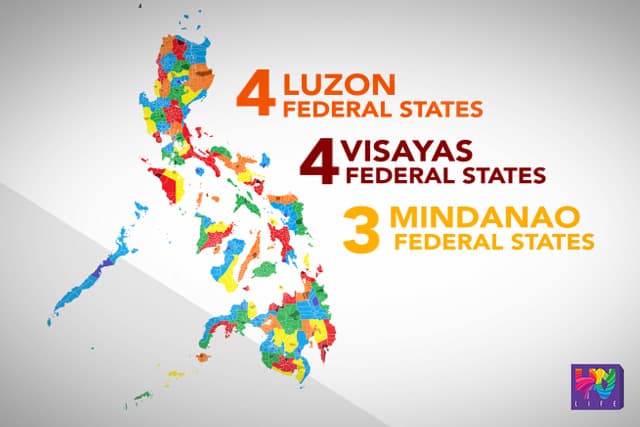
The call for federalism is not new. Aguinaldo and Mabini had envisioned the three main island groups of Luzon, Visayas, and Mindanao as separate federal states. Pre- and post-Marcos, the Philippines has had voices continuing to advocate a federal system. In 2016, as standard-bearer for the PDP-Laban, Mr. Duterte further adopted the party’s platform toward federalism, making it one of the central pillars of his own campaign for the presidency, causing a resurgence of the topic in social consciousness.
According to PDP-Laban’s Federalism Institute Primer, the party has spearheaded the call for a division of the country into eleven different states with cheesy names, like Northern Luzon, Eastern Visayas, Southern Mindanao—you get the picture—as well as one administrative capital region where Metro Manila now stands.
Within the proposed structure of a Federal Republic of the Philippines, we find two levels of government: the state government, and the central or federal government. The Constitution, as it is interpreted, delegates and protects what powers either of them have.
Its core principles: a constitutionally guaranteed degree of independence in state power from the central government, or autonomy; specific powers vested into the state and local governments to better address problems at the grassroots level, or subsidiarity; and a significant interrelatedness between the states as equal and integral members of a union under the central government, or solidarity.
Following the three principles, the most important proposed changes to the constitution concern the functions and powers of the two levels of government. The central government is responsible for the nation as a whole, overseeing national defense and security, foreign policy, currency, banking, monetary policy, customs and national taxation, and international trade.
Each of the states have certain degrees of freedom in pursuing their own policies in regional planning and development, supervision of local governments, waste management, educational infrastructure, traffic management, and many others, yet they must always be in line with national policy. Certain powers, such as concerning education, health, the justice and police system, and energy, are shared.
The Philippines has continued to exist in a state of almost impenetrable limbo, despite numerous bills being passed in the hopes of devolving power further to the other regions of the nation while still retaining a centralized government. Within this diverse spectrum of federalist governance lies, in the eyes of those espousing this type of government, a model in which we may find the solution to those problems.
The prime push for federalism lies in the need for decentralization within our country. The NCR by itself produces 37 percent of the entire GDP of the country. Throughout the country large portions remain grossly underdeveloped, and revenue spent on them is minimal in comparison to other prominent urban centers. This lopsided development is a result of centralization of government resources, specifically into what has consequently become the beating heart of the Philippines: Metro Manila.
By dividing the country into numerous states, each with their own government, power and resources are decentralized throughout the nation. A central government alone cannot micromanage numerous regions throughout the country while governing the country as a whole, and so with responsibility divided, each state can have an equal chance toward greater development.
The central government, with its share of the national revenue, allocates block grants to states according to their need, encouraging them to follow nationally oriented policies as well. These block grants, as well as the numerous states’ own tax derived revenues, can be used at the discretion of the state governments to carry out their responsibilities. This will always be the case as long as they do not overstep from their constitutionally defined powers.
Decentralization also creates a much more productive and reliable governing body, as each level of the government can focus on their own responsibilities.
The national government can focus on the country as a whole, facilitating interstate relations, defining national and foreign policy, and international trade, only occasionally intervening in interstate concerns. Unlike a faraway central government dictating what must be done to solve regional problems, state governments, using powers brought down to the more local levels, can better hear and deal with problems within their own constituencies.
Greater autonomy grants states freedom in determining their own paths within the confines of the constitution. This fixes the problems of the numerous ethnic and religious minorities throughout the Philippines wishing to have their own special problems and voices heard and dealt with by a localized government which can better understand them.
But we cannot hide the proverbial skeletons in the closet federalism surely does have.
By separating our country into a number of relatively autonomous states, we hold the risk of further dissipating some already strained national and cultural bonds, worsening the already tense atmospheres in the regions, and could ultimately lead to secession.
This amount of freedom and power bestowed upon the states can also create an economic and developmental disparity throughout the country, with certain states choosing to go one way or the other in their own path to progress.
Despite the shift from a unitary to a federal government, the Philippines as it is now still needs an established strong central government to counter these problems. This central government must be strong enough to assert its powers for the good of the nation as a whole as a general push in national policy in cases where there are contentions such as these.
Nevertheless, I do believe federalism is a viable solution for the problems our country faces. Yet an important matter still lies in the actual implementation and transition of our country on the path to federalism. Already there have been charter drafts submitted to Congress and timetables drawn up.
However, Mr. Duterte continues to pressure the Senate and the House to fast-track the process. Isn’t it simple enough to just set up one central and eleven state governments, assign them their roles and powers, and have the Philippines go along its merry way? Not in the slightest. The original joint resolution filed in 2008 called for the amendment of fourteen out of the eighteen articles of the 1987 Philippine Constitution. That’s a bit less than simple, no?
A bill needs to be passed by Congress to allow a Constitutional Convention for the revision of the Constitution. Once it gets through—let’s stay optimistic—it is then and there that a public referendum will most likely be held in 2019.
Even with the odds in favor of that happening, this potentially complicated and volatile transition must be dealt with great care. It cannot be, and indeed shouldn’t be, guaranteed that all of this could be accomplished in just one presidential term.
While I firmly believe federalism is what our country needs, it must be done properly. With all it has to show, still federalism cannot solve all our problems, and it would certainly make things worse if we rushed down that path helter-skelter
This revolutionary turn in our country’s path should neither be understated nor overstated. In spite of all of these well-meaning changes and revisions to the way our country is run, all of this would be for naught if the leaders we elect cannot be trusted to properly use these as they should. And if our leaders are a decisive factor in such a thing as this, how much more so is the common Filipino?
Power to the people: the constant mantra of democracy, as persistently repeating as a broken record. And indeed federalism could bring the government closer to the people than our old unitary system ever could. This doesn’t only refer to the power of being able to choose our leaders, though it is imperative that we learn to say no to traditional politicians who will always be able to corrupt whatever system they find themselves in. These people who vote, who give opinions, who argue, and strike, and complain, and who have a voice, are ultimately what could make or break everything.
As the lights dim upon the chaos and the show, or what’s left of it, ends, what then will we do to fix all this? The Philippines needs change. The system, the people, the attitudes, they need change. This change is, for all intents and purposes, an experiment. While we don’t know what will come next, this turn of events marks a huge leap for our country out of the circus cesspool it had been festering in for so many years. All we can do right now is cross our fingers and hope we don’t land in anything worse. When the spotlights flicker on again, let’s hope they will shine on something better than this.
Imagine from UNTV