Earth’s Algorithm: Soil Science in the Age of AI
By Nate Baking (11H)
|3 min read
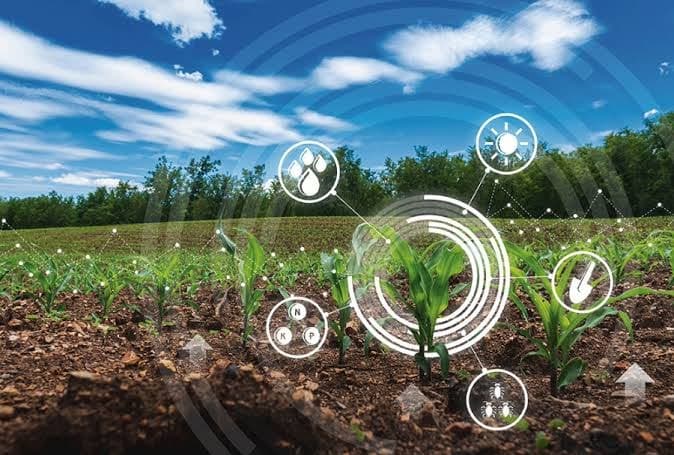
Image Source: Kameresan K. (2023, September 7). Artificial Intelligence in soil quality Monitoring – Bannari Amman Institute of Technology. Bannari Amman Institute of Technology. https://www.bitsathy.ac.in/artificial-intelligence-in-soil-quality-monitoring/
By: Nate Baking (11H)
WALES – What happens when artificial intelligence is no longer confined to our screens, but infused into the machines of our world? Artificial Intelligence (AI) has been rapidly integrating itself within every spec of our lives at a nonstop pace. From using chatbots on our smartphones to creating robots that are more or less able to work without human interventions, AI continues to simplify many tasks from our day-to-day lives. This artificial evolution does not simply confine itself to the screens of our phones, but is now digging back into the earth itself.
Recently, much research has been put into the usage of AI in soil science. This field is one that usually takes manual labor and human-made analytics. Soil data is one that is complex and important in checking the composition of soil, as well as its formation and classification (Wadoux, 2025). Given the labor-intensive nature of this science, speeding up mundane tasks can help research for many environmental issues, or stand in the forefront against these issues as a way to monitor any soil-related problems in real time.
How exactly can AI transform soil science?
As stated earlier, there are many components in analyzing soil. Chemical compositions, moisture levels, organic carbon content and mineral structures, are only some of the datasets commonly watched over by researchers. But when studied, recurring patterns more often than not appear, which can be heavily capitalized by AI. The components of soil are largely affected by the environment it appears in. Though each area has its unique aspects, certain information remains similar, such as the type of matter within it, the relation between soil health to the weather, and more. Machine learning is one of the many types of AI used, and it can be applied to soil science in pattern recognition, learning from these patterns, and predicting outcomes. To better understand how machine learning works, it is best to understand its three domains.
The first domain is sensing and interacting. Robotics is a big component for this domain due to the need for AI to have a physical body. This domain focuses on collecting data and in the case of soil science, this is done through soil sampling, monitoring, and automated soil analyses. Using its computer vision, it is able to capture images of soil to classify the soil type. Alongside this, it uses natural language processing to look into and learn soil practices from online papers and amendments and applying it to its own algorithm.
In order to give meaning to its data sets, it undergoes the second domain of reasoning and decision-making. AI emulates “expert systems” that are basically systems that mimic the decision-making skills of a human expert. This is mostly used for soil classification, soil quality assessments, and agronomic decision-making. Given the expert systems, AI uses knowledge engineering to adapt its system to the knowledge of experts in a way that is digestible for the AI. Based on that knowledge, the AI’s inference engine kicks in to create an output based on the data inputs.
Using all the previous processes, it reaches the last domain which is learning and predicting. Machine learning optimizes the workload by recognizing the patterns in the data. An example of this was seen in Ethiopian Catchments, wherein pattern recognition helped with ranking soil erosion potential. It then uses data mining to correlate its findings with bigger data. This is more exploratory, and goes beyond simply following an algorithm.
These AI systems can and should be applied all around the world, for they will effectively and efficiently create systems that will develop agriculture to something that the world has never seen before. From physically manifesting and interacting with the real world, to giving reason and learning from the data accumulated, AI can address many problems that the world faces. This intersection between AI and earth sciences will not stop growing, and for a nation like the Philippines, a country rich in natural resources will be essential for the development of our farmlands.
Sources:
Kameresan K. (2023, September 7). Artificial Intelligence in soil quality Monitoring – Bannari Amman Institute of Technology. Bannari Amman Institute of Technology. https://www.bitsathy.ac.in/artificial-intelligence-in-soil-quality-monitoring/
Wadoux, A. M. J. (2025). Artificial intelligence in soil science. European Journal of Soil Science, 76(2). https://doi.org/10.1111/ejss.70080