When the Heat Rises: How Science and Technology Can Help the Philippines Face El Niño
By Jacob Siao (12I)
|5 min read
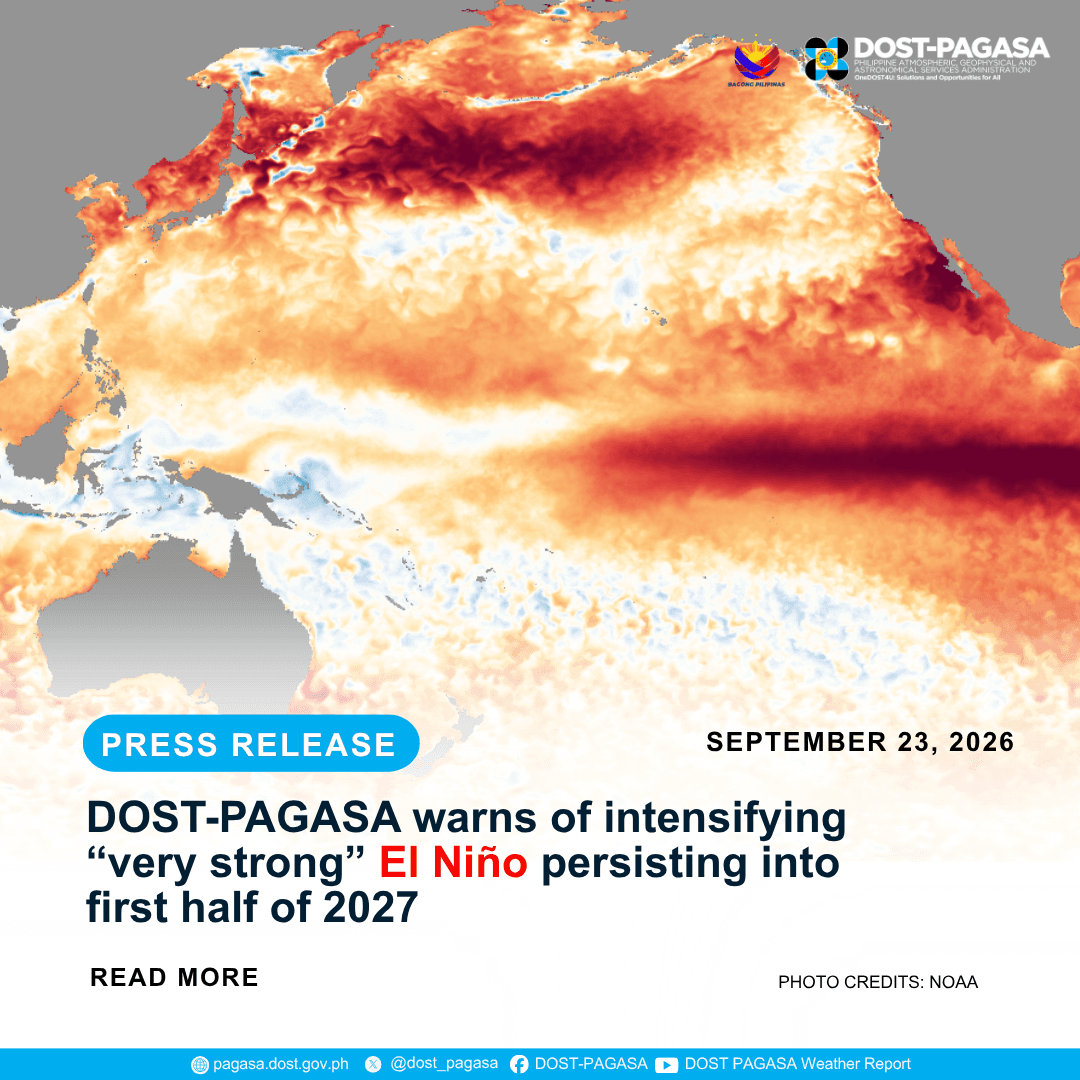
“DOST-PAGASA warns of intensifying “very strong” El Niño persisting into first half of 2027” (Photo Credits: NOAA)
By Jacob Siao (12I)
As the country prepares for warmer temperatures and possible water shortages, scientific research and technological innovation offer hope for a better prepared future.
A country that relies on rain for agriculture, crop production, and irrigation needs to come up with ways to cope with the decline in the volume of rain. As the climate is changing and precipitation patterns become increasingly erratic, the Philippines needs to develop ways to cope with one of the toughest natural phenomena, namely El Niño. The only way for the country to significantly enhance its forecasting abilities and mitigate the effects of this phenomenon is to invest in and become more dependent on science and technology.
El Niño is a climate phenomenon that is marked by a significant increase of the temperatures of the waters of the central and western parts of the Pacific Ocean. This phenomenon brings changes to the atmospheric circulation and has a strong influence on the weather around the globe. In the case of the Philippine archipelago, El Niño usually results in an increase of the precipitation deficit, droughts, and dry spells.
The year 2026 shows the occurrence of a strong El Niño phenomenon in the tropical Pacific, according to the Philippine Atmospheric, Geophysical, and Astronomical Services Administration or PAGASA. Predictions show that the El Niño will gain intensity towards the end of the year and might prevail during the first half of 2027. The phenomenon affects concerns about water supply, agriculture, electricity power production, and public health, etc. However, El Niño does not mean that there will be no rain at all. Tropical cyclones and other weather activities can also cause rainfall and floods.
To learn about how to minimize the negative effects of El Niño, one needs first to learn what it is and how to prepare for the conditions it can cause. Scientists can then monitor what happens in oceans, atmosphere, rainfall history, and climate models and identify potential problems before they happen.
Modern forecasting techniques have become increasingly effective in studying the El Niño phenomenon. Thanks to thousands of satellites, meteorological stations, oceanographic instruments, and computer models around the world, scientists can collect information about changes in the environment and climate. In addition, PAGASA uses climate monitoring and forecasting to provide early warnings and information to government agencies, farmers, and the public, helping them prepare for the possible effects of El Niño.
The same technology can improve the management of water resources in the country. All kinds of advanced water meters, automated monitoring, and various sensors can be used for leak detection, reservoir-level measuring, and recording water consumption. Thus, communities can define the points of water losses and make more use of water resources. For instance, farmers may utilize soil moisture gauges to know what time is best for watering crops.
Since agriculture is highly affected by long periods of dry weather, these innovations are very important. A lack of water in the soil can reduce crop production, leading to lower farm income and higher food prices. Scientists can help address this problem by developing drought-resistant crops, identifying the best times for planting, and studying ways to conserve soil moisture. In addition, digital agricultural tools can help farmers by providing useful information about rainfall, weather conditions, and the best time to plant their crops.
Technology has another important function in terms of renewable energy. Solar panels can offer electricity to businesses, homes, schools, and communities and lower reliance on water-consuming forms of electricity generation. It is important to keep in mind that renewable systems should be placed according to certain plans: extreme heat can hinder them from functioning properly, while the weather can affect energy production negatively.
The acceptance of the importance of science and technology, in practice, does not pave the road for success immediately. The outcome is mainly dependent on how existing knowledge is put into practice. At the local level, multiple climate forecasting and territorial mapping instruments used by governments are available. Schools should help children understand climate science, how to consume water appropriately, and how to preserve the environment. Families should take the initiative to fix non-working taps, and increase the chance of using home water efficiently.
The use of effective communication is another important factor. With the help of mobile applications, social networks, radio, and television, one can send weather reports that will allow people to prepare for any meteorological phenomenon. At the same time, it is essential that people depend only on credible sources rather than any gossip or wrong information they can come across on the Internet.
The preparedness must also be equitable. Low-income communities as well as small farmers could have restricted access to advanced irrigation facilities, reliable sources of water, and modern technologies. Hence, the government must support and provide reasonably priced infrastructure and scientific information to help needy communities.
El Niño serves as a lesson for mankind, reminding people that while we cannot control natural climate processes, we are able to mitigate the effects of these processes if they prepare properly. Science comes into play allowing individuals to realize what is going on, while technology makes it possible to find ways of addressing the effects.
The Philippines must therefore use scientific solutions, especially now, given that a strong El Niño is soon predicted to hit the country, stretching out to the year 2027. The task includes financing scientific efforts to find advances in water conservation techniques which will help citizens and farmers make use of water-saving methods.
Ultimately, our response to a hotter and drier future should not be fear, but rather preparation. By combining scientific discoveries with responsible decisions and collective action, Filipinos can protect their resources, support vulnerable communities, and build a more sustainable future, even when the rain does not come.
References:
Cabato, L. (2026, October 5). El Niño to bring drought to all provinces by March 2027 – DOST. Inquirerdotnet; INQUIRER.net. https://newsinfo.inquirer.net/2317567/el-nino-to-bring-drought-to-all-provinces-by-march-2027-dost.
PAGASA. (2026). Dost.Gov.Ph. https://pagasa.dost.gov.ph/press-release/225.
France-Presse, A. (2026, October 8). El Nino will intensify, then peak in December: UN | ABS-CBN News. ABS-CBN. https://www.abs-cbn.com/news/weather-traffic/2026/10/8/el-nino-will-intensify-then-peak-in-december-un-1212.