Indian Hydrogen Fueled Trains
By Coen Sy (11A)
|6 min read
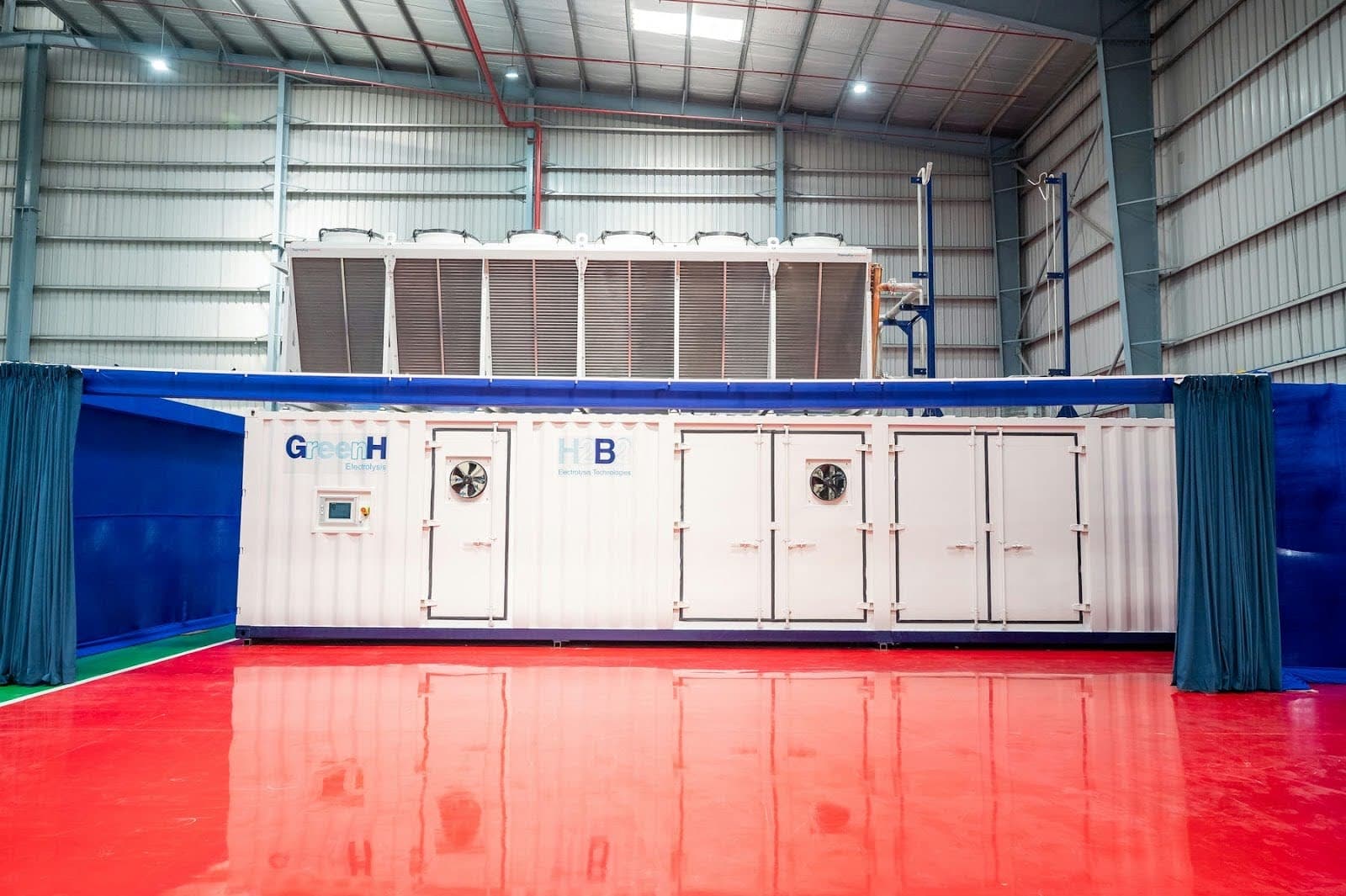
Photo credits: GreenH Electrolysis (2025)
By: Coen Sy (11A)
Hydrogen being used to generate electricity as fuel cells is not an old technology and has been around since the 1900s, and yet as an emission free method of producing electricity, this is still barely used for transportation, where they could replace combustion engines completely. As the fifth country to utilize fuel cells to create the required energy for transportation, India has recently announced its plans for creating 35 hydrogen powered trains with routes that pass through heritage sites.
One goal of using hydrogen fuel cells is to minimize the environmental impact of vehicles by using a chemical reaction between hydrogen and oxygen to produce electrical energy. Through India’s project of creating 35 trains that utilize hydrogen fuel cells instead of standard combustion engines, they will be able to reduce the emitted greenhouse gases while at the same time providing useful data to how hydrogen fuel cells can be improved.
Hydrogen fuel cells use a hydrogen atom as an input, and pass it into an anode (entry point of electrical charges/electricity within an electrical system), which takes hydrogen’s only electron to be used as electricity. The hydrogen is then moved through an electrolyte, which only allows ions (atoms with more or less electrons than its normal ground state) to pass through. After the hydrogen passes through the electrolyte, it rejoins its electron in the cathode (exit point of electrical charges/electricity within the circuit). Upon exiting the cathode, hydrogen meets oxygen and reacts with it to form water vapors, which is the output of the fuel cell. The electrons that were added into the circuit in the anode is the electrical current in the system, and generates electricity to be used.
In this system, the oxygen is used to attract the electrons coming from the anode in order for the circuit to be completed since all circuits need a substance in the anode where the electrons can come from, and another substance in the cathode where the electrons would be attracted to. The electronegativity (tendency/ability to attract electrons) of the substance in the cathode would have to be greater than the electronegativity of the substance in the anode.
Oxygen is an easily accessible resource due to its presence in the air, however, pure hydrogen is not something that can be acquired easily. Through the process of hydrolysis, water is used as an input, then hydrogen is split from oxygen into its proton and electron. Similarly to the fuel cell, the proton (hydrogen ion) moves through the electrolyte to join with another hydrogen ion and two electrons coming from the cathode to form hydrogen gas (H₂). The remaining oxygen atoms bond together to form O₂ (oxygen).
Since O₂ is stable and does not need an electron, the electron readily shifts over to the hydrogen atoms that were forced to pass through the electrolyte to form H, which is a more stable form compared to an H+ ion. After this, two hydrogen atoms join together to form H₂, which is also more stable than a hydrogen atom (It is through chasing stability that electrons, protons and atoms can be manipulated to generate electricity).
The issue with the electrolysis of water is compared to the chemical reactions in a fuel cell is that water needs to be broken down, and the hydrogen ions have to be forced through the electrolyte, which takes energy to accomplish, while a hydrogen fuel cell readily reacts since hydrogen wants to form bonds with oxygen to become more stable (which is why hydrogen needs to be forced away from oxygen). Given this, India created a 1 megawatt electrolyzer, which would fuel the trains. According to GreenH Electrolysis, 420kg of hydrogen would be produced daily in order to fuel these trains (2025).
Despite the lack of emissions of hydrogen fuel cells, the creation of hydrogen fuel also requires electricity, which may or may not still come from fossil fuel combustion plants. Undoubtedly, this would be a reduction compared to the emissions created when drilling up fuel for vehicles (both from the drilling and the procurement of energy used to drill) combined with the emissions of the vehicles themselves, however, there is also a question of whether the energy inefficiency in creating hydrogen to fuel vehicles would be greater compared to if vehicles were directly powered through electricity. On the aspect of containing energy, hydrogen fuel cells definitely have the upper hand in terms of the amount of energy a vehicle can carry at a time compared to batteries.
As the fifth country to utilize hydrogen as a fuel for trains, India would be a great source of technological inspiration (and data when the project is finished), which could further the research of hydrogen fuel cells towards more innovation. One aspect of innovation would definitely be the energy efficiency of hydrogen powered vehicles since a significant amount of energy is lost through the process of converting chemical energy to electrical energy. Another idea to ponder on would be what to do with excess hydrogen fuel as hydrogen powered cars are not as accessible compared to electric or normal combustion reliant cars, and so any excess hydrogen fuel from India’s electrolyzer could go to waste if the trains are unable to maximize their consumption of hydrogen fuel (of course, uselessly powering the trains is also a waste of hydrogen gas).
India’s technological advancement is undoubtedly a major step forward into a greener scenery in the field of transportation in India, and could also act as a stepping stone for other researchers and scientists to further knowledge on fuel cells and energy efficiency based on the data that the new train systems can provide.
What is lacking in research on hydrogen fuel cells is how to more efficiently convert chemical energy into electrical energy due to how a portion of the chemical energy of the fuel typically becomes heat energy, which is unusable in the current systems that are in place to make use of hydrogen fuel. Additionally, it is also a question on if hydrogen fuel cells are the way to go, or increasing the life span, capacity, and recyclability of electric cars will lead to more technological benefits and advancements.
Other notable hydrogen fueled devices are the Toyota Mirai, Hyundai Santa Fe, various NASA probes, drones, satellites and rockets among other things.
Sources
Bacancy Systems. (n.d.). Hydrogen vs. electric cars – comparing various parameters. Retrieved from https://bacancysystems.com/blog/hydrogen-vs-electric-cars#electric-vs-hydrogen-cars:-comparing-various-parameters
Cathode and Anode. (n.d.). In BYJU’S Chemistry. Retrieved from https://byjus.com/chemistry/cathode-and-anode/
Water Electrolysis. (n.d.). In BYJU’S JEE Chemistry. Retrieved from https://byjus.com/jee/water-electrolysis/
FuelCellsWorks. (2025, August 15). India’s hydrogen train passes all tests, set to debut on Jind–Sonepat route. FuelCellsWorks. Retrieved from https://fuelcellsworks.com/2025/08/15/fuel-cells/india-s-hydrogen-train-passes-all-tests-set-to-debut-on-jind-sonepat-route
GreenH Electrolysis. (n.d.). Green hydrogen: a viable and sustainable alternative. Retrieved from https://www.greenh.in/green-hydrogen-a-viable-and-sustainable-alternative/
GreenH Electrolysis. (2024, October 1). India’s first hydrogen train powered by Medha Servo Drives and GreenH. Retrieved from https://www.greenh.in/indias-first-hydrogen-train-powered-by-medha-servo-drives-and-greenh/
KDC Projects. (n.d.). The history of hydrogen fuel. Retrieved from https://www.kdcprojects.com/the-history-of-hydrogen-fuel/
Times of India Business Desk. (2025, August 13). India’s first hydrogen-powered train is ready! Railway minister Ashwini Vaishnaw shares sneak peek – watch video. The Times of India. Retrieved from https://timesofindia.indiatimes.com/business/infrastructure/indias-first-hydrogen-powered-train-is-ready-railway-minister-ashwini-vaishnaw-shares-sneak-peek-watch-video/articleshow/123259976.cms
Tripathi, V. (2025, August 14). India’s leap to its first hydrogen-powered train; check its route, features and costs. Jagran Josh. Retrieved from https://www.jagranjosh.com/general-knowledge/india-first-hydrogen-powered-train-route-features-and-costs-1820001559-1
U.S. Department of Energy, Office of Energy Efficiency & Renewable Energy. (n.d.). Fuel cells. Retrieved from https://www.energy.gov/eere/fuelcells/fuel-cells
Umicore. (n.d.). Fuel cells vs. batteries: what’s the difference?. Retrieved from https://www.umicore.com/en/media/newsroom/fuel-cells-battery-difference/
Electrode | Conductors, Reactions & Cells. (n.d.). In Britannica. Retrieved from https://www.britannica.com/science/electrode
Electronegativity | Chemical Bonding, Intermolecular Forces & Polarity. (n.d.). In Britannica. Retrieved from https://www.britannica.com/science/electronegativity