Scientifically Accurate Space Game
By Coen Sy (11A)
|5 min read
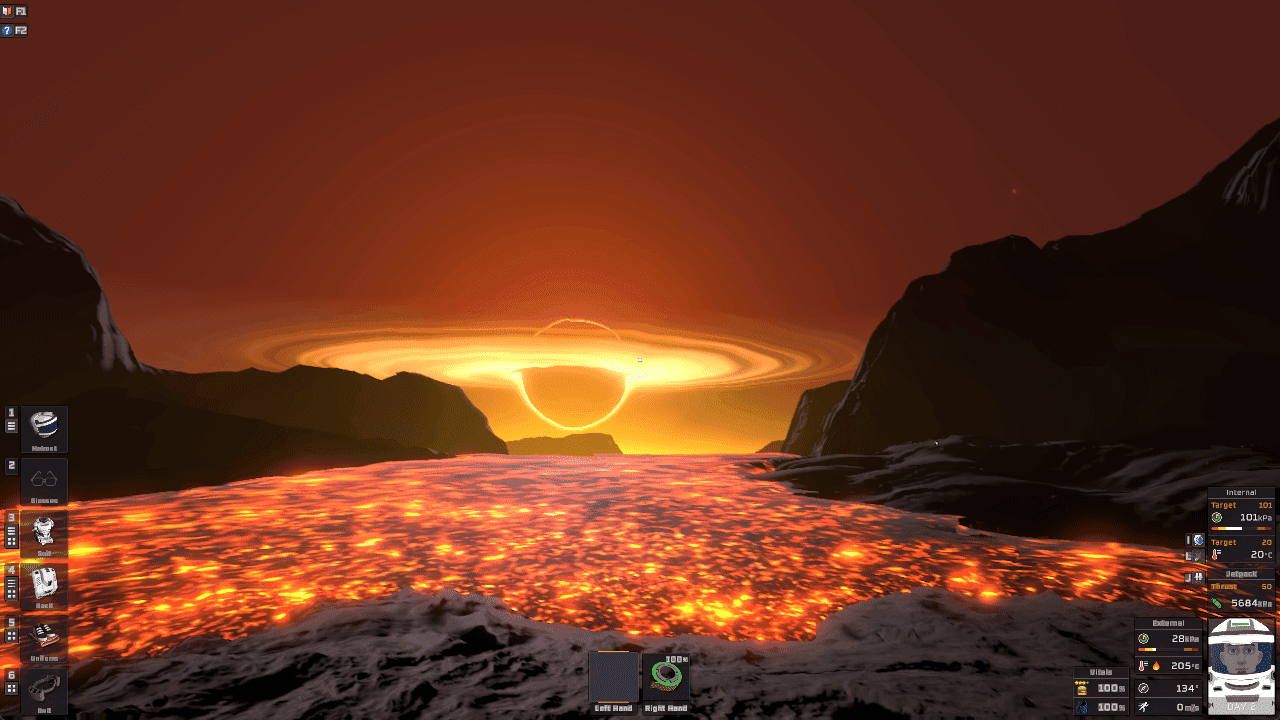
Photo credits: Stationeers Patch Notes on Steam (September 15, 2025)
By: Coen Sy (11A)
Rocketwerks’s Stationeers has been in development since 2017, and recently, it has been receiving more and more updates as a scientifically accurate game. As a survival game, Stationeer sets itself apart from the other games in this genre with its heavy reliance on science concepts with most if not all of the gameplay elements being based on real life concepts, mechanics and even equations. This game has been receiving constant updates since 2017 (as can be seen in the Stationeer’s steam page). However on September 15, Rocketwerks launched a massive revamp to how the game works by adding different worlds, all ready for players to explore their own unique gimmicks. In the very same update, Stationeers is now also available to play in multiplayer with up to 10 players.
When starting off, you are dropped into a completely deserted planet, with nothing but some power tools, and barely enough materials to scrap together a starter base (in harder modes, you don’t even start with any materials at all). Throughout your time exploring the different planets, food, water, electricity, and oxygen are the main concerns. Although enough supplies are given in the very beginning, producing more and sustainably becomes the issue. The singular solar panel given in the beginning will not be sufficient to power everything, the food and water won’t last and carbon dioxide will not revert back to oxygen by itself.
Most of the early game is spent building an airtight room to release waste carbon dioxide, and maintaining a small garden to replenish food. Water can be achieved through melting ice in furnaces (which takes a while to reach in terms of technological progression), while finding coal would be an important replacement for solar power in the early game. Of course, like all survival games, resource management is critical to survival, and focusing on achieving only one resource at a time would lead to disastrous consequences.
The main mechanics in Stationeers are pressure, temperature, volume, and quantity. These are the four values that make up the ideal gas law of PV = nRT, where P is pressure, V is the volume, n is the quantity in moles, T is the temperature and R is the ideal gas constant (8.31446261815324 Joules per Kelvin per mol). According to Britannica (2025), the ideal gas law states the ideal behavior of gases, which means that an ideal gas of n moles at T temperature would exhibit P pressure and V volume. Manipulating one variable and holding all others constant would lead to a change in another. For example, having n moles in a container that can hold V liters would leave pressure and temperature as the two variables dependent on each other. An increase in temperature would lead to a subsequent increase in pressure, and a decrease in temperature would lead to a decrease in pressure. Likewise, if pressure changes, temperature would also change because both are directly proportional. On the other hand, if n and T are held constant, then pressure and volume would be dependent on each other. The subsequent relationship would be inversely proportional, meaning that as pressure increases, the volume of the gas would decrease, and vice versa. All gasses exhibit similar properties to ideal gases, and this law is used to predict the general pressure, volume, quantity or temperature requirement for these gases to move as needed.
Stationeers uses the ideal gas law in containers that have specific processes, such as furnaces. This is because specific amounts of specific substances are required to smelt different alloys and create different materials, and the ideal gas law helps to ensure that the inputs are perfect for the desired output. Similarly, an airtight room also needs ideal gas law computations in order to make sure the room does not explode (if the room gets too hot and contains combustible substances in its “atmosphere,” it will explode). This means that on top of handling food, water, electricity, and oxygen, there is also a significant amount of calculations that need to be done in order to make sure everything doesn’t blow up out of nowhere. Similarly, plants are also very picky with their environments, with specific nutrients required in the soil, else their growth will become inefficient and will consume more resources than they should be consuming. When there is too little of one nutrient, it will grow slower but continue consuming other nutrients, taking more time and electricity to grow (because the UV lamp needs to be turned on for the plants to grow). When there is an excess of nutrients, this would typically mean that there is too little of another (because the excess takes up a percentage of the soil’s total nutrients), therefore it would still take more time and resources to grow.
On top of managing necessities, of course there are gadgets such as the autolathe and jetpack. The autolathe is an electronic “printer” (different from the electronics printer) that takes in an input of materials to output processed goods such as doors, frames, vents, containers, etc.. The jetpack, on the other hand is, as expected, a device that propels the player character upwards and softens landings, which can be useful in planets that have stronger gravity. As more technology is unlocked by the player, more gadgets and devices will be unlocked, such as nuclear batteries and the electronics printer, however, all of these devices take a lot of time and effort to reach and utilize properly. For example, although the autolathe and jetpacks are both given out for free from the very beginning (meaning players have access to crafting a large amount of crafted equipment), the autolathe still requires its inputs to be processed through the smelter, (which requires the raw ore and electricity), and the jetpack still requires propellant/fuel (which is quite far down the progression line).
Another key aspect of gameplay in Stationeers is the building mechanics, where players can build their base using the metal frames and plates available in multiple different variations to allow for an artistic touch in base design (of course, this still comes with the cost of having to find the materials, process them and convert them into the base building components). Overall, Stationeers is a nice game with a good application of scientific concepts and an engaging tie-in to the normal game design of survival games. Science enjoyers who are looking for science related video games should look into Stationeers to learn about more science concepts, or apply already known science concepts in a semi-realistic survival game, that is now available in multiplayer of up to 10 players.
Sources
The Editors of Encyclopaedia Britannica. (2025, July 29). ideal gas law. Encyclopedia Britannica. https://www.britannica.com/science/ideal-gas-law
RocketWerks.(2025, September 15). Patch Notes: The Biggest Update Ever. Stationeers. https://store.steampowered.com/news/app/544550/view/533235259603419415