The Future of PAF Fighter Procurement
By Euwan Cuady (11H)
|7 min read
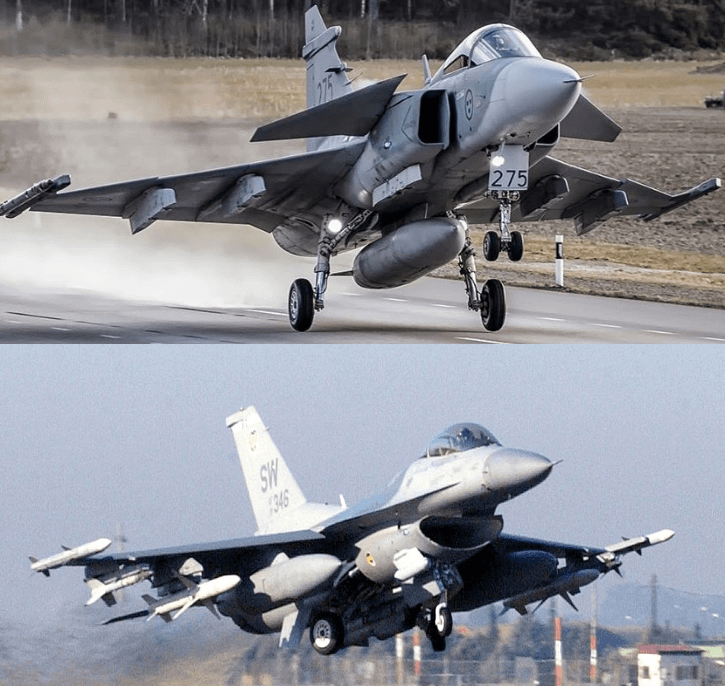
Photo credits (top-bottom): Jörgen Nilsson/SAAB, Jason Gamble/USAF
By: Euwan Cuady (11H)
In late June 2025, Philippine Air Force (PAF) General Arthur Cordura made a statement to the press in Villamor Airbase citing the Air Force’s submission of a proposal to the Department of National Defense (DND) regarding the procurement of modern Multirole Fighters (MRF). This signals the Air Force’s current intent to acquire modern aircraft capable of protecting Philippine interests across its sovereign waters, departing from more inward-facing doctrines of the past. The two current contenders in filling this role are SAAB’s JAS 39 C/D “Gripen” from Sweden and the F-16 Block 70/72 “Viper” from the United States. Though neither are stated to have been selected as the definitive choice for the Philippines, both serve two distinct options for the future of the Philippine Air Force.
Chinese Provocations over the Decade
In January 2013, the Philippines filed official proceedings to the Permanent Court of Arbitration regarding the rights and claims between China and the Philippines. Chinese non-cooperation was displayed here through its outright rejection in participating. This would continue with outright confrontations from the Chinese Navy and Coast Guard while harassing Philippine merchant and military vessels, culminating recently when two Chinese ships collided while in pursuit of a Philippine Coast Guard vessel. This context is crucial as projection capabilities over the West Philippine Sea has been explicitly stated as a requirement in the acquisition of MRF platforms.
Recently, the deployment of US Typhon Missile Systems have caused opposition to such a deployment to rise within China, with the Chinese claiming the Philippines is “playing with fire” and breaking its “promises” to withdraw such missile systems after joint exercises with US allies. Mirroring such a response, the acquisition of F-16s by the Philippines will certainly provoke similar responses by China, if not more prolific. The risk of such provocations by China will certainly play a role in the DND’s final decision for acquisition.
Justifications for Air Force Expansion
Seeing the increasing tensions in the West Philippine Sea, it is only logical that the Philippines must respond in such a manner that can equip itself to deter further Chinese aggression. However, such capabilities from the armed forces is still woefully underpowered when considering the capabilities of the Chinese Navy and Coast Guard within the West Philippine Sea.
In recent developments, the Philippines has taken a more proactive stance in protecting its sovereign claims over the West Philippine Sea. This shift has been presented in the Armed Forces Modernization act and its third phase (Re-Horizon 3) currently being projected to modernize the equipment of the Armed Forces. Beyond expansions already covered, however, Air Force involvement must also be emphasized in projecting Philippine sovereignty within the West Philippine Sea. Given the vast area covered, an expanded air force provides invaluable capabilities in both patrolling and projecting Philippine jurisdiction over its territorial claims. By acquiring such multi-role platforms, among other Armed Forces expansions – the Philippines will be able to sufficiently respond to any threat presented by sovereign airspace.
Among such expansions, it must also be understood that acquisition of equipment also serves as a diplomatic message. It is for this reason that the Philippines must also be cautious in emphasizing defensive capabilities, while limiting misinterpretations from the Chinese Government in Beijing as even defensive acquisitions may cause further unwarranted rise in tensions.
National Considerations in Acquiring Fighter Aircraft
Though lighter fighters such as the Korean FA-50 have since been acquired, it is clear that the Philippine Air Force has its express intent on being more capable of protecting the Philippines’ claims across its claims within the West Philippine Sea.
The requirements for a potential MRF stems from the shift of national interest into a more outwardly focused defense strategy. This is embodied through the Comprehensive Archipelagic Defense Concept, with its intent being an undeniable capability in projecting defense capabilities in the Philippines’ EEZ. Support for such shifts in doctrine has increased in the current Marcos administration, with such support in the expansion of the Armed Forces being followed by increased provocation in the West Philippine Sea from China. Such a response currently signals a more proactive approach in protecting Philippine interests internationally.
Despite funding allocated through the Philippines’ current initiatives, financing the procurement of a potential fleet of fighters remains to be a difficult endeavor. In a recent proposal by Lockheed Martin, a public offer for 20 F-16 Block 70/72s has been made with the total cost of such procurement landing at about USD 5.5 billion. Such an offer has, however, been cited as being difficult to fulfill, with the Philippines specifically stating cost as a main concern in the deal.
A More Compatible Fighter
Currently, the most pressing considerations for the PAF are range, Short Take-Off and Landing (STOL) capabilities and costs. These factors must be considered in any possible acquisition, with cost in particular being a critical factor.
Serving as the primary multi-role platform for Sweden, the JAS 39 “Gripen” was designed from the ground-up to operate in remote, underdeveloped locations. Operating on airstrips and roads of as short as 800 meters makes the aircraft remarkable in serving flexible roles as a combat aircraft. Furthermore, the Gripen has one of the lowest operating costs of any Multi-role Fighter (~4,700 USD/hr). Such an aircraft provides a low-cost and capable platform for operating in many conditions the PAF necessitates.
In addition, the Gripen’s capacity in rugged operating conditions is renowned for its ability to operate on limited logistics and conscript-level groundcrews. These capabilities reflect Swedish doctrine as much as it reflects the Philippines’ operational needs: a fighter aircraft capable of decentralized operations in the most limiting conditions continuously over time.
Currently, the main issues facing such acquisition is a solid deal and overall funding. Unlike the proposal by Lockheed-Martin, no clear deal has been released to the public regarding Gripen sales to the Philippines by SAAB. Furthermore, even with the clear benefits of operating the Gripen, its general availability compared to that of the F-16 raises concerns in procurement durations. These issues in potential procurement makes predicting the decision of the DND an illusive prospect.
The Philippines’ Appeal in the F-16 “Viper”
Being a likely candidate for the Philippine Air Force since 1995, the F-16 “Viper” is one of the most widespread Multi-role Fighters in the world. The F-16 was designed for flexibility from close-range duels to long-range strike missions while keeping modular maintenance in mind. Such a design allows for excellent performance while keeping to low maintenance burdens compared to other American aircraft. With short turnaround times and easily maintainable components, the F-16 combines excellent design with practical operations capabilities.
In the case of a Philippine acquisition, the F-16 provides the PAF with a versatile MRF platform with excellent combat performance figures. The aircraft’s modular design allows for quick turnaround times, ensuring effective operations during times of conflict. Furthermore, Lockheed Martin — producer of the F-16, has been pushing for the sale of the F-16 to the Philippines for decades. The proposal has evolved over time, culminating in the current deal for 20 F-16s alongside additional munitions, industrial cooperation and training for new pilots. Such a deal and general availability of the F-16 ensures a shorter procurement timeline once decided.
The Future of the Philippine Air Force
Regardless of how negotiations within the Philippine government and between both defense firms progress, the Philippines’ potential acquisition of a multi-role platform will ensure greater defense capabilities against threats in the near future.
Though delayed by decades, initiatives in expanding the capabilities of the Armed Forces of the Philippines are already bearing fruit in the current process of obtaining MRFs and the purchase of 12 more FA-50s from South Korea.
Despite recent strides in progress, emphasis must also be placed on the capabilities of the Philippines to finance these expansion programs in the immediate term. With budget constraints already becoming prevalent in the Armed Forces, the Philippines must be pragmatic in what it can realistically attain to maximize its current acquisitions.
Following the uncertainty of rising tensions in the West Philippine Sea and the Strait of Taiwan, increased focus on defense capabilities must be prioritized for the Philippines to ensure credibility on its sovereign airspace. However, any procurement must also tread a line between excessive spending and unwarranted Chinese provocation. Such financial and geopolitical constraints will continue to plague further acquisitions by the Philippines, with careful discernment of such decisions being vital for the success in the modernization of the Armed Forces.
Sources
Brunnstrom, D., & Martina, M. (2025, April 11). US tariffs on Philippines could affect weapons deal, ambassador says. Reuters. https://www.reuters.com/world/asia-pacific/us-tariffs-philippines-could-affect-weapons-deal-ambassador-says-2025-04-10/
Cases | PCA-CPA. (n.d.). Permanent Court of Arbitration. https://pca-cpa.org/en/cases/7/
Ismael, J. J. (2025, August 16). Not our fault: PH denies responsibility in collision of Chinese vessels. The Manila Times. https://www.manilatimes.net/2025/08/16/news/national/not-our-fault-ph-denies-responsibility-in-collision-of-chinese-vessels/2168458
Joshi, S. (2012, July 4). Gripen Operational cost lowest of all Western fighters: Jane’s. StratPost. https://stratpost.com/gripen-operational-cost-lowest-of-all-western-fighters-janes/
Nepomuceno, P. (2025, June 25). PAF bats for multi-role jet fighters capable of short runway ops. Philippine News Agency. https://www.pna.gov.ph/articles/1252884
Reuters. (2025, February 14). China opposes US missile deployed by Philippines. https://www.reuters.com/world/china-opposes-us-missile-deployed-by-philippines-2025-02-14/
Saab AB. (2016). GRIPEN C IN BRIEF. In Saab. https://www.saab.com/products/gripen-c-series
Tiwari, S. (2025, April 2). U.S. approves sale of F-16s worth $5.5B to Philippines as it prepares for a “Chinese invasion of Taiwan” EURASIAN TIMES. https://www.eurasiantimes.com/us-approves-f-16-sale-to-philippines/#google_vignette
Torrecampo, R. C. (2024, April 3). A paradigm shift in the Philippines’ defense strategy. The Diplomat. https://thediplomat.com/2024/04/a-paradigm-shift-in-the-philippines-defense-strategy/
United States Air Force [USAF]. (2021, September). F-16 Fighting Falcon > Air Force > Fact Sheet display. Air Force.mil. https://www.af.mil/About-Us/Fact-Sheets/Display/Article/104505/f-16-fighting-falcon/