Trump’s Tariffs: A Zero-Sum Game
By Shaun Cua (11A) and Keith Tan (12A)
|8 min read
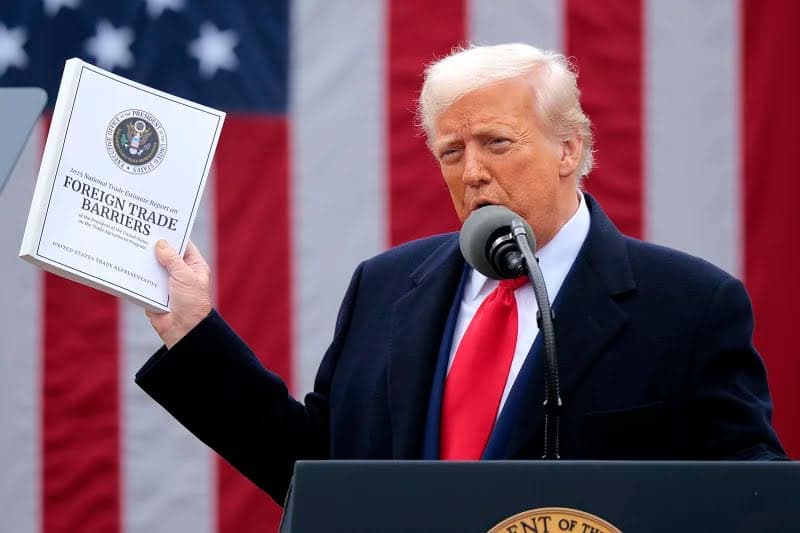
Photo credits: Rafael Nam / NPR
By: Shaun Cua (11A) and Keith Tan (12A)
In the first half of 2025 alone, United States President Donald Trump dramatically expanded and escalated tariffs, setting the stage for an internationally consequential economic showdown in modern U.S. history. With the administration’s continuous tariffing of imported goods and much steeper rates on key trading partners, such as China and the European Union, Trump persistently claims to be fighting for American jobs and economic sovereignty. Nonetheless, these tariffs raise serious concerns in destabilizing global stability: risking further trade wars, driving up consumer prices, and severing relations with allies. As the impacts of these measures only continue to uncoil, the question remains if the tariffs defend national interests, or deepen economic divides.
Trump’s Justifications
Trump argues that America’s trading partners have been disproportionately benefiting from trade, exploiting America’s open economy and driving the country’s economic imbalance to an “unsustainable” $1.2 trillion (making the U.S. the world’s biggest importer). Due to this, he says that America’s manufacturing sector has experienced a decline, resulting in a loss of factory jobs and increased economic dependency on imports. He specifically blames China (which, conversely, is the world’s biggest exporter), for undercutting American industries with subsidies and intentionally low labor costs, as well as other countries for “non-reciprocal trade”, essentially imposing higher barriers on U.S. goods than the U.S. imposes on theirs. To combat this, he has escalated the nation’s tariff rates to levels unseen since the 1930s, aiming to protect economic sovereignty, encourage domestic production or consumption, increase tax revenue, and therefore shrink the nation’s budget deficit, trade deficit, and debt.
Yet, many have openly criticized this logic, and for good reason. Even though tariffs can achieve these effects, they are a draconian solution to problems caused by far more complex factors than “unfairness”. In the end, tariffs risk upending the U.S. economy–along with the trust of its allies.
Populism Through Tariffs
In 2016, 2020, and again in 2024, Donald Trump styled himself as the “champion” of the American worker. As a central point in his economic platform, the U.S. president consistently alluded to tariff imposition, portraying the move as a sword against imports he believed were responsible for job losses, and as a shield in protecting domestic firms from foreign competition. Furthermore, Trump’s presidential campaigns would typically amplify criticism of Democrat-led administrations, particularly accusing them of causing “through the roof” prices (e.g. the Biden administration).
While Trump’s tariff rhetoric may resonate with anti-globalization Americans who believe that American workers have been hollowed out by foreign trade activity, the results of these tariffs contravene the “golden age of America” Trump promised. In 2018, Trump slapped 25% tariffs on Chinese products, mostly machinery and electronics. In response, China promptly retaliated with a reciprocal rate on American products, targeting soybeans and cars. The result? American agriculture, being heavily reliant on Chinese consumers, was critically hurt with the tariffs, resulting in billions of dollars for farmer bailouts that elucidated Trump’s failure to substantiate America-wide job growth. Owing to the subsequent rising costs and supply chain disruptions, the tariff policy, overall, epitomized more as a crowd-pleasing political performance to entice support than a sustainable economic approach – a not so “America first” stance but a “Trump first” rather.
A Poorer America
Trump expects his tariffs to increase government revenue. However, America’s consumers and producers will end up shouldering a large part of tariff duties. This is because it is American importers (American companies), not exporters from other countries, who pay tariff duties at customs. To keep retail prices the same, American corporations would have to absorb tariff costs and accept lower profit margins. This decrease in profits hurts the economy, and ultimately results in less income tax collected, therefore moderating the increase in government revenue. Additionally, absorbing tariffs is unsustainable for many, especially for smaller businesses or with higher tariff rates. If this is the case, a sizable portion of tariff duties will end up being paid by consumers as well, through higher prices.

Photo credits: Lucia Mutikani / Reuters
Indeed, as American companies begin to run out of stockpiled goods from the pre-tariff era, tariffs are beginning to fuel inflation, with last month’s Consumer Price Index (CPI) showing a 0.3% increase in prices since May. Ellen Zenter, the chief economic strategist at Morgan Stanley Wealth Management, argues that “the acceleration in tariff-exposed goods in June is likely the first of greater price pressures to come”.
Is this what Trump wants? Maybe. These higher prices would dampen consumption of imported products and, in theory, incentivize consumption of domestic goods instead. In practice though, this slows down the economy and makes Americans poorer, as the reason why consumers choose to purchase imported goods in the first place is that they are more affordable than domestic alternatives. Trump says, “maybe the children will have two dolls instead of 30 dolls”–would the same logic be acceptable for Canadian lumber, used to build houses?
Tariff-Dollar Dilemma
Donald Trump staunchly touts that a strong United States Dollar would be tantamount to a booming United States economy, solidifying American economic dominance and attracting global market confidence. Yet, he concurrently insists that a weaker dollar will guarantee that internationally exported U.S.-made goods are maintained at affordable prices in reducing the trade deficit he criticizes. These paradoxical positions of the president only reveal a basal dilemma: tariffs and the dollar work against one another. While tariffs may, in theory, protect domestic industries as import costs rise, a strong dollar forestalls this by making foreign goods cheaper and making “Made in U.S.A.” more unaffordable.
In practice, Trump’s tariff-heavy approach in dealing with trade, meant to boost American manufacturing, clashes with his desire for a robust dollar, leaving only domestic industries he seeks to defend undermined. Trump’s currency-tariff logic emerged when he threatened BRICS+ member states with a 110% base tariff should they attempt further to de-dollarize global trade. Trump justified this threat, framing the verbal commination as a punishment for, he believed was an economic warfare launched against the United States. With steep tariff rates in place, Trump risks pushing his country’s allies and trade partners away from the U.S. financial system, accelerating the shift from the already suffering dollar he promised to defend. In trying to coercively preserve the currency’s still-powerful standing, he may inadvertently weaken it in the long-term, isolating the United States economically and geopolitically.
Innovation Consequences
For the longest time, the United States has been a global leader in technological innovation, thus continuing to lead the global tech race. However, from landing on the moon to birthing Silicon Valley, Trump’s tariffs risk undercutting the preeminent scientific power’s legacy by smothering access to the global components and collaboration needed to remain on the frontier of innovation. By increasing costs and narrowing the ingress of foreign-made resources into local soil, the U.S. already positions itself at risk of falling behind the global tech race it continues to lead in. In this regard, Trump’s protectionist approach may unintentionally generate an innovation tailback, where American companies cannot scale or prototype efficiently, by that means accelerating economic advancement in the domestic industries in the years and decades to come.
Economic Uncertainty
Confusion in Trump’s economic policy does not stop at the dollar. Trump’s tariffs are also broadly at odds with his other policies. Remember how a goal of Trump’s tariffs was to balance the budget deficit? Well, the Big Beautiful Bill, a landmark bill recently signed into law by Trump, achieves the reverse, exacerbating this deficit instead. The bill extends Trump’s 2017 tax cuts and implements new ones, which slashes government revenue even when cost-saving measures like cuts to Medicaid are considered. On one hand, you have a policy that aims to add billions to government revenue; on the other hand, one that slashes it by billions more. Both policies come with catastrophic side effects. What is Trump trying to accomplish?
A Zero-Sum Game
In view of these points, Trump’s tariff-centered economic policy diminishes the impression of the tariffs as a national growth blueprint for the United States. While the rhetoric of protecting American jobs may strike a chord with working-class voters, the actual outcomes, as aforementioned, paint a different picture of America being great once more. As global markets grow more interconnected, isolating the U.S. not only stunts economic growth, but also subverts decades of global leadership in trade, diplomacy, economy, and innovation.
Sources
Cseadm. (2025, May 29). Who’s Leading the Tech Race? Center for Sustainability & Excellence. https://cse-net.org/global-tech-leaders-ai-semiconductors-quantum-2025/
Herzlich, T. (2025, July 1). US dollar suffers worst start to a year since 1973 over Trump tariff concerns. New York Post. https://nypost.com/2025/07/01/business/us-dollar-suffers-worst-start-to-year-since-1973/
Mutikani, L. (2025, July 16). US consumer prices rise in June as tariff pass-through begins. Reuters. https://www.reuters.com/business/us-inflation-expected-rise-june-with-tariff-driven-price-hikes-2025-07-15/
Lobosco, K. (2022, May 8). Trump’s trade war looms over soybean farmers 4 years later. CNN. https://edition.cnn.com/2022/05/08/politics/soybean-farmers-china-tariff-trump
Nam, R. (2025, April 22). The global economy will be hit hard by Trump’s tariffs, IMF warns. NPR. https://www.npr.org/2025/04/22/nx-s1-5372588/trump-tariffs-imf-trade-world-economy
Reporter, G. S. (2025, May 2). No Ken do: Trump says US kids may get ‘two dolls instead of 30’ due to tariffs. The Guardian. https://www.theguardian.com/us-news/2025/may/01/trump-dolls-tariffs-war-china
Sutherland, C. (2025, July 8). Trump threatens extra 10% tariff for countries ‘Aligning’ themselves with ‘Anti-American’ BRICS policies. TIME. https://time.com/7300395/trump-tariffs-threat-brics-anti-american-concerns/
The White House. (2025, April 2). Fact Sheet: President Donald J. Trump Declares National Emergency to Increase our Competitive Edge, Protect our Sovereignty, and Strengthen our National and Economic Security. https://www.whitehouse.gov/fact-sheets/2025/04/fact-sheet-president-donald-j-trump-declares-national-emergency-to-increase-our-competitive-edge-protect-our-sovereignty-and-strengthen-our-national-and-economic-security/
Watson, G., Li, H., York, E., Muresianu, A., Cole, A., Van Ness, P., & Durante, A. (2025, July 4). “One Big Beautiful Bill Act” Tax Policies: Details and Analysis. Tax Foundation. https://taxfoundation.org/research/all/federal/big-beautiful-bill-senate-gop-tax-plan/
Winters, M. (2024, March 11). Trump attacks Biden for “through the roof” prices—here’s how much they’ve actually risen since 2021. CNBC. https://www.cnbc.com/2024/03/11/how-much-prices-have-risen-since-2021.html
York, E., & Durante, A. (2025, July 16). Trump Tariffs: Tracking the Economic Impact of the Trump Trade War. Tax Foundation. https://taxfoundation.org/research/all/federal/trump-tariffs-trade-war/