Typhoon Tino: A Natural Calamity and a Man-made Catastrophe
By Keith Tan (12A) and Shaun Cua (11A)
|9 min read
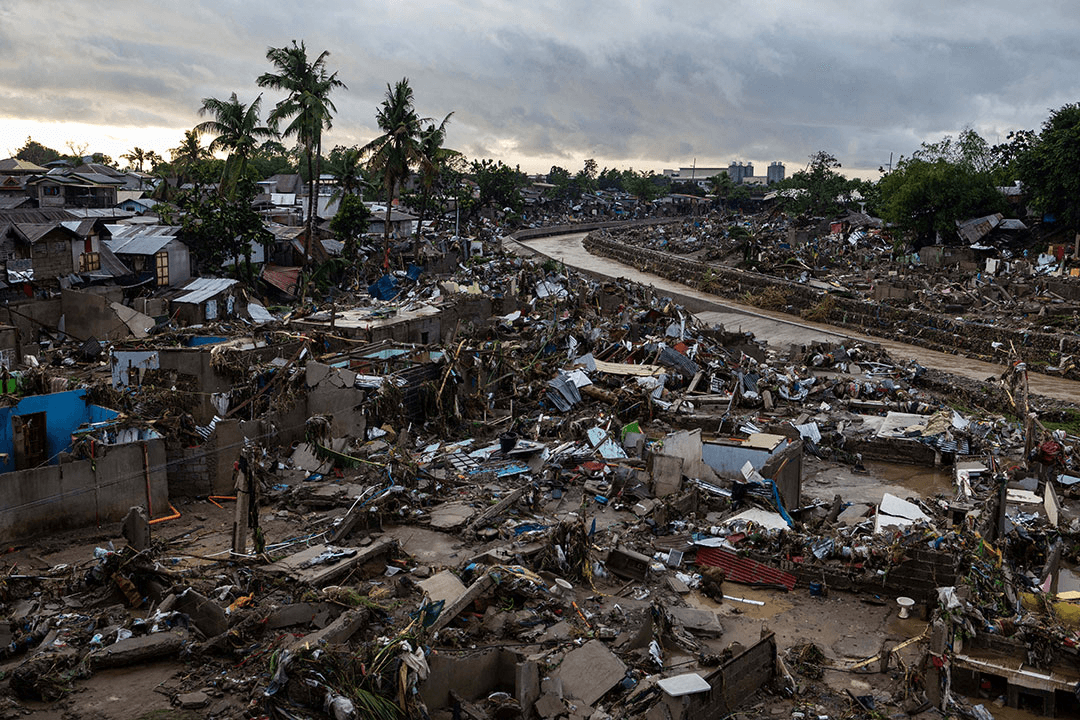
Photo Credits: Eloisa Lopez/Reuters
By: Keith Tan (12A) and Shaun Cua (11A)
Typhoon Tino, internationally referred to as Typhoon Kalmaegi, developed in late October 2025 during the western Pacific typhoon season, entering the Philippine Area of Responsibility (PAR) in early November. As a powerful tropical cyclone, it brought strong winds, heavy rainfall, landslides and flooding, particularly affecting the Visayas and Palawan regions.
The storm caused widespread destruction and displaced over 600,000 lives. However, despite the typhoon’s departure and the ongoing recovery and relief efforts in progress, Typhoon Tino’s aftermath has exposed the incomplete and poorly executed flood infrastructure of the Philippines. In light of the status quo, institutional idleness has left and will continue to leave communities vulnerable even amid ongoing government efforts.
How Incomplete Infrastructure Intensified the Aftermath
Typhoon Tino exposed the flaws in the drainage, dike, and floodway systems that have been plaguing the country for a long time, from the Visayas to Palawan. Most of the villages in low-lying regions had no drainage systems functioning at all and even a little rain was enough to drown whole communities. The flood-control works of the DPWH that had been unfinished and delayed for years because of procurement issues and political changes left the major river basins without the protective measures they were guaranteed.
The severe flooding caused by Typhoon Tino was therefore attributed not only to nature but also to the failure of the authorities. The dismal state of the rivers and clogged drainage channels played a major role in this situation by forcing the water to rise so high that it turned into a flood and the runoff that should have been under control became destructive. Some dikes were already cracked, others were too small or had deteriorated because of many years of lack of inspection and repair. People in these areas were left to depend on temporary barriers and local volunteers because the mitigation systems that had been promised were either incomplete or non-functional. Ultimately, the Typhoon showed that the real disaster was due to the incapable systems which were not properly built or maintained.
The Government’s Role in the Worsened Outcome
The Philippine government’s response to Typhoon Tino only leaves accountability in question. In its handling of long-standing infrastructure weaknesses, national agencies deployed relief goods and rescue teams after the storm. This, however, highlights a deeper issue nationally: the systems meant to prevent such devastation were already broken long before Tino made landfall. The Philippines currently witnesses many of its flood-control projects, designed to protect vulnerable communities, being delayed, substandard, or never fully implemented due to weak oversight. As a result of this, the government’s post-disaster actions appeared more short-term than long-term, and more reactive than preventive, only offering temporary relief without addressing the root causes of natural disasters for years.
Additionally, the lack of transparency surrounding the status of flood-mitigation projects has intensified public outrage. This frustration, rooted in reports of “ghost” projects and uninspected and deteriorating structures, have blurred the line between negligence and outright mismanagement. As Typhoon Tino victims face the aftermath of a calamity that blew off their shelters and other necessities, they are only left to wonder who is responsible for ensuring that the billions of pesos allocated to anti-typhoon infrastructure actually translate into functional shields. Until the government confronts these systemic issues and holds appropriate figures and agencies accountable, the cycle of destruction and blame is likely to plow on, leaving millions of Filipinos susceptible to the next naturally inevitable storm.
Communities Caught in the Crossfire
Typhoon Tino’s destruction hit hardest in the communities that had been enduring for years the consequences of being neglected in terms of urban planning and infrastructure. In low-lying villages, the annihilated urban drainage systems turned the rainwater that was supposed to be directed and drained through them into the water that inundated the neighborhood up to the people’s waste, and that included houses, schools, and roads. The local people recount that the temporary dikes and the sandbags were no good at all, and the children, the old, and the sick were the ones most exposed. The emergency shelters were not equipped and soon overcrowded with people.
Moreover, affected families were promptly forced to find accommodation either with their relatives or in unsafe shelters built from whatever material was at hand. The lack of timely information and poor communication further complicated the chaos, some families were even totally unaware of the fact that the river levels were rising until it was too late. The volunteers and the local officials came to help, but often their efforts were overwhelmed by the scale of the flooding and the devastation. The experience of those who went through it is totally different. They do not only see the storm as a natural disaster but also as a very strong reminder of the maladministration and inadequate infrastructure through which the common people have to endure the suffering caused by such events. Thus, the communities remained to deal with the aftermath of the calamity which was again an indication of how human suffering is inextricably linked to the very failures of the systems that were meant to protect them.
A Facade of Accountability
Occurring in the shadow of the flood control scandal that has rocked the country, the tragedy of Typhoon Tino is further compounded by the political theatrics and lack of accountability of those implicated in the scandal.
Over the past few months, dozens of bombshell accusations have been detonated in high-profile hearings such as those in the Senate Blue Ribbon Committee. So much political noise has been created, from the Marcos and Duterte clans trading accusations and politicizing the scandal, to Zaldy Co’s exposé videos. If history tells us anything though, it is unlikely for justice to be served if things are as they are right now.
Ultimately, the flood control investigations are doomed to fail because those tasked with investigating are implicated themselves. Despite being convicted of plunder in the 2013 Pork Barrel scandal, for instance, Senator Jinggoy Estrada is still in office, in the Blue Ribbon Committee, and implicated again in the current flood control scandal. This is ridiculous–investigators cannot investigate themselves. With this, accountability may be delivered to scapegoats on the lowest rungs of the scandal, like low-level DPWH engineers and contractors. However, the congressmen, senators and executives who approve, manage, and benefit from these projects and funds ultimately get away with it.
The Independent Commission for Infrastructure or ICI should have been the solution to this, but it, too, is questionable. As a recommendatory, ad-hoc body created by the president, dissolvable by the president, appointed by the president, and funded by the Office of the President, submitting monthly reports to the Office of the President, it isn’t quite “independent”. It was also completely opaque, with hearings not being livestreamed to the public, until very recently (even now still having strict restrictions). Why the secrecy? As the supposed investigator for the flood control scandal, it is crucial for it to gain the trust of the public, and doing so requires transparency.
Pushing for Systemic Change
The victims of Typhoon Tino, and all Filipinos, deserve more than political theater. In the aftermath of past corruption scandals, reforms have delivered scapegoats, but fail to tackle the systemic flaws that guarantee the next one. Thus, man-made catastrophes like Typhoon Tino are doomed to occur again.
At the center of this system is the national budget. In the past, the cycle of corruption was funded by opaque, discretionary lump sums: “pork barrel” or the Priority Development Assistance Fund (PDAF). Now though, opaque “unprogrammed funds” have become the new pork barrel.

Photo Credits: AJ Montesa/Rappler
Despite its primary purpose as a standby fund, these insertions have been used as a loophole to add to the budget beyond limitations, ballooning to the point that they exceeded the actual budget. Much of these funds were funneled into flood control projects; P107 billion in 2024, according to Representative Mikaela Suansing. Yet, unprogrammed funds remain at P249 billion for the 2026 budget. It is clear that these funds are not being used for their intended purpose (a contingency fund), and are instead a vehicle for corruption. Thus, to fight corruption and improve transparency, it is imperative that these funds are either removed, or at least made transparent and used as contingency only.
Second, the Philippines needs a truly independent anti-corruption commission: one created by an Act of Congress instead of an executive order, with transparent proceedings, and members and funding that are apolitical. It must be legally-binding, such that those it presses charges against cannot escape abroad or bail themselves out. In doing so, the commission aligns with the public’s interests, rather than those who seek to protect themselves.
Finally, and most importantly, impunity and corruption must be tackled not only within the flood control scandal, but across the DPWH and the entire government, by resolving systemic issues. Otherwise, a new scandal will inevitably appear, only, perhaps, in another department. For the government to regain public trust, a true anti-dynasty law must be signed, and the bank secrecy law for government officials must be weakened or removed. Additionally, implicated officials should not be allowed to be the investigators themselves, especially in high-profile hearings like those in the Blue Ribbon Committee. These demands are not new or unreasonable, but are ultimately unmet due to political resistance. Thus, they can be fulfilled only when we vote in officials who prioritize transparency and accountability.
Typhoon Tino was a natural event. Yet, the catastrophic flooding that displaced 600,000 Filipinos was a man-made choice: a choice to prioritize greed over public safety, and complacency over reform. Sooner or later, the next typhoon will arrive; sooner or later, another political scandal will erupt. Unless we fundamentally challenge the systems that enable bad governance, the cycle of destruction, deflection, and performative hearings will simply repeat. The tragedy of flood control is the latest of many. Let it be the last.
Sources
Caecent No-ot Magsumbol. (2025, September). Flood control scandal: PCAB under fire over “leniency.” Philstar.com; The Freeman. https://www.philstar.com/the-freeman/cebu-news/2025/09/02/2469875/flood-control-scandal-pcab-under-fire-over-leniency
CEDTyClea. (2025, November 6). Philippines declares national calamity as Typhoon Tino kills more than 100. BusinessWorld Online. https://www.bworldonline.com/the-nation/2025/11/06/710669/philippines-declares-national-calamity-as-typhoon-tino-kills-more-than-100/
Chi, C. (2025, November 12). ICI focuses on 80 flood control projects tied to contractors Marcos flagged. Philstar.com. https://www.philstar.com/headlines/2025/11/12/2486742/ici-focuses-80-flood-control-projects-tied-contractors-marcos-flagged
Context.ph. (2025, September 3). DPWH halts bidding for local projects amid corruption probe. Context.ph → Context.ph. https://context.ph/2025/09/03/dpwh-halts-bidding-for-local-projects-amid-corruption-probe/
Gov Blasts Failed Flood Control Projects After Typhoon Tino. (2025). Proudbisayabai.ph. https://proudbisayabai.ph/story/2025/11/06/gov-blasts-failed-flood-control-projects-after-typhoon-tino
De Leon, D. (2025, October 10). Despite criticisms, House keeps unprogrammed funds in 2026 budget. Rappler. https://www.rappler.com/philippines/video-house-representatives-keeps-unprogrammed-appropriations-2026-budget/
Destinado, M. (2025, November 17). Cebu evacuees face ‘dirty shelters,’ displaced as classes resume. RAPPLER. https://www.rappler.com/philippines/visayas/typhoon-tino-cebu-evacuees-dirty-shelters-classes-resume/
Montesa, A. (2025, October 18). [ANALYSIS] How unprogrammed appropriations have become a shadow budget. Rappler. https://www.rappler.com/voices/thought-leaders/unprogrammed-appropriations-shadow-budget/
Punongbayan, J. (2025, September 26). [In This Economy] Murder on the Budget Express. Rappler. https://www.rappler.com/voices/thought-leaders/in-this-economy-murder-budget-express/
Taclob, J. (2025, November 6). Billions washed away: Typhoon Tino and the Price of Neglect. Peso Weekly. https://www.pesoweekly.com/p/billions-washed-away-typhoon-tino-and-the-price-of-neglect
Tropical Storm Tino inside PAR; Signal No. 1 hoisted in some areas. (n.d.). Philippine News Agency. https://www.pna.gov.ph/index.php/articles/1262341
Typhoon Tino in Philippines – Charter activations | The International Charter: Space and Major Disasters. (2025, October 10). https://disasterscharter.org/activations/flood-in-philippines-activation-1001-
Untalan, S. (2025, November 5). Cebu towns reel from floods as Tino cuts power, water, communication. GMA News Online. https://www.gmanetwork.com/news/topstories/regions/964956/cebu-towns-floods-typhoon-tino-cuts-power-water-communication/story/