December: Family
By Daniel Co
|16 min read
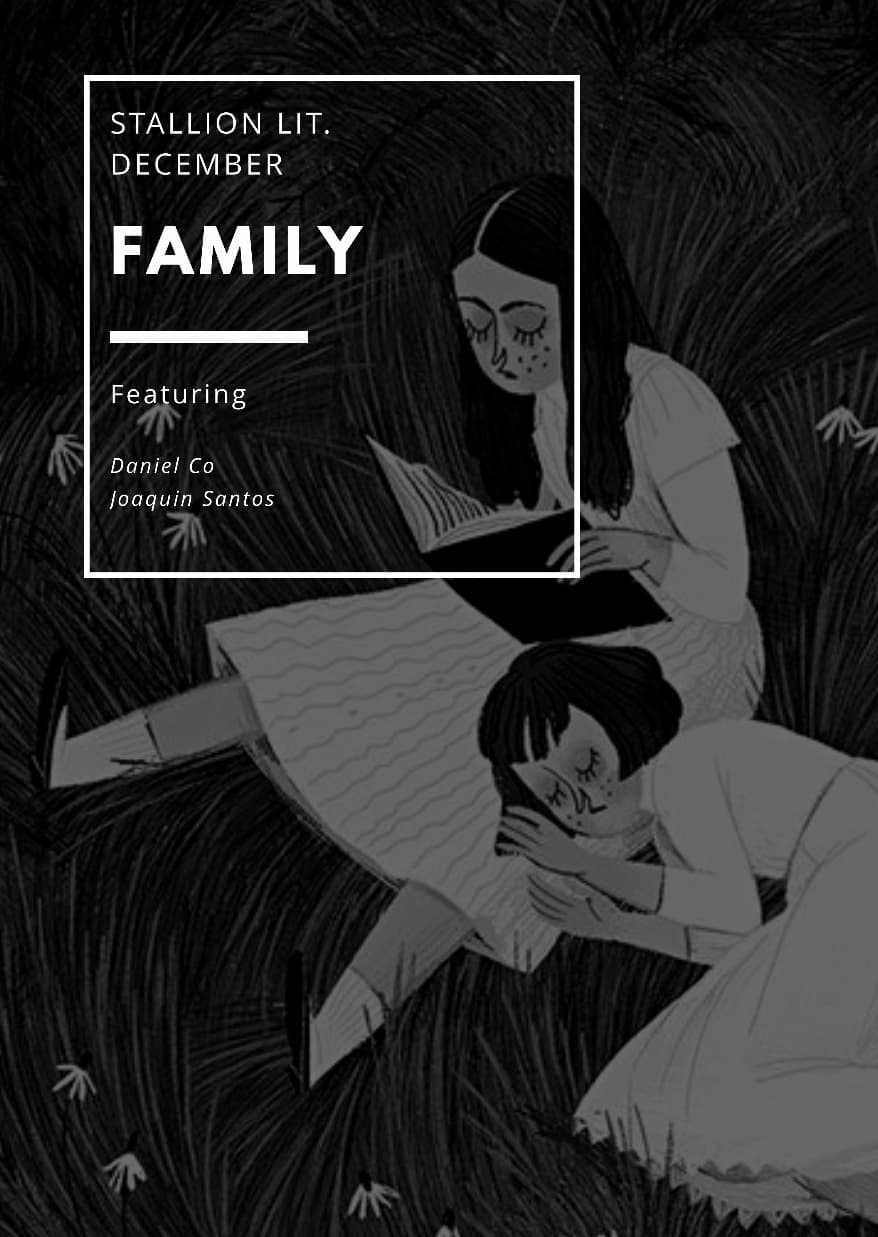
From those biological or adopted, or simply those we share raw feelings with, we bring you who “family” really is … for there’s definitely more than we might initially think.
1. Daniel Co — My Mother’s Example
2. Joaquin Santos — Throughout Life, Beyond Death
3. Juan Jacinto — A Fleeting Happines
1. My Mother’s Example
My mother was never the-
re—assuring type; as a
kid, she was
there, but
not really:
A shadow, lurking at the back-
ground shaping us. Specks off
her cotton-candy
cloud. Dust spreading for
our crystal-ices
to cling on to and form.
Molded by traits she thought wasn’t
hers; weaknesses she never thought
to see bloom,
Life had never floated beside
her; so alike her,
born from what she
hid; thriving— buried under lackluster
pressure.
My mother was
never there, reassuring types as a
kid, I wanted to be; words slipped off
her mouth, actions off her
hands: Love she regretted but
Shouldn’t.
– Daniel Co
2. Throughout Life, Beyond Death
This is a tale of how the love of a father is not bounded by his lifetime. Even Death has made its exceptions.
Considering the boy was nine years of age, nine-thirty was way past his bedtime. He would have been asleep now, dreaming of a life outside the orphanage together with his father, if it wasn’t for the strange silhouette that stood in front of the window opposite his bed. It was probably just a shadow of the lamp post outside, he thought. But oddly enough, the shadow–whatever it was–moved!
The boy could not believe his eyes. Visitors weren’t allowed at this hour (not that he had any visitors to begin with), and even so he would have known if someone was to visit him beforehand.
“E-excuse me,” the boy managed to say, his voice trembling with uncertainty. The shadow turned what seemed to resemble a thin, malnourished body and moved towards the boy.
He heard no sound of footsteps. The wooden floor would always creak no matter how soft people’s steps were. This was surely mysterious to the boy, who had lived in this room for half his life. Only the moonlight from the window kept the bedroom from total darkness. So the boy flipped the switch of the lamp on his side table to get a closer look at the figure.
The old man was stooped down in what could only be described as a semi-squat, his hair white and frizzled in all directions. His skin was so pale, the boy swore he could see the figure’s heart beating from within his chest. His clothes were tattered like rags and worn out, exposing his thin (almost stick-like) body. He must have snuck in through the window.
The nine-year old fumbled with his phone under his pillow and enabled the recording option, hoping to use this conversation as evidence if things go out of hand. He untucked himself from the bedsheets and faced the old man who stood in front of his bed now. “You must be Kano,” said the visitor in a rough, hoarse voice. “Yes mister, that’s my name,” replied the boy. “Heh, your blonde hair’s the giveaway.” “So tell me, lad,” continued the old man, “do you believe in the supernatural?”
Kano gave no answer, not knowing whether to scream for help or remain silent. “Well, in some aspect, I do, mister,” he responded while slyly pressing a button on the side table next to him. He just needed to buy some time before the authorities arrest this deranged lunatic. “Ah, then there is still a chance,” said the old man. “A chance for what?” inquired Kano, puzzlement written all over his face. “Well, to meet your father of course!”
Then the boy felt a tingling sensation around his body. It was a mixture of shock and anxiety, as his nerves buzzed unintentionally. “You know my father, mister?” asked Kano, expecting anything but not bent on believing any of it. The man cackled in response, highlighting the folds and wrinkles on his face.”Yes, I do know your father. I must say that he was very persistent to see you, even for a single moment.” Inside, Kano felt the awakening of emotions as sad and violent as the day he was found alone in his father’s home all those years ago. “I don’t believe how it is possible after he..” his voice trailed off and before he knew it the sheets were covered in his tears.
He never mentioned dealings with his father to the people he knew, but now he was letting it out to some stranger. How despicably ironic, he thought. “There, there now,” said the man, patting the sobbing boy gently with his bony palm. It felt as if some ice pack was dabbed on the boy’s back, and his sadness turned to confusion and then to astonishment.
“Kano, your father wants to see you. Know that it is rare for me to allow such–” he hesitated, debating whether to continue. “–such Supernatural occurrences. In my field of work, I merely arrive to lead souls to whichever place they are sentenced to.” Kano’s eyes widened, highlighting the bluish tint in his eyes. “So you are the one they call Death?” The old man did his best to smile, but it came out as a mere smirk. “Oh, I am known by many names, but Solas is what they all call me, a euphemism of sorts, I suppose.” His voice was clear and crisp, losing all hoarseness. “So you are Death’s servant, Solas?” asked Kano. “Indeed. I am a mere harbinger of the dead, lad. Your father, however, was stubborn and resilient. He refused to go with me, you see. All he wanted was to see you one last time, and I so believe that the love you two have for each other is beyond what I could have foreseen. This should be reason enough. And, as time permits, I must depart soon. Are you to join me?”
There was no need for further reason and explanation. Kano, fueled solely by his desire to meet his father, only had one word to say: “Yes.” “Take my hand, boy.” And Kano gripped what seemed to be a warm palm, full of life and vigor.
Not long after, a knock sounded on the bed room door. After about five taps, the caretakers unlocked the door and entered. Surprisingly, no one was in the room. Soon after the police arrived and confiscated Kano’s belongings, including the phone hidden inside his pillow cover. Upon further inspection, the investigators happened upon a recording made on the same day the boy was declared missing. What was even more peculiar was what it held.
The Article Of A Newspaper Reads:
The mysterious disappearance of a nine year old orphan has been under investigation for the past week, while the police has yet to release an official statement regarding the incident.
The boy was reported by the orphanage personnel to have called for them at approximately 9:31 PM, just minutes before they entered the already vacated bedroom at 9:35 PM.
The child’s cellphone which was obtained by authorities is the only substantial source of evidence gathered during the search. However, the recording within the phone has prompted more questions and speculations than answers.
From the words of the detective called to pursue the case, “The recording proved that the boy was involved in a conversation before the incident took place. Yet what puzzled me and my team was that even after modifications to increase the sound quality, we were unable to hear who the boy was talking to.”
Recent interviews with psychiatrists stationed within the orphanage however, have led the authorities to speculations regarding the boy’s mental health. Having lost his father at the early age of seven, the trauma and loss of his only parental figure has proven difficult for the child to accept throughout the past two years in the orphanage.
With this context in mind, we believe that we will come up with a conclusion to the case very soon,” continues the detective. “He was alone in the room, wasn’t he?”
– Joaquin Santos
3. A Fleeting Happiness
The alarm cut the silence of the bedroom, as though a blade was being sharpened before us. With a sharp jolt, I wake up, gaze wandering around the bedroom. First to the stack of files and papers on the bedside table; then to the window, where dust was absentmindedly floating in the air, illuminated by the mix of red and orange hues the early morning brought about.
And finally, to the now moving body of my wife.
“What time is it?” She asks with a drowsy voice.
I reach out for the phone, reading the first few numbers that come to sight. “4:30.”
And suddenly, my internal rhythm starts to accelerate and my vision begins to clear up. My wife and I were awake, excited and preparing for the day to come.
But we were late, and we had to hurry! Rushing to the bathroom, I ready myself, hastily slathering some shaving cream on and spreading toothpaste over my old, worn out toothbrush. The sounds of my wife waking the children breaking the silence with their screams and rushing footsteps. In one fluid motion, I put my suit and tie on like every other day; while in the distance, I hear the children yelling for their uniforms. The watch beeped, signaling that 4:45 was upon us.
I was about to leave the room, with papers tucked beneath my left arm and suitcase clasped on my right, when I saw the picture. Instantly, I was relieved of the stress of going to work and bringing the children to school. It was the picture of my high school graduation. I looked benign then, clad in the translucent barong; decorated with various honor medals and a valedictorian certificate clutched within my right hand; now proudly framed on my study wall.
“Honey, breakfast is ready.” my wife calls out with an upbeat voice from downstairs, interrupting my thoughts.
“Alright, I’ll be right down.” I call back. And with a swift turn, I was walking out of my room, down the stairs, and bracing myself for the day to come.
—
As the blanket of night fell over the Metro, the glowing tail lights of cars illuminated Edsa like a sea of fireflies. I tried to quiet the annoying horns flying through the air by putting music on, but to no avail. My attention then gravitated to the stack of papers in the backseat, stress was creeping up to me from the back of my mind, like a horrid centipede burrowing through my brain; slowly writhing, wriggling and becoming restless. At once, I thought of the promotion I was working for, the pay that was coming up tomorrow, and of course, all the files I had to sort through when I reached home; tension building up within my brain. The only thought that I found comfort in was my memory of the graduation. Ah, yes, the graduation.
I sigh, thinking about all those gleaming medals I had once received, the once beaming faces of my teachers and the headmaster. In that moment, I was at peace. All the stress vanishing in the presence of my success, for in that moment, I was truly and fully happy. The lights of Edsa blurred together and I was submerged in light; light akin to the flashes of those photos taken after the graduation with the different school dignitaries.
“Oh, so you’re the genius of the batch.” The voices of my head clamored.
“May I shake your hand.” They cooed in my ear.
“Why, of course you could shake my hand.” I replied following their requests. In a matter of minutes, I found myself at the my house’s doorstep.
—
“Dinner’s ready!” My wife calls out from the kitchen.
Sighing, I shutdown my computer and walk down the stairs disappointed. “Looks like I’ll have to finish this later” I quietly say to myself.
The dining table was filled with decadent dishes. The smell of roast chicken wafted from the kitchen and filled the air with subtle hints of rosemary too, and the unmistakable aroma of garlic. Sitting at opposite ends of the table were my two sons. The eldest sat at the left side, absentmindedly drawing on his sketchbook; while the younger was reading his maths book and jotting down notes. As I pull out my chair, both children’s eyes immediately direct themselves to my position. I could feel their gazes, observing my every movement, as though I was a curious creature they’ve never seen before.
“How was your day?” I asked them. And with those four words, the younger child jumped up from his chair and walked to his bag, pulling out a sheet of paper and striding towards my seat as if he was a champion marathon runner who had just won first place. With a joyous smile, he showed me his test papers in Math and Chinese. Both were immaculate, without so much as a red dot! Papers unstained with any corrections, from the Gems class no less.
And at the upper right hand of the test, in a small box were the grades. Two A+’s written in fine ink, like gleaming medals of honor. I was happy.
I glanced towards my older son, and his eyes instantly averted their gaze. I could feel his pulse hastening and the sweat trickling down his forehead as though he was hiding something. No, he was hiding something. And the thought came to me, his exams.
His exams, my mind repeated over and over again.
“Can I see them?” I asked with a judge’s voice and an inquisitor’s wrath.
“See what?” He replied with a shaking voice.
“Your exams.” In that moment, time seemed to slow down. A coldness creeped up from the cracks of the room. The previously warm lighting became austere and emotionless. All the eyes of the room seemed to be focused on my eldest son.
With a heavy heart, he pulled out two crumpled papers from his rucksack. I could see it, albeit very faintly, I could see it. Red markings. Suddenly, everything spiraled downwards as I focused on those splashes of vermilion. He trudged like a dying man towards the table, and set the papers in front of me. My vision blurred.
Red was stained all throughout the paper. I turned it over and over again, the more I looked the more red I saw to the point of it tainting my vision. With a screech from the chair, I stood up paper in hand and yelled at the top of my lungs: “How could you get such a disgrace of a grade?!”
My son flinched like he was being flailed. Every word I screamed seemed to contort his face with pain, turning into something more monstrous than the last, and resentment welled up in his eyes. My wife stood with a gaping maw, a look of shock and horror as if I were a savage from a land forgotten. And when I looked at my younger son, he averted his gaze like he was trying to avoid me. That was when things started to unravel.
“You never really cared about me.” My older son snapped back, causing chatter of the room die down. “You never even took the time to go to any of my art exhibits. Or even bothered to at least see any of my paintings once!” He spat out, seething anger.
“Your paintings are useless! You use your pointless creativity to hide your only flaw, you dump, stupid idiot!” I spit back “Why can’t you be like your little brother? Knowing his intellect and capacity, I’m sure he can outdo you in life; I’m sure he can outsmart you and your pointless paintings anytime!” I look to my younger son for reassurance and support, but all I was given was nothing but a harsh, unforgiving glare. I then look to my wife to agree with me, she’d agree with me, right? But the only thing I could see is fear and disgust painted across her face.
And then I realized it: what I had said. The ignorance in my voice; the stupidity in my words.
Suddenly, I felt a guilt and pain gripping my heart, as my mind cruelty repeated the words I said to my son. “Your paintings are useless… you dumb, stupid idiot!” My eyes slowly turn to face my son. Horror dawned on me as his face was gnarled with hatred; eyes fiery and unforgiving. Hands trembling with rage.
“You are not my father.” He spat at me in a voice colder than winter. He turned around, grabbed a separate rucksack and burst out the door like a howling tempest. I could never have thought, with only five words, he would manage to shatter everything I was so proud of.
For the next hour or so, I was inconsolable. Holed up in my room, muttering to myself “what have I done” over and over again, like a crazed monk with only one mantra. My hands were trembling and my palms cold and clammy. The rooms atmosphere seemed to be drenched with sadness and guilt. From all around I could hear scornful voices mocking me and shaming me for what I did.
“He was your son,” they wail. “You are a failure of a father!” some shouted, grinding their teeth. The door opened and the bright light cut the shadows; with that, the voices dissolved into the darkness of the room. Seemingly whispering: “we’ll be back” as they sank into the corners of the room. My eyes look up to see my younger son’s figure, illuminated like a saint. “Come with me,” he said with an outstretched hand. And I obeyed.
He led me up a flight of stairs, to a room with a closed door splattered with paint. Slowly, he opened the door to reveal a room full of haunting art. Ceilings, walls, even the floor was covered with some kind of drawing. Some were of fantastical dreams and phantasmagoria. Others were images of real people or events with some historical significance like a hand drawn picture of Nelson Mandela atop the mantle. Paint was splattered all over the walls, creating murals of nature so realistic it was as if you were in the midst of an arctic forest.
“This is his room you know.” My son spoke, breaking the silence. “He used to ask me what I wanted to see, and he drew them for me.” He stated as he looked wistfully around the room and ran to pick up a mountain of papers. With a proud expression, he presented the papers to me.
“What are these?” I asked, puzzled.
“These are worksheets he xeroxed himself.” My son claims. My eyes suddenly darted down to the papers. All of them were worksheets, some handwritten, but most were xeroxed copies that still had the faint markings of ink on the paper. And the realization dawned on me that all of them were Math and Chinese worksheets. He tried.
Something was welling up inside me, an emotion that I hadn’t felt for a long time: pride, for my son. But that still didn’t take the place of the guilt and regret eating away at my conscience.
“Oh, and one more thing,” my younger son said while pulling out a wrapped box out of the desk drawer. “This was meant to be your birthday gift.” He said, presenting the parcel to me and taking out its contents. It was a drawing made using the dark lines of charcoal. It took a moment, but I identified the scene rather quickly, it was my graduation picture.
The drawing itself was haunting. Dark lines were etched into the paper as if it were made out of shadows. The stage was lightly dusted with coal dust, simulating the dust floating with the light. I was standing in the middle of the stage, shrouded in a billowing graduation cloak. My face iced over with an emotionless expression, devoid of all happiness and joy. Ironic, given that that was the happiest day of my life. Images raced through my head that of my wedding, my honeymoon and finally my son’s first birthday.
Only seven words escaped my mouth, “What have I done with my life?”
As dawn drew near, my alarm clock buzzed at four like every other day. I was long awake since then. Trembling with anticipation I paced around the room, thoughts running in my mind “Will he come back?” I repeated over and over again. Inevitably, another scenario climbed out from the recesses of my mind. “What if he won’t?” These words shook me to the core. But then again, I thought: “He has to…” However, my thoughts were cut by the shrill ringing of the doorbell.
I stood up, sprinting to the door as if it would kill me if I didn’t. Skidding to a complete stop in front of the door, I stopped and organized my thoughts. What I would say to him, my apologies, and most importantly: how I would say I loved him? I turn the brass knob of the door, I half expected my son to be bedraggled, dirty and apologizing for his outburst; to be waiting outside the door. But instead, it was a policeman with a somber and grave look and my heart sank.
“Are you Mr. Yi?” He says with a heavy voice.
“Yes, I am.” I answer shakily.
“We regret to inform you that we found your son’s body… washed along the riverbank early this morning.”
– Juan Jacinto